


This article was automatically translated from the original Turkish version.
+2 More
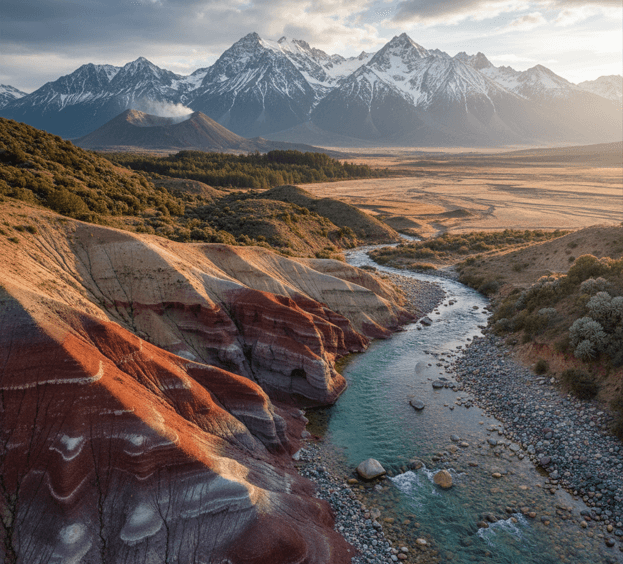
International Geodiversity Day (Generated by Artificial Intelligence.)
History | 6 October | ||||||||
|---|---|---|---|---|---|---|---|---|---|
Official Decision | Adopted at the 41st session of the UNESCO General Conference | ||||||||
International Geodiversity Day is an international observance held annually on 6 October to highlight the importance of geological diversity on Earth—that is, rocks, minerals, soils, landscapes, and the dynamic processes that shape our planet. The day aims to raise awareness of our planet’s approximately four-billion-year geological history.
The purpose of International Geodiversity Day is to promote awareness of the services geodiversity provides to humans and ecosystems, and to foster understanding of the conscious management of geological heritage, natural resources, and the sustainable use of the planet. Within this framework, understanding past climate change and the evolution of life, as well as promoting the sustainable use of mineral resources, are emphasized.
6 October was officially proclaimed as an annual observance during the 41st session of the UNESCO General Conference (41 C/Resolution 24). The resolution text underscores that geodiversity forms the foundation of biodiversity, provides habitat and support for all living organisms, and plays a critical role in human well-being and the sustainable management of the planet. The resolution highlights the importance of conserving geological diversity, encouraging scientific research, and advancing the sustainable governance of the Earth.【1】
Nineteen international organizations, including the International Union of Geological Sciences (IUGS), the International Union for Conservation of Nature (IUCN), and the African Association of Women in Geosciences (AAWG), along with seven regional organizations and 82 national organizations from 40 countries across all continents, have been identified as stakeholders in the celebrations and activities. The Director-General of UNESCO has invited member states, universities, research centers, civil society organizations, and other local actors to actively participate in commemorating the day and to support it through extrabudgetary funding.
Geodiversity constitutes a fundamental building block for biodiversity and provides the underlying infrastructure upon which all ecosystems depend. Geodiversity plays a major role in areas such as food production, water management, and energy supply in relation to the sustainability of human activities. It is also used as a key reference in environmental protection, natural resource management, and sustainable development initiatives.
As the United Nations agency with expertise in Earth sciences, UNESCO has supported international cooperation for over 50 years through the International Geoscience Programme.
UNESCO monitors and protects an area of approximately 855,000 square kilometers encompassing 229 geoparks in 50 countries through the Global Geoparks Network. Through Biosphere Reserves and World Heritage Sites, both biodiversity and geodiversity are conserved, and research activities and sustainable development initiatives are supported.
International Geodiversity Day is organized to ensure that society can benefit equitably from geodiversity. In this context, geological sites can be made accessible for visitation, and opportunities for geological education and research can be provided. Understanding geological processes contributes to informed environmental and sustainable decision-making.
UNESCO Türkiye Millî Komisyonu. “Doğa Bilimleri (SC) Komisyonu Raporu.” Accessed October 23, 2025. https://www.unesco.org.tr/Home/Page/1760?slug=Do%C4%9Fa%20Bilimleri%20Komisyonu%20Raporu
UNESCO. "International Geodiversity Day." UNESCO. Accessed October 23, 2025. https://www.unesco.org/en/days/geodiversity
UNESCO. “41 C/38: Proclamation of an International Geodiversity Day.” UNESCO. Accessed October 23, 2025. https://unesdoc.unesco.org/ark:/48223/pf0000378845?posInSet=39&queryId=08165229-ebec-4394-86de-2d3fb2c7a661
UNESCO. “Message from Ms Audrey Azoulay, Director-General of UNESCO, on the Occasion of International Geodiversity Day 6 October 2025.” UNESCO Digital Library. Accessed October 23, 2025. https://unesdoc.unesco.org/ark:/48223/pf0000395816?posInSet=6&queryId=N-aadfba9f-51b2-4a8d-8129-c2a7b8e04505
[1]
UNESCO. “41 C/38: Proclamation of an International Geodiversity Day.” UNESCO. Erişim 23 Ekim 2025. https://unesdoc.unesco.org/ark:/48223/pf0000378845?posInSet=39&queryId=08165229-ebec-4394-86de-2d3fb2c7a661

International Geodiversity Day (Generated by Artificial Intelligence.)
History | 6 October | ||||||||
|---|---|---|---|---|---|---|---|---|---|
Official Decision | Adopted at the 41st session of the UNESCO General Conference | ||||||||
No Discussion Added Yet
Start discussion for "International Geo-Diversity Day" article
Purpose
History
Significance
UNESCO’s Contributions
Society and Education