


This article was automatically translated from the original Turkish version.
+2 More
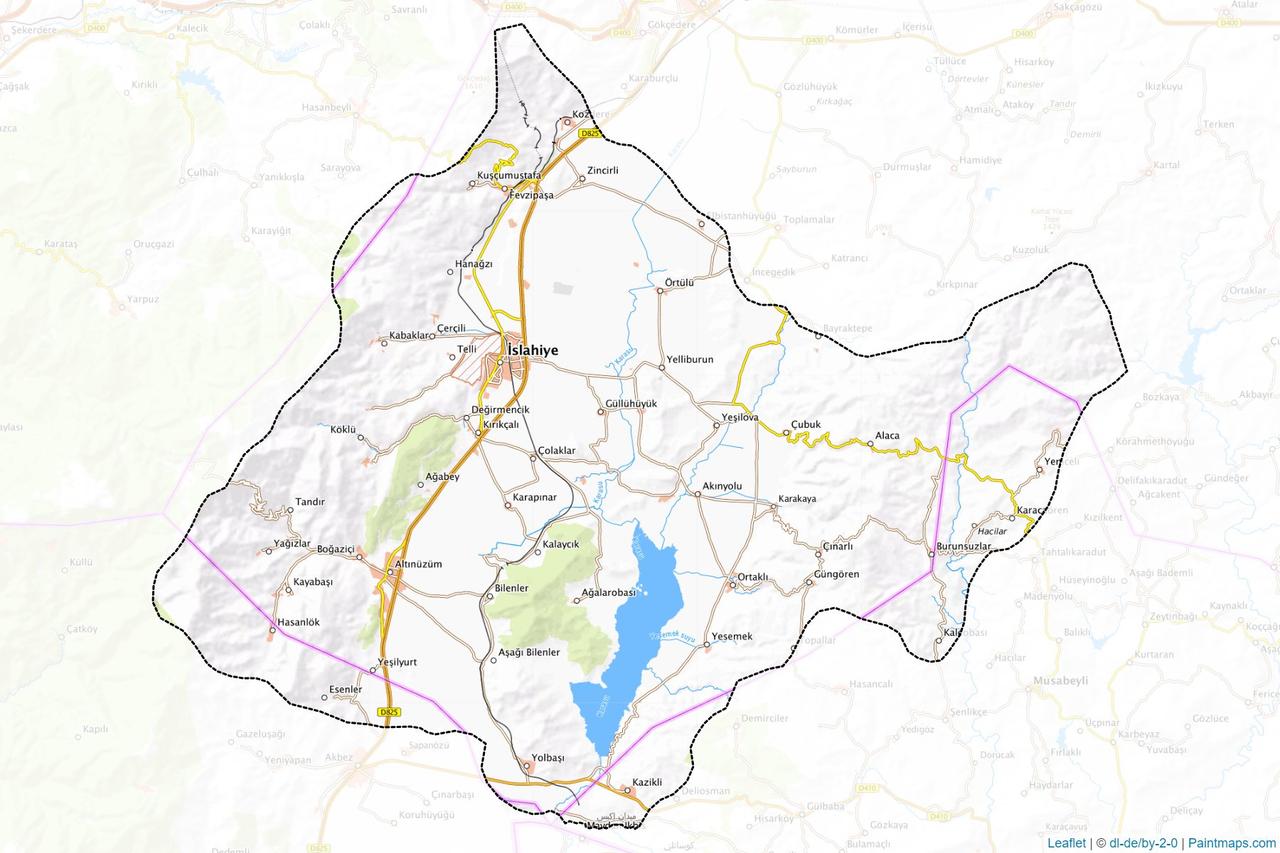
İslahiye (District)
Location | The southwest of Gaziantep province Southeastern Anatolia Region (at the eastern end of the Mediterranean Region) | ||||||||
|---|---|---|---|---|---|---|---|---|---|
Area(s) | 1 513 km² | ||||||||
Elevation(s) | 518 metres | ||||||||
Distance(s) | Distance | ||||||||
İslahiye is a district of Gaziantep Province in southeastern Türkiye. Due to its location at the eastern edge of the Mediterranean Region, it exhibits Mediterranean characteristics in terms of climate and vegetation cover. İslahiye, notable for its history, agriculture, and strategic location, possesses a rich cultural heritage.
The history of İslahiye extends back to the Early Chalcolithic period (5500–5000 BCE). Excavations at the mounds in the İslahiye Plain indicate that the region was an ancient settlement center. During the Late Hittite period, the area was a settlement inhabited by the Luwians and Hittites around 1400 BCE, followed by the Arameans and Assyrians in the 8th century BCE. In 333 BCE, Alexander the Great conquered the region and founded the city of Nikopolis, which later became part of the Roman province of Syria. After being plundered by the Parthians, Nikopolis lost its significance and is not recorded as a settlement during the Byzantine period.
In 1516, İslahiye was incorporated into Ottoman territory. In 1865, it was reorganized as the headquarters of the Fırka-i İslahiyye military unit, established to suppress rebellions in Çukurova and the Gavur Dağları. The district derives its name from this military unit and gained official status in 1866. Following World War I and the Armistice of Mudros, İslahiye was first occupied by the British and then by the French. It was liberated on 13 July 1920 after the local population defeated the French at the Güvercin Geçidi. The Treaty of Ankara on 20 October 1921 established the current Türkiye-Syria border, defining İslahiye’s present boundaries. In the late 19th century, the district was part of the Adana Vilayet and was attached to Gaziantep in 1933, acquiring its current district status.
Important archaeological sites in the region include the ruins of Nikopolis, Tilmen Höyük, Zincirli (Sam’al) Höyük, and the Yesemek Open-Air Museum. Yesemek, as the largest open-air museum in Türkiye, attracts tourists, while Tilmen Höyük provides evidence of a major urban center dating to the 3rd millennium BCE.
İslahiye is located in the southwest of Gaziantep, 88–90 km from the provincial center. The district covers an area of 1,513 km² and is bordered by Gaziantep Central to the east, Kilis to the southeast, Hatay to the southwest, Osmaniye to the west, Kahramanmaraş to the north, and Syria to the south. Its elevation is 518 meters above sea level. The İslahiye Plain extends between the Nur Mountains and the Sof (Kartal) Mountains and is a tectonic depression. The plain is irrigated by the Karasu Çayı and other streams originating from the Nur and Sof Mountains; the Tahtaköprü Dam has been constructed on this river system. The western and eastern parts of the district are hilly, while the central area is flat. The Istanbul-Aleppo railway passes through the district center, with a train station in Fevzipaşa Village. İslahiye lies on the Hatay-Kahramanmaraş fault line and is located in the first earthquake zone.
İslahiye exhibits transitional characteristics between Mediterranean and continental climates, with the Mediterranean climate being dominant. Summers are hot and dry, while winters can be severe in some years due to its geographical position. The natural vegetation consists of maquis, with forested areas found in higher elevations such as Hınzırlı Yaylası.
The social structure of İslahiye reflects a traditional lifestyle based on agriculture and animal husbandry. According to the 2000 census, the district center had a population of approximately 30,000, with a total population of 80,174; according to the 2016 Address-Based Population Registration System, the population was 66,941. Settlements within the district include İdilli, Köklü, Yeniköy, Kabaklar, Çerçili, and Yesemek. Cultural events such as grape festivals are held in the district.
The district’s economy is based on agriculture, animal husbandry, and forestry. Major agricultural products include wheat, grapes, red pepper (İslahiye Pepper), olive, cotton, onion, sugar beet, pistachios, maize, and soybeans. İslahiye Pepper has become a branded export product and is shipped abroad. Grape production is also significant, with annual output of approximately 174,000 tons, meeting 70% of Türkiye’s table grape demand. Grapes are exported to countries such as Russia, Germany, and Dubai, and are processed into products such as pekmez and bastık. Livestock farming includes cattle, sheep, and goat breeding; forestry is practiced in mountainous areas. The region also contains bauxite and dolomite deposits.
İslahiye is rich in tourism potential due to its historical and natural attractions. The Yesemek Open-Air Museum, located 23 km from the district center, is the largest open-air museum in the Middle East, housing over 500 stone carvings dating back to the 9th century BCE. Tilmen Höyük, located 5 km to the east, contains the remains of a major urban settlement from the 3rd millennium BCE. Zincirli (Sam’al) Höyük offers important remains from the Early Hittite period. Structures from the Roman period such as the Cıncıklı Artifacts and Yılan Castle also attract attention. Highlands such as Huzurlu, Karagöz, and Meydan, as well as the area around the Tahtaköprü Dam, attract visitors during the write months. Studies are ongoing to open Peace Yaylası for tourism.
The total population of İslahiye was recorded as 80,174 in 2000 and 66,941 in 2016. The population is distributed between the district center and villages. The first population census in 1866 recorded 2,049 inhabitants (28 non-Muslims and 2,021 Muslims); by the end of the 19th century, the population of the kaza and its villages reached 17,509. Today, the population structure is predominantly based on agriculture and animal husbandry.
İslahiye is one of the important districts of Gaziantep due to its strategic location, fertile soils, and historical richness. The district stands out for its agricultural products and tourism potential, offering a unique identity at the intersection of the Mediterranean and Southeastern Anatolia regions.
Gaziantep Valiliği. “İslahiye.” Accessed April 8, 2025. http://www.gaziantep.gov.tr/islahiye.
İslahiye Belediyesi. “Coğrafya.” Accessed April 8, 2025. https://www.islahiye.bel.tr/icerik/cografya.
İslahiye Belediyesi. “İslahiye Biberi.” Accessed April 8, 2025. https://www.islahiye.bel.tr/icerik/islahiye-biberi.
İslahiye Belediyesi. “İslahiye Üzümü.” Accessed April 8, 2025. https://www.islahiye.bel.tr/icerik/islahiye-uzumu.
İslahiye Belediyesi. “İslahiye’de Turizm.” Accessed April 8, 2025. https://www.islahiye.bel.tr/icerik/islahiye-de-turizm.
İslahiye Belediyesi. “İslahiye’de Ulaşım.” Accessed April 8, 2025. https://www.islahiye.bel.tr/icerik/islahiye-de-ulasim.
İslahiye (District)
Location | The southwest of Gaziantep province Southeastern Anatolia Region (at the eastern end of the Mediterranean Region) | ||||||||
|---|---|---|---|---|---|---|---|---|---|
Area(s) | 1 513 km² | ||||||||
Elevation(s) | 518 metres | ||||||||
Distance(s) | Distance | ||||||||
No Discussion Added Yet
Start discussion for "İslahiye (District)" article
History
Geographical Structure
Climate and Vegetation Cover
Social Structure
Economic Structure
Tourism Potential
Demographic Structure