 Recently Added:
This article was automatically translated from the original Turkish version.
The Istanbul Negotiations are peace talks facilitated by Türkiye in May, June, and July 2025 as part of diplomatic efforts to end the ongoing war between Russia and Ukraine. The process began when Russian President Vladimir Putin called on 11 May 2025 for unconditional direct negotiations, a proposal positively received by Ukrainian President Volodymyr Zelenskyy. Although leaders of both sides were expected to meet in Istanbul, Putin decided not to attend, and Zelenskyy consequently did not participate directly; as a result, the talks held on 15 May 2025 were conducted at the technical level.
Diplomatic engagement continued on 16 May 2025 with tripartite meetings hosted by Türkiye: one involving Türkiye the United States and Ukraine, and another involving Türkiye Russia and Ukraine. These discussions addressed ceasefire conditions prisoner exchange and humanitarian issues. The parties reached an agreement on the mutual release of 1000 prisoners which was implemented between 23 and 25 May 2025. In June the parties reconvened in Istanbul for a second round of talks. The meeting on 2 June 2025 addressed technical details regarding the expansion of prisoner exchanges temporary ceasefire procedures the return of children forcibly taken and the protection of civilians. Throughout June numerous phased prisoner exchanges were carried out under this framework.
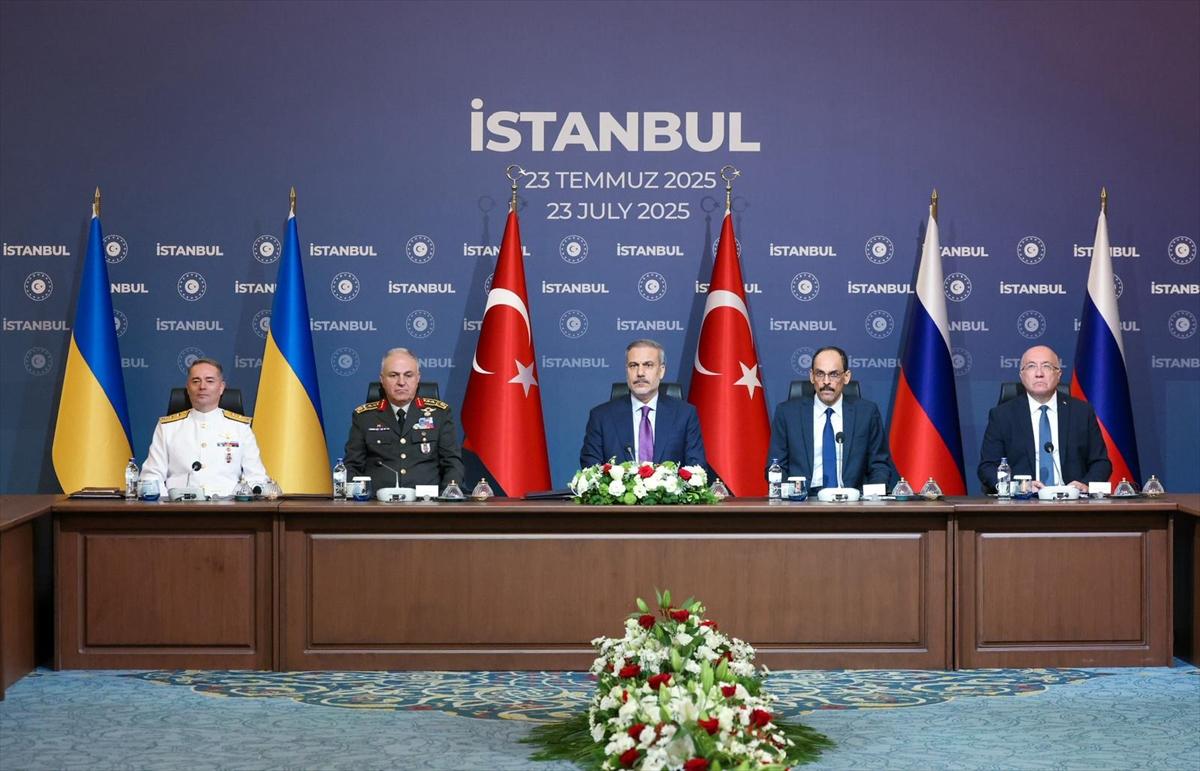
The third phase of the process continued with the Türkiye Russia Ukraine Tripartite Meeting held on 23 July 2025 at the Çırağan Palace in Istanbul. During the talks the parties focused on the return of war prisoners and remains humanitarian security measures and diplomatic steps preparatory to a leaders summit. At the conclusion of the third round the parties decided to continue technical consultations toward establishing permanent working groups under political military and humanitarian headings. The Istanbul Negotiations provided a platform for the restoration of direct dialogue between the parties and paved the way for partial agreements on certain issues toward a lasting peace.

Third Türkiye Russia Ukraine Tripartite Meeting 23 July 2025 – (Anadolu Ajansı)
Following the outbreak of war between Russia and Ukraine on 24 February 2022 the parties met for the first time on 28 February 2022 in Gomel region of Belarus. This was followed by a second round of talks on 3 March 2022 in Brest Belarus where a temporary ceasefire was declared.
On 10 March 2022 the parties held their first high-level meeting at the foreign minister level as part of Türkiye’s Antalya Diplomacy Forum. Subsequent diplomatic contacts continued and on 29 March 2022 delegations from both countries met again at the Presidential Dolmabahçe Office in Istanbul. This meeting was regarded as the most comprehensive negotiation process during the initial phase of the war.
At the Istanbul talks Ukraine presented Russia with a draft agreement based on permanent neutrality nuclear disarmament a commitment not to host foreign military bases and international security guarantees. The text was initialed by both sides. Under the proposed agreement Ukraine would not join military alliances and security guarantees would be provided by members of the United Nations Security Council as well as regional actors such as Türkiye.
Shortly after the Istanbul talks the Russian Ministry of Defense announced that some Russian military units near Kyiv and Chernihiv would withdraw. Soon after allegations emerged that civilians had been killed in the town of Bucha near Kyiv. In response Ukraine announced it was suspending negotiations. By 17 May 2022 the talks were halted and direct diplomatic contacts were suspended.
In July 2022 under Türkiye’s mediation and with United Nations support the Black Sea Grain Initiative was signed to address the global food crisis caused by the war. This agreement enabled limited technical cooperation between the parties but political efforts to find a solution remained stalled for three years.
On 11 May 2025 Russian President Vladimir Putin proposed the unconditional resumption of direct negotiations and suggested that talks be reconvened in Istanbul on 15 May 2025. Turkish President Recep Tayyip Erdoğan welcomed the proposal and reaffirmed Türkiye’s readiness to host the peace process as it had done previously.
On 11 May 2025 Russian President Vladimir Putin publicly offered direct talks with Ukraine without preconditions. This proposal came in response to a 30-day ceasefire appeal issued by European countries to Moscow.
On 12 May 2025 U.S. President Donald Trump responded to Putin’s offer by stating in a public address that he supported direct negotiations and described their conduct as “very important.” Speaking at a press briefing in the Oval Office he said “I think a good outcome can come from the meeting between Russia and Ukraine in Türkiye on Thursday.” In the same statement he added “I believe both leaders will be there. I even thought about going myself. I am not sure exactly where I will be on Thursday because I have so many meetings. I think both leaders will be in Istanbul. I could go too. I do not know exactly where I will be at that moment.” Trump indicated he had not yet made a final decision on attendance saying “If I am not there I do not know if Putin will be.” However Trump did not attend the Istanbul talks held on 15–16 May 2025.
On 12 May 2025, Ukrainian President Volodymyr Zelensky announced that he had accepted Russian President Vladimir Putin’s offer of unconditional negotiations and stated that he would personally participate in the talks. He also indicated that he expected Russia to declare a permanent ceasefire. On the same day, the presidents of China and Brazil issued a joint statement supporting the negotiations and emphasized that direct dialogue must begin without delay. After it became clear that Putin would not attend the talks, Zelensky decided on 15 May not to participate personally, citing the absence of conditions for a leaders-level meeting. The Ukrainian delegation was led by Defense Minister Rustem Umerov.
Al Jazeera. "Trump’s Offer to Join Russia-Ukraine Peace Talks Triggers Diplomacy." Accessed May 13, 2025. https://www.aljazeera.com/news/2025/5/13/trumps-offer-to-join-russia-ukraine-peace-talks-triggers-diplomacy
Anadolu Ajansı. "Istanbul Talks: Why Russia and Ukraine View Türkiye as a Reliable Mediator." Accessed May 13, 2025. https://www.aa.com.tr/en/russia-ukraine-war/istanbul-talks-why-russia-and-ukraine-view-turkiye-as-a-reliable-mediator/3566001
Anadolu Ajansı. "Russia-Ukraine Talks in Türkiye ‘Very Important’: Trump." Accessed May 13, 2025. https://www.aa.com.tr/en/world/russia-ukraine-talks-in-turkiye-very-important-trump/3565011
Anadolu Ajansı. "Zelenskyy Rules Out Talks with Any Russian Official but Putin in Istanbul Meeting: Official." Accessed May 13, 2025. https://www.aa.com.tr/en/russia-ukraine-war/zelenskyy-rules-out-talks-with-any-russian-official-but-putin-in-istanbul-meeting-official/3565976
Anadolu Ajansı. “Istanbul Talks: Zelenskyy Agrees to Meet Putin in Türkiye amid Pressure from Trump.” Accessed May 13, 2025. https://www.aa.com.tr/en/americas/istanbul-talks-zelenskyy-agrees-to-meet-putin-in-turkiye-amid-pressure-from-trump-/3564073
Anadolu Ajansı. “Ukraine’s Zelenskyy Says He Will Be in Istanbul to Meet Putin, Supports Trump’s Call for Ceasefire.” Accessed May 13, 2025. https://www.aa.com.tr/en/russia-ukraine-war/ukraines-zelenskyy-says-he-will-be-in-istanbul-to-meet-putin-supports-trumps-call-for-ceasefire/3565282
Anadolu Ajansı. “İstanbul Müzakereleri, Rusya-Ukrayna Savaşını Bitirme Çabalarının Dönüm Noktası Olarak Biliniyor.” Accessed May 13, 2025. https://www.aa.com.tr/tr/dunya/istanbul-muzakereleri-rusya-ukrayna-savasini-bitirme-cabalarinin-donum-noktasi-olarak-biliniyor/3564612
CNN. "Zelensky insists he will only join Ukraine-Russia talks in Turkey this week if Putin is present." CNN International. Accessed May 13, 2025. https://edition.cnn.com/2025/05/12/europe/trump-russia-ukraine-talks-turkey-intl-hnk
Reuters. "Ukraine's Zelenskiy insists on face-to-face talks with Putin in Istanbul." Accessed May 13, 2025. https://www.reuters.com/world/rubio-discusses-way-forward-ukraine-ceasefire-with-european-counterparts-2025-05-13/
The Moscow Times. “Kremlin Yet to Confirm Who It’s Sending to Istanbul Talks with Ukraine.” The Moscow Times. Accessed May 13, 2025. https://www.themoscowtimes.com/2025/05/13/kremlin-yet-to-confirm-who-its-sending-to-istanbul-talks-with-ukraine-a89063
The agenda of the negotiations in Istanbul has been shaped according to each party’s priorities. The Russian side has sought to base its position on the draft text worked on in Istanbul in 2022. The Moscow administration has defined the status of the Donetsk, Luhansk, Zaporizhzhia and Kherson regions as a “new reality” and demanded the complete withdrawal of Ukrainian forces from these areas. It has also emphasized that Ukraine must be granted the status of a neutral, non-aligned, nuclear-weapons-free country with limited military capacity. Moscow’s negotiation agenda includes recognition of the status of the regions it has declared as part of Russia, guarantees for the rights of Russian-speaking populations, and the gradual establishment of “good neighborly relations” with Europe.
The Ukrainian side has presented the recognition of its internationally recognized territorial integrity as a fundamental precondition for negotiations. The Kiev administration has demanded the removal of Russian control over Donetsk, Luhansk, Zaporizhzhia and Kherson regions, including Crimea, and the restoration of Ukrainian sovereignty over these territories. Ukraine has also put forward its desire to be brought under NATO’s security umbrella to guarantee its future security, the deployment of an international peace force on its territory, and the enhancement of its deterrent capabilities. The Ukrainian side has further stated that it expects economic and military support from European Union countries and the United States during the post-war reconstruction process.
As of the morning of May 15, 2025, the Kremlin officially announced that Russian President Vladimir Putin would not attend the negotiations in Istanbul. On the evening of May 14, 2025, Kremlin Spokesperson Dmitry Peskov stated that a security summit had been held in Moscow under the chairmanship of Russian President Vladimir Putin. The meeting was attended by Foreign Minister Sergey Lavrov, Defense Minister Andrey Belousov, Secretary of the Security Council Sergey Shoigu, Chief of the General Staff Valery Gerasimov, FSB Director Alexander Bortnikov, Commander of the National Guard Viktor Zolotov, and members of the negotiation delegation scheduled to travel to Istanbul. The summit addressed the preparatory process and strategic framework for the talks in Istanbul.
On May 15, 2025, the delegation representing the Russian Federation arrived in Turkey to participate in the negotiations in Istanbul. The delegation is headed by Vladimir Medinsky, Presidential Advisor who also led the previous negotiations in Istanbul in 2022. The delegation includes Deputy Foreign Minister Mikhail Galuzin, Head of the Main Directorate of the General Staff Igor Kostyukov, and Deputy Defense Minister Alexander Fomin.

Domestic and foreign media representatives covering the negotiations between the Russian and Ukrainian delegations at the Dolmabahçe Office in Istanbul, May 15, 2025 – Anadolu Agency
Among the expert-level participants are Deputy Head of the Russian General Staff Information Directorate Alexander Zorin, Deputy Head of the Department of Humanitarian State Policy Yevgeniya Podobreyevskaya, Director of the Second Department for the Commonwealth of Independent States at the Ministry of Foreign Affairs Alexander Polischchuk, and Deputy Head of the Ministry of Defense for International Military Cooperation Vladimir Shevtsov.
On May 15, 2025, U.S. President Donald Trump stated that he had considered attending the negotiations in Istanbul personally but noted that his official schedule was fully occupied for that day and the following day. Trump said, “I am fully booked today and tomorrow, but if there is progress on Friday, I may come.” He also expressed support for the commencement of peace negotiations between Russia and Ukraine and the end of hostilities. He made these remarks during a meeting with business representatives in Qatar. Trump did not attend the Istanbul talks on May 15–16, 2025.
On May 15, 2025, Ukrainian President Volodymyr Zelenskiy arrived in Ankara and was officially welcomed by Turkish President Recep Tayyip Erdoğan at the Presidential Complex. Following the welcoming ceremony, the two leaders held a one-on-one meeting. Participating on the Turkish side were Minister of National Defense Yaşar Güler, Head of the National Intelligence Organization Ibrahim Kalın, and Presidential Advisor on Foreign Policy and Security Akif Çağatay Kılıç.

President Erdoğan and Ukrainian President Zelenskiy, May 15, 2025 – Anadolu Agency
In a statement at Ankara Esenboğa Airport, Zelenskiy indicated that his decision to participate directly in the peace negotiations in Istanbul would be contingent upon the outcome of his meeting with President Erdoğan. He also thanked Erdoğan for organizing the talks. Zelenskiy described the meeting with President Erdoğan as the first high-level contact in the negotiation process. The Ukrainian delegation includes the Minister of Foreign Affairs, intelligence officials, and presidential advisors. Zelenskiy stated that he considered the level of representation of the Russian delegation inadequate and believed it lacked the authority to make decisions.

President Erdoğan and Ukrainian President Zelenskiy, May 15, 2025 – Anadolu Agency
Al Jazeera. “Live: Russia’s Putin Not on List to Attend Ukraine Peace Talks in Istanbul.” Al Jazeera Live Blog. Accessed May 15, 2025. https://www.aljazeera.com/news/liveblog/2025/5/15/live-russias-putin-not-on-list-to-attend-ukraine-peace-talks-in-istanbul
Anadolu Ajansı. "Cumhurbaşkanı Erdoğan, Ukrayna Devlet Başkanı Zelenskiy ile Bir Araya Geldi." Accessed May 15, 2025. https://www.aa.com.tr/tr/gundem/cumhurbaskani-erdogan-ukrayna-devlet-baskani-zelenskiy-ile-bir-araya-geldi/3568855
Anadolu Ajansı. “İstanbul Müzakerelerine Katılacak Rus Heyeti Türkiye’de.” Accessed May 15, 2025. https://www.aa.com.tr/tr/gundem/istanbul-muzakerelerine-katilacak-rus-heyeti-turkiyede/3568317
On 15 May 2025, Ukrainian President Volodimir Zelenskiy held a press conference after meeting with President Recep Tayyip Erdoğan in Ankara. During the press conference, he highlighted Türkiye’s diplomatic role in the peace process and confirmed that Erdoğan had expressed a willingness to host direct negotiations. Zelenskiy stated, “If an unconditional ceasefire is to be discussed at the leadership level, I am here in Türkiye and ready for direct talks.” He also emphasized the necessity of initiating the peace process, saying, “If we do not start, the war could last for many years.”

Ukrainian President Volodimir Zelenskiy meets with journalists at the Ukrainian Embassy in Ankara, 15 May 2025 – Anadolu Agency
In his remarks, Volodimir Zelenskiy stated that he would not personally attend the peace talks scheduled in Istanbul. He noted that the level of the Russian delegation sent was inadequate and that the conditions for a direct meeting between leaders had not yet been established. Zelenskiy announced that Defence Minister Rustem Umerov would lead the Ukrainian delegation to Istanbul. He explained that the decision to send a delegation to Istanbul was made out of respect for President Recep Tayyip Erdoğan of Türkiye and U.S. President Donald Trump. It was specified that the delegation’s agenda would be limited solely to the topic of a ceasefire.
Vladimir Medinskiy, head of the Russian delegation, made statements on 15 May 2025 regarding the talks in Istanbul. Medinskiy said, “We view our participation in these talks as a continuation of the peace negotiations that were disrupted by Ukraine in Istanbul in 2022.” He stated that Russia’s objective is to eliminate the root causes of the crisis and achieve a lasting peace.
Al Jazeera. “Live: Russia’s Putin Not on List to Attend Ukraine Peace Talks in Istanbul.” Al Jazeera Live Blog. Accessed May 15, 2025. https://www.aljazeera.com/news/liveblog/2025/5/15/live-russias-putin-not-on-list-to-attend-ukraine-peace-talks-in-istanbul
The Guardian. “Ukraine War Live: First Direct Talks between Moscow and Kyiv in Three Years Set to Begin in Turkey.” The Guardian Live. Accessed May 15, 2025. https://www.theguardian.com/world/live/2025/may/15/ukraine-war-live-first-direct-talks-between-moscow-and-kyiv-in-three-years-set-to-begin-in-turkey
The Russia-Ukraine peace negotiations planned for 16 May 2025 in Istanbul could not proceed as intended due to the absence of direct participation by the leaders of the parties involved. The Kremlin officially announced that Russian President Vladimir Putin would not attend the talks; in response, Ukrainian President Volodymyr Zelenskyy decided not to attend personally. As a result, no high-level contact was established at the negotiation table, and the diplomatic process has since continued at the technical level through multilateral formats.
In this context, two separate trilateral meetings were held on 16 May 2025 at the Presidency Dolmabahçe Working Office in Istanbul’s Beşiktaş district. The first meeting took place at 10:45 between delegations from Türkiye, the United States and Ukraine; the second meeting occurred at 12:30 between delegations from Türkiye, Russia and Ukraine.

Türkiye-USA-Ukraine Trilateral Meeting held in Istanbul, 16 May 2025 – Anadolu Agency
The Türkiye-USA-Ukraine Trilateral Meeting took place on 16 May 2025 at 10:45 at the Presidency Dolmabahçe Working Office in Istanbul. The meeting was chaired by Türkiye’s Minister of Foreign Affairs Hakan Fidan. The Turkish delegation included Ibrahim Kalın, Head of the National Intelligence Organization (MIT). The U.S. delegation comprised Secretary of State Marco Rubio, U.S. Ambassador to Ankara Tom Barrack, and U.S. President Donald Trump’s Special Representative for Ukraine Keith Kellogg. The Ukrainian delegation included Andriy Yermak, Head of the Office of the President of Ukraine, Foreign Minister Andriy Sybiha, and Defense Minister Ruslan Umerov.
The meeting addressed the technical progress of peace negotiations, conditions for achieving a ceasefire, and mechanisms for diplomatic coordination. Following the talks, the Ukrainian side issued a statement: “Ukraine is ready for peace and for a lasting, unconditional ceasefire. The Ukrainian delegation is in Istanbul today to secure an unconditional ceasefire.” This statement was shared with the public by Andriy Yermak, Head of the Office of the President of Ukraine.
Kremlin spokesperson Dmitry Peskov confirmed that Putin did not attend the talks but noted that the Russian delegation in Istanbul maintained direct real-time communication with Moscow and continuously provided Putin with updates. Peskov added, “We hope that direct Russia-Ukraine negotiations will begin shortly.”

Türkiye-USA-Ukraine Trilateral Meeting held in Istanbul, 16 May 2025 – Anadolu Agency
A trilateral meeting involving delegations from Türkiye, Russia and Ukraine took place on 16 May 2025 at the Presidency Dolmabahçe Working Office in Istanbul. The meeting began at 12:30 and lasted approximately one hour and 45 minutes. It was chaired by Türkiye’s Minister of Foreign Affairs Hakan Fidan. Also present in the Turkish delegation was Ibrahim Kalın, Head of the National Intelligence Organization (MIT).
The Russian delegation was led by Vladimir Medinsky, Advisor to President Vladimir Putin. He was accompanied by Deputy Minister of Foreign Affairs Mikhail Galuzin, Director of the Main Intelligence Directorate of the General Staff (GRU) Igor Kostyukov, and Deputy Minister of Defense Alexander Fomin.
The Ukrainian delegation was headed by Defense Minister Ruslan Umerov. Other members included Deputy Minister of Foreign Affairs Serhiy Kyslytsya, Deputy Head of the Security Service of Ukraine (SBU) Oleksandr Poklad, and Deputy Head of the Foreign Intelligence Service Oleh Luhovskyi.

Türkiye-Russia-Ukraine Trilateral Meeting held in Istanbul, 16 May 2025 – Anadolu Agency
In his opening remarks, Türkiye’s Minister of Foreign Affairs Hakan Fidan said, “We are pleased to see that strong commitments have opened a new window of opportunity for us.” Fidan characterized the resumption of diplomatic engagement aimed at ending the war as a significant development. “You understand that at this stage, two paths lie before us. One leads to a process that will bring peace; the other leads to further destruction and loss of life. The parties themselves, exercising their own will, must decide which path to take. Since the beginning of the war, we have been making intense efforts to determine how this conflict can be brought to an end.”
Fidan has stated that the meeting marked the first direct contact between the parties since March 2022. He also referred in his remarks to President Recep Tayyip Erdoğan’s efforts to contribute to the peace process and to the support of U.S. President Donald Trump.
It was conveyed that Türkiye aims to lay the groundwork for a potential leaders’ summit expected to take place in the coming period. Fidan said, “We have an opportunity ahead to ensure the ceasefire is achieved simultaneously with negotiations,” and concluded his statement by saying, “Türkiye is ready to offer every possible contribution toward peace.”
Following trilateral diplomatic talks hosted by Türkiye in Istanbul on 16 May 2025, an agreement was reached between the Russian and Ukrainian delegations on prisoner exchange. After the completion of the Türkiye-Russia-Ukraine trilateral meeting, Ukrainian Defense Minister Ruslan Umerov stated, “We have agreed to exchange one thousand prisoners for one thousand prisoners.”
Vladimir Medinsky, head of the Russian delegation, also provided an assessment of the negotiations. Medinsky said, “Russia and Ukraine will present their views on a potential ceasefire in detail, after which negotiations will continue.” Regarding the overall course of the talks, he added, “We are generally satisfied with the outcomes achieved in the negotiations and are ready to continue our contacts.”
Anadolu Ajansı. “İstanbul’da Düzenlenen Türkiye-ABD-Ukrayna Üçlü Toplantısı Başladı.” Accessed May 16, 2025. https://www.aa.com.tr/tr/gundem/istanbulda-duzenlenen-turkiye-abd-ukrayna-uclu-toplantisi-basladi/3569924
Following an agreement reached on 16 May 2025 during trilateral talks in Istanbul between Russian and Ukrainian delegations to exchange 1,000 prisoners each, technical procedures for implementation have progressed. Kremlin Spokesperson Dmitry Peskov, in a statement to Interfax on 22 May 2025, confirmed that the list of prisoners requested for return by Ukraine had been delivered to Moscow. Peskov noted that Russia had previously submitted its own list, that mutual verification of the lists was ongoing, and that the exchange was a “process that takes some time but moves quickly.”
On the same day, Ukrainian President Volodymyr Zelenskiy stated, “The agreement to free 1,000 of our citizens from Russian captivity is perhaps the most concrete outcome of the Istanbul talks. We are working to implement this result.” The prisoner exchange process is coordinated by a committee headed by Ukrainian Defense Minister Rustem Umerov, which includes representatives from the Office of the President of Ukraine, intelligence agencies, and relevant ministries.

The prisoner exchange agreed upon during the Istanbul negotiations has been completed, 25 May 2025 – Anadolu Agency
The prisoner exchange process was completed between 23 and 25 May 2025. According to a statement by the Russian Ministry of Defense, 303 Russian soldiers were handed over from areas under Ukrainian control, and in return, an equal number of Ukrainian soldiers were released. The exchanged Russian soldiers were transported to Belarus, where they received necessary medical and psychological support before being transferred to Russia. The statement indicated that on the first day, 270 soldiers and 120 civilians were exchanged; on the second day, 307 soldiers; and on the final day, 303 soldiers.

The prisoner exchange agreed upon during the Istanbul negotiations has been completed, 25 May 2025 – Anadolu Agency
Ukrainian President Volodymyr Zelenskiy also announced on Telegram that the prisoner exchange process had been completed. Zelenskiy stated, “The 1,000-for-1,000 prisoner swap agreed upon in Turkey has been completed.” He further affirmed that efforts to repatriate all Ukrainian prisoners would continue.
Al Jazeera. “Ukraine-Russia Crisis.” Al Jazeera. Accessed May 23, 2025. https://www.aljazeera.com/tag/ukraine-russia-crisis/
Anadolu Ajansı. "Rusya ve Ukrayna, İstanbul’daki Müzakerelerde Kararlaştırdıkları Esir Takasını Tamamladı." Accessed June 2, 2025. https://www.aa.com.tr/tr/gundem/rusya-ve-ukrayna-istanbuldaki-muzakerelerde-kararlastirdiklari-esir-takasini-tamamladi/3578867#
Anadolu Ajansı. “İstanbul’da Kararlaştırılan Rusya-Ukrayna Esir Takası Süreci İlerliyor.” Accessed May 23, 2025. https://www.aa.com.tr/tr/dunya/istanbulda-kararlastirilan-rusya-ukrayna-esir-takasi-sureci-ilerliyor/3577185
Following tripartite technical-level talks held in Istanbul in May 2025, a second round of direct negotiations between Russia and Ukraine is scheduled to take place in Istanbul on 2 June 2025. Kremlin Spokesperson Dmitry Peskov, in a statement on 30 May 2025, confirmed that the Russian negotiation delegation had completed its preparations to travel to Istanbul and would be ready “by Monday morning for the second round of talks”.
In the same statement, Peskov assessed the possibility of a summit involving Turkish President Recep Tayyip Erdoğan, Russian President Vladimir Putin, Ukrainian President Volodimir Zelenskiy and US President Donald Trump. He emphasized that concrete outcomes must result from the inter-delegation talks. The agenda for the planned new round includes reviewing mutually prepared draft agreements and defining the framework for a temporary ceasefire.
Russian Ministry of Foreign Affairs Spokesperson Maria Zakharova, in a statement on 29 May 2025, noted that Ukraine’s position regarding the new round of negotiations had not yet been clarified. She confirmed that details such as the date, format and composition of the delegation had been communicated to Ukraine, but that Kyiv’s stance remained undecided. It was also stated that the Russian negotiation delegation would consist of the same members who met in Istanbul on 16 May 2025.
White House officials, in statements made around the same time, indicated they expected direct talks between Russia and Ukraine to take place in Istanbul. The US administration assessed that progress in the negotiation process could be achieved following the prisoner exchange agreed upon during the previous round.
On 1 June 2025, Ukrainian President Volodimir Zelenskiy announced the composition of the Ukrainian delegation to participate in the peace talks planned for Istanbul. Defense Minister Ruslan Umerov has been appointed as head of the delegation. The delegation also includes various officials from the fields of security and foreign policy. According to the presidential decree issued by the Office of the President of Ukraine, in addition to Umerov, the delegation comprises Deputy Minister of Foreign Affairs Serhiy Kyslytsya, Deputy Head of the Security Service of Ukraine Oleksandr Poklad, Deputy Chief of the General Staff Oleksii Shevchenko and officials from the intelligence services.
In a statement via Telegram, Zelenskiy listed the issues he intended to raise during the negotiations as “a full and unconditional ceasefire”, “the release of prisoners” and “the return of abducted children”. He also stated that a summit at the leadership level is necessary to establish a reliable and enduring structure for the peace process. Regarding the Istanbul meeting, he declared that Ukraine would make efforts to achieve “at least some progress”.
The Ministry of Foreign Affairs of the Republic of Turkey announced that the talks between the Ukrainian and Russian delegations are planned to take place on 2 June 2025 at 13:00 at the Çırağan Palace in Istanbul.
Anadolu Ajansı. "Rusya: Rus Heyeti, Ukrayna ile İstanbul’daki 2 Haziran Müzakerelerinde Hazır Olacak." Accessed May 30, 2025. https://www.aa.com.tr/tr/dunya/rusya-rus-heyeti-ukrayna-ile-istanbuldaki-2-haziran-muzakerelerinde-hazir-olacak/3584354
Anadolu Ajansı. “Beyaz Saray: Rusya ve Ukrayna'nın Haftaya İstanbul'da Doğrudan Görüşmeler Yapacaklarını Umuyoruz.” Accessed May 30, 2025. https://www.aa.com.tr/tr/dunya/beyaz-saray-rusya-ve-ukraynanin-haftaya-istanbulda-dogrudan-gorusmeler-yapacaklarini-umuyoruz/3583778#
Anadolu Ajansı. “Dışişleri Kaynakları: Ukrayna ve Rusya Heyetlerinin İstanbul’da Görüşmesi Planlanıyor.” Accessed June 2, 2025. https://www.aa.com.tr/tr/gundem/disisleri-kaynaklari-ukrayna-ve-rusya-heyetlerinin-istanbulda-gorusmesi-planlaniyor/3586047
Anadolu Ajansı. “Rusya: Ukrayna'nın Yeni Tür Müzakerelerle İlgili Pozisyonu Net Değil.” Accessed May 30, 2025. https://www.aa.com.tr/tr/dunya/rusya-ukraynanin-yeni-tur-muzakerelerle-ilgili-pozisyonu-net-degil/3583860#
Anadolu Ajansı. “Zelenskiy, Ukrayna Heyetini İstanbul’daki Barış Görüşmelerine Katılmak Üzere Görevlendirdiğini Duyurdu.” Accessed June 2, 2025. https://www.aa.com.tr/tr/dunya/zelenskiy-ukrayna-heyetini-istanbuldaki-baris-gorusmelerine-katilmak-uzere-gorevlendirdigini-duyurdu/3585967
On 2 June 2025, at the Çırağan Palace in the Beşiktaş district of Istanbul, the second round of peace talks aimed at ending the war was held between delegations from Türkiye, Russia, and Ukraine. The meeting continued the trilateral negotiations initiated on 16 May 2025. During this session, outcomes from the previous round, progress on humanitarian issues, technical negotiation schedules, and new diplomatic initiatives were discussed.

Türkiye-Russia-Ukraine Trilateral Meeting, 2 June 2025 - Anadolu Agency
The Turkish delegation was headed by Foreign Minister Hakan Fidan. Other members of the Turkish delegation included Head of the National Intelligence Organization (MİT) Ibrahim Kalın and Chief of the General Staff General Metin Gürak.
The Russian delegation was led by Vladimir Medinsky, Advisor to President Vladimir Putin. Other members of the Russian delegation included Deputy Foreign Minister Mikhail Galuzin, Deputy Defense Minister Alexander Fomin, and Director of the Main Intelligence Directorate (GRU) General Igor Kostyukov.
The Ukrainian delegation was headed by Defense Minister Rustem Umerov. Other members of the Ukrainian delegation included Deputy Foreign Minister Sergiy Kyslytsya, Deputy Head of the Security Service of Ukraine (SBU) Oleksandr Poklad, and Deputy Head of the Foreign Intelligence Service Oleh Luhovskyi.

Türkiye-Russia-Ukraine Trilateral Meeting, 2 June 2025 - Anadolu Agency
The main agenda of the meeting focused on the implementation status of items agreed upon during the 16 May 2025 talks in Istanbul and on humanitarian priorities. Discussions addressed the scope of the temporary ceasefire, the prisoner exchange process, humanitarian security conditions in conflict zones, and procedures for the return of children forcibly taken from Ukraine.
The Russian side presented Ukraine with a memorandum consisting of three sections. The document outlined long-term ceasefire plans, scenarios for ending the war, and comprehensive political solution proposals. The first proposed ceasefire option required the withdrawal of Ukrainian Armed Forces from the regions of Kherson, Zaporizhzhia, Donetsk, and Luhansk. The second scenario proposed measures including preventing Ukraine from redeploying troops to frontline areas, suspending conscription, and limiting foreign military assistance. The memorandum also listed demands that Ukraine maintain a neutral status, refrain from joining military alliances, be denuclearized, and have sanctions imposed by Russia lifted.
At the meeting on 2 June 2025, the parties reached a comprehensive agreement on the exchange of war prisoners. Under the agreement, priority will be given to the full exchange of wounded and seriously ill prisoners of war. It was also decided that prisoners of war aged between 18 and 25 will be exchanged en masse. The scope of this process is based on a list of approximately 1,000 to 1,200 individuals. The parties agreed to establish permanent health commissions to ensure the regular and transparent conduct of the exchange process.
Additionally, the Russian side announced that it would return the frozen remains of 6,000 Ukrainian soldiers killed during the war whose identities have been confirmed. To enable the safe execution of this repatriation, a humanitarian ceasefire of two to three days will be implemented at specific points along the front line. The duration and geographic scope of the ceasefire will be determined by technical teams and monitored by independent observation mechanisms on the ground.
Concurrently with the main talks, Ukrainian Deputy Foreign Minister Sergiy Kyslytsya and Ukrainian Presidential Advisor Oleksandr Bevz held bilateral meetings in Istanbul with representatives from Germany, the United Kingdom, and Italy. These discussions focused on coordinated humanitarian aid, laying the diplomatic groundwork for a potential future leaders’ summit, and evaluating European Union support mechanisms.
Following the meeting, Turkish Foreign Minister Hakan Fidan stated that the prisoner exchange agreed upon in the previous round had been successfully implemented, that trust between the parties was gradually developing, and that the agreed humanitarian objectives had entered the implementation phase. Fidan also affirmed Türkiye’s readiness to continue its role as host and facilitator in the next stages of the process.
On the same day, Ukrainian President Volodymyr Zelenskiy, speaking at the Bucharest Nine Summit in Vilnius, Lithuania, provided information on the areas of agreement reached in Istanbul. Zelenskiy emphasized that prisoner exchanges, ceasefire implementation, and the return of forcibly deported children were Ukraine’s top priorities. He also stated that if negotiations fail, the European Union and the United States must implement new sanctions packages against Russia.
Al Jazeera. “Russia-Ukraine war updates: Kyiv, Moscow agree to POW exchange.” Accessed June 2, 2025. https://www.aljazeera.com/news/liveblog/2025/6/2/live-ukraine-russia-to-hold-talks-in-istanbul-after-kyivs-drone-attacks
Anadolu Ajansı. “Türkiye-Rusya-Ukrayna Üçlü Toplantısı İstanbul'da Yapıldı.” Accessed June 2, 2025. https://www.aa.com.tr/tr/gundem/turkiye-rusya-ukrayna-uclu-toplantisi-istanbulda-yapildi/3586386#
On 26 June 2025, a new prisoner of war exchange took place between Russia and Ukraine, in accordance with agreements reached during the Turkey-Russia-Ukraine Trilateral Meeting held in Istanbul on 2 June 2025, hosted by Türkiye. This development forms part of the ongoing prisoner exchange process between the parties since that date.

Funeral exchange of soldiers killed in the Russia-Ukraine War, 26 June 2025 – (Anadolu Agency)
On 26 June 2025, Ukrainian President Volodimir Zelenskiy announced that another prisoner exchange had taken place under the framework of the agreements reached in Istanbul. Zelenskiy noted that a significant number of the soldiers returning to Ukraine had been held captive since 2022. He also stated that the Ukrainian government continues its efforts to secure the release of all prisoners of war in its custody.
The Russian Ministry of Defense also confirmed the exchange. The ministry reported that a group of Russian soldiers had been handed over from areas under Ukrainian control. The Russian side stated that the released soldiers had been transported to Belarus, where they received psychological and medical assistance, and were subsequently transferred to healthcare facilities under the Ministry of Defense to begin their treatment.
This new exchange is a continuation of the five-stage prisoner swap process previously carried out on 9, 10, 12, 14, 19 and 20 June 2025 under the Istanbul Agreements. In those earlier stages, exchanges primarily involved seriously ill, wounded, and soldiers under the age of 25. Both parties implemented the exchange program under the facilitation of Türkiye and with the observation of relevant international institutions.
With this latest exchange, another phase of the prisoner swap plan established under the “all for all” principle agreed upon at the 2 June 2025 meeting has been completed. The parties continue technical-level consultations regarding the remaining stages of the exchange process. Mutual coordination is also being maintained to ensure the process proceeds in alignment with humanitarian assistance efforts and ceasefire arrangements.
Anadolu Ajansı. “Ukrayna ve Rusya, İstanbul Anlaşmaları Gereği Yeni Bir Esir Asker Takası Daha Yaptı.” Accessed June 27, 2025. https://www.aa.com.tr/tr/dunya/ukrayna-ve-rusya-istanbul-anlasmalari-geregi-yeni-bir-esir-asker-takasi-daha-yapti/3614548#.
The third round of negotiations was held on 23 July at the Çırağan Palace in Istanbul. The meeting began around 18:00 local time and lasted until approximately 21:30, totaling about three and a half hours.

Turkey-Russia-Ukraine Trilateral Meeting, 23 July 2025 - (Anadolu Ajansı)
The Turkish delegation was led by Foreign Minister Hakan Fidan, and included National Intelligence Organization Chief Ibrahim Kalın and Chief of the General Staff General Metin Gürak. Representing Russia were Vladimir Medinsky, advisor to Russian President Vladimir Putin, and Deputy Foreign Minister Mikhail Galuzin. The Ukrainian delegation included Secretary of the National Security and Defense Council Ruslan Umerov, Deputy Foreign Minister Sergiy Kyslytsya, Head of the Presidential Office Andriy Yermak, and Deputy Chief of Military Intelligence Vadym Skybytskyi.
The third round of negotiations opened with a statement by Turkish Foreign Minister Hakan Fidan. In his remarks, Fidan emphasized Turkey’s role as host and facilitator in the negotiation process, stating that Turkey is committed to creating a climate of trust for the parties involved. He underscored that diplomacy is a process, and that this process can only gain meaning through concrete achievements at each step.

Turkey-Russia-Ukraine Trilateral Meeting, 23 July 2025 - (Anadolu Ajansı)
At the opening of the meeting, Fidan stated that the ultimate goal is to establish a ceasefire that paves the way to peace. He affirmed Turkey’s readiness to fulfill its responsibilities based on any agreement reached by the parties. He noted that should a mutual understanding on a ceasefire emerge, Turkey possesses the necessary infrastructure to support a monitoring mechanism and can contribute to a more structured approach to prisoner exchanges.
Fidan also stressed the importance of focused and results-oriented consultations based on the memoranda previously exchanged by the parties. He highlighted that these talks in Istanbul represent a significant opportunity to demonstrate that peace can be achieved through diplomacy and dialogue.
In his remarks, Fidan noted that Russian President Vladimir Putin and Ukrainian President Volodymyr Zelenskyy have expressed support for the negotiations, that U.S. President Donald Trump has contributed to the process, and that other countries have provided direct or indirect support. He reiterated that Turkey has been actively working since the first days of the conflict to establish a lasting peace.
In a social media post following the meeting, Hakan Fidan announced that decisions were made to take additional steps on the exchange of war prisoners, the repatriation of remains, and the return of civilians. He also stated that the proposal to establish working groups on political, humanitarian and military issues was under consideration, and that technical talks aimed at bringing the parties’ positions closer together will continue.

Turkey-Russia-Ukraine Trilateral Meeting, 23 July 2025 - (Anadolu Ajansı)
The Ukrainian delegation conveyed its core priorities at the outset of the negotiations. Following the talks, Secretary of the National Security and Defense Council Ruslan Umerov stated that Ukraine’s primary objective is the convening of a summit between Ukrainian President Volodymyr Zelenskyy and Russian President Vladimir Putin. He proposed that this summit be held by the end of August, and called for the participation of Turkish President Recep Tayyip Erdoğan and U.S. President Donald Trump.
Umerov emphasized that any ceasefire must be comprehensive and unconditional, and that it must serve as the foundation of the peace process. He called for an immediate halt to all attacks on civilian settlements and critical infrastructure, asserting that the first necessary step toward ending the war is the complete cessation of such attacks.
The Ukrainian side also raised the issue of the return of children reported to have been abducted and the release of civilians. Umerov stressed that the release of children is an urgent humanitarian priority. It was reported that during the talks, the situation of civilian detainees and abducted children was addressed in detail alongside the exchange of war prisoners.
In statements made on behalf of the delegation, it was emphasized that Ukraine has always been open to negotiations, but that such talks must proceed on the basis of unconditional mutual good faith. Umerov stated that they are ready to evaluate every opportunity for peace and that the process initiated with the United States is ongoing. He also noted that the previously submitted memoranda by both sides could be useful for setting the agenda and that both parties are in favor of continuing technical-level consultations. The Ukrainian side stated that, at the current stage, Russia is avoiding taking the fundamental step toward peace, yet Ukraine remains ready at all times for a ceasefire and humanitarian measures.
The Russian delegation was led by Vladimir Medinsky, adviser to President Vladimir Putin, at the third round of talks. In his statement following the meeting, Medinsky noted that while the negotiations have lasted a long time, the positions of the two sides remain significantly distant. He confirmed that both parties agreed to continue contact. He proposed establishing permanent working groups to operate online in three areas: political issues, humanitarian matters, and military topics. Each group would consist of experts appointed by the relevant authorities. The Ukrainian side has decided to evaluate this proposal.
Medinsky stated that the Russian side proposed declaring short-term ceasefires of 24 to 48 hours to facilitate the evacuation of the dead and wounded from the front lines. These ceasefires are intended to allow medical teams to safely reach the battlefield and for military commands to retrieve the bodies of fallen soldiers. It was highlighted that unmanned aerial vehicle activity in the gray zones poses a risk to medical personnel.
The delegation also indicated its readiness to hand over the remains of 3,000 Ukrainian soldiers. It was proposed that these remains be delivered to the Ukrainian side through the International Committee of the Red Cross. Medinsky claimed that some Ukrainian prisoners of war had been returned to the front lines in violation of previously agreed conditions. He stated that they did not understand why this had occurred and called for a clear definition of the status of prisoners of war.
Regarding a meeting of leaders, the Russian delegation adopted a cautious approach. Medinsky emphasized that such a meeting should be the final stage of a process and cannot take place without a specific agenda and concrete preparations. He stated that, first and foremost, agreement must be reached between the parties on specific issues.
The Russian delegation also addressed allegations concerning Ukrainian children reported to have been abducted. Medinsky stated that the status of the 329 children listed by Ukraine had been reviewed, and that the majority of them were not in Russia, while the remainder were in state-supervised care facilities. He clarified that children would be returned if their legal parents or representatives were identified. He also noted that Russian children reportedly taken from Russian territory to Ukraine or European countries had been raised in the discussions, and that a list of 20 such children and their representatives had been provided to the Ukrainian side.
The most concrete progress achieved during the third round of negotiations concerned the reciprocal exchange of prisoners of war and remains. Both sides reached agreement on the exchange of approximately 1,200 prisoners of war, making this one of the most comprehensive agreements to date compared to previous exchanges.
The Russian delegation noted that the exchange of 250 soldiers along the Ukraine-Belarus border had been completed and that a new phase of this process is now on the agenda. The Ukrainian side reaffirmed its commitment to continuing the process. Yuriy Kovbasa, representative of the Ukrainian Parliament’s Commissioner for Human Rights, stated that there had been calls for the release of those held as prisoners for more than three years, and that Russia had accepted this request in principle. The priority of exchanging wounded prisoners was prominently raised during the negotiations.
The Russian side indicated its readiness to hand over the remains of 3,000 deceased Ukrainian soldiers. The delivery of these remains is planned through the International Committee of the Red Cross. The Ukrainian side noted that due to logistical obstacles, particularly the lack of refrigerated transport vehicles, the process may take longer.
The situation of children and civilians was also discussed during the negotiations. The Ukrainian side declared that it prioritizes the release of civilians, especially children held as civilian prisoners. Umerov stated that this issue concerns more than 1,200 individuals and that efforts are being carried out accordingly. It was also noted that Ukraine is working on lists documenting approximately 19,000 children allegedly forcibly taken out of the country.
The Russian side stated that the children are under state protection, that their physical and psychological well-being is being monitored, and that they will be immediately returned if their legal parents or close relatives are identified. It was proposed that an online humanitarian working group be established to coordinate the return of civilians, the humane delivery of remains, and the systematic conduct of future similar exchanges.
Al Jazeera. “Russia Set for Ukraine Talks in Türkiye, Says Progress Will Be Difficult.” Al Jazeera English, Accessed July 24, 2025. https://www.aljazeera.com/news/2025/7/23/russia-set-for-ukraine-talks-in-turkiye-says-progress-will-be-difficult
Anadolu Ajansı. “Rusya ile Ukrayna Arasındaki Müzakerelerin 3. Turunda Barışın Şartları Ele Alınacak.” Accessed July 23, 2025. https://www.aa.com.tr/tr/dunya/rusya-ile-ukrayna-arasindaki-muzakerelerin-3-turunda-barisin-sartlari-ele-alinacak/3639312
Anadolu Ajansı. “Türkiye’nin Ara Buluculuğunda Rusya-Ukrayna Barış Müzakerelerinin Üçüncü Turu.” Accessed July 24, 2025. https://www.aa.com.tr/tr/gundem/turkiyenin-ara-buluculugunda-rusya-ukrayna-baris-muzakerelerinin-ucuncu-turu/3640049#
Anadolu Ajansı. “Ukrayna ve Rusya, İstanbul’da Yapılacak Müzakerelerin Yeni Turuna Hazırlanıyor.” Accessed July 23, 2025. https://www.aa.com.tr/tr/dunya/ukrayna-ve-rusya-istanbul-da-yapilacak-muzakerelerin-yeni-turuna-hazirlaniyor/3637410#
Kyiv Independent. “Breaking: Third Round of Ukraine-Russia Negotiations Begin in Istanbul.” The Kyiv Independent, Accessed July 24, 2025. https://kyivindependent.com/breaking-third-round-of-ukraine-russia-negotiations-begin-in-istanbul/
The Moscow Times. “Ukraine Demands Zelensky-Putin Talks, Russia Proposes Brief Truces in Latest Talks.” The Moscow Times, Accessed July 24, 2025. https://www.themoscowtimes.com/2025/07/23/ukraine-demands-zelensky-putin-talks-russia-proposes-brief-truces-in-latest-talks-a89929/pdf

Peace talks between Russia and Ukraine, planned for May 15, 2025 in Istanbul, were intended as direct negotiations aimed at ending the war. The Kremlin announced that Putin would not attend the talks in Istanbul. In response, Zelensky declared that he would not personally attend the Istanbul talks and announced that Ukraine’s delegation would be led by Defense Minister Rustem Umerov. The talks were scheduled to continue on May 16 in a Turkey-Russia-Ukraine trilateral format. The second round of Turkey-Russia-Ukraine trilateral peace talks took place on June 2, 2025 at the Çırağan Palace in Istanbul. The discussions addressed prisoner exchanges, humanitarian ceasefires, the return of children, and security guarantees. Russia presented Ukraine with a new memorandum consisting of three parts and announced that the remains of 6,000 Ukrainian soldiers would be handed over. The parties reached agreement on the exchange of severely wounded and young prisoners and on the implementation of temporary ceasefires. The third phase of the process continued with the Turkey-Russia-Ukraine Trilateral Meeting held on July 23, 2025 at the Çırağan Palace in Istanbul. At the end of the third round, the parties decided to continue technical discussions on establishing permanent working groups under political, military and humanitarian headings.
No Discussion Added Yet
Start discussion for "Istanbul Negotiations (May 2025)" article
May 13, 2025
Background to the Negotiations
May 13, 2025
Origin of the Negotiation Proposal
May 15, 2025
Developments as of May 15, 2025
May 15, 2025
Zelenskiy’s Press Conference Following His Ankara Meetings
May 15, 2025
Medinskiy’s Remarks on the Istanbul Talks
May 16, 2025
New Diplomatic Talks Initiated After Leaders Failed to Attend Istanbul Negotiations
May 16, 2025
Türkiye-USA-Ukraine Trilateral Meeting
May 16, 2025
Türkiye-Russia-Ukraine Trilateral Meeting
May 16, 2025
Prisoner Exchange Agreement
May 23, 2025
Prisoner Exchange Process
May 23, 2025
Completion of the Prisoner Exchange Process
May 30, 2025
Preparation Process for the Istanbul Negotiations in June 2025
May 30, 2025
Appointment of the Ukrainian Delegation and Negotiation Agenda
June 2, 2025
2nd Türkiye-Rusya-Ukrayna Trilateral Meeting
June 2, 2025
Participating Delegations and Representatives
June 2, 2025
Agenda and Discussed Issues
June 2, 2025
Prisoner Exchange Agreements and Ceasefire Procedures
June 2, 2025
Bilateral Talks and International Observers
June 2, 2025
Official Statements
June 27, 2025
New Prisoner of War Exchange Under the Istanbul Agreements (26 June 2025)
July 23, 2025
Turkey-Russia-Ukraine Trilateral Meeting - 3rd Round