


This article was automatically translated from the original Turkish version.
+2 More
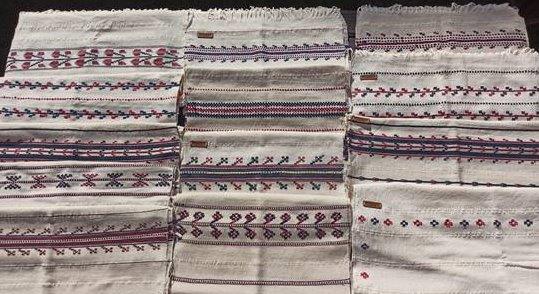
Iznik Derbent Weaving is a traditional textile produced in the Iznik district of Bursa using wool, cotton, and linen yarns, either patterned or plain, with diverse applications ranging from coverings and undergarments to kilims and bags. This production began in 1924 in Derbent Village and gradually spread throughout the entire Iznik region, becoming an integral part of the area’s economic and cultural fabric. Traditional colors such as black, maroon, navy, red, green, and yellow dominate the designs, while distinctive motifs including double pot, fern, broken meter, and duck shape define the craft’s visual identity.

Iznik Derbent Weaving (AA)
Traditionally, black, maroon, navy, green, red, and yellow are preferred colors, though other hues may be applied based on demand. The fineness and thickness of the yarns used depend on the intended product, with warp yarns of 20, 30, 40, and 50 counts commonly selected. Cotton, linen, or wool yarns may be used individually or in combination, and production can also incorporate yarns with different properties. The width and length of the textiles vary according to the product being made.
The origins of Iznik Derbent weaving trace back to 1924 in Derbent Village, located in the Iznik district of Bursa. Over time, production expanded to encompass the entire Iznik region. Iznik Derbent weaving plays a significant role in both the local economy and traditional practices, establishing a direct link between geographic boundaries and production.
Iznik Derbent weaving is typically executed on a off-white or cream-colored ground. Traditional motifs include double pot, fern, broken meter, side pass, duck, drumstick, tefe, islihas leaf, bird’s eye, crossed islihas, knife tip, and ball of yarn. These patterns serve as both visual identifiers and functional elements within the textiles.
The motifs used in these textiles include ball of yarn, jug, flower in pot, tulip, geranium, spotted cherry, bird’s eye, broken meter, fern, clover, tefe, snake curve, drumstick, duck, side pass, crossed islihas, knife tip, and various geometric patterns. These designs contribute both to visual diversity and to the traditional character of the weaving.

Iznik Derbent Weaving (AA)
All stages of Iznik Derbent weaving production must take place within the administrative boundaries of the Iznik district of Bursa. This geographic connection is maintained through the transmission of traditional knowledge and regional production practices.
Iznik Derbent weaving was registered as a geographical indication on 16 May 2023 under number 1357. The application number is C2022/000334, with the application date of 5 October 2022. The registering authority is Iznik Municipality, located at Selçuk Mah. Rauf Denktaş Cad. No: 65/A, Iznik, Bursa. This geographical indication, in the form of a certification mark, must appear on the product or its packaging as “Iznik Derbent Weaving” along with the official certification emblem. If not used on the product or packaging, the inscription and emblem must be displayed in a clearly visible location within the production facility.
The production process of Iznik Derbent weaving is monitored under the coordination of Iznik Municipality. The monitoring body consists of experts selected from Iznik Municipality, Iznik Women Producers Development Cooperative, and Iznik People’s Education Center. Annual inspections are conducted, but additional inspections may be carried out at any time in response to complaints or as deemed necessary. During inspections, the suitability of yarn types used, conformity of patterns to traditional characteristics, accuracy of production methods, and proper use of the “Iznik Derbent Weaving” inscription and certification emblem are verified. The monitoring body may obtain services from public or private institutions or individual experts as needed. The registering authority holds the legal authority to pursue judicial processes to protect the rights associated with this geographical indication.
Köksal, Saliha Nur. “Sandıklardan Çıkan Derbent Dokuması İznikli Kadınların Ellerinde Yeniden Hayat Buldu.” Anadolu Ajansı. Accessed May 31, 2025. https://www.aa.com.tr/tr/yasam/sandiklardan-cikan-derbent-dokumasi-iznikli-kadinlarin-ellerinde-yeniden-hayat-buldu/3477135.
Turk Patent and Trademark Office. "İznik Derbent Dokuması – Coğrafi İşaret Detayı." Turk Patent ve Marka Kurumu. Accessed May 31, 2025. https://ci.turkpatent.gov.tr/cografi-isaretler/detay/7663.
Türk Patent ve Marka Kurumu. *İznik Derbent Dokuması Coğrafi İşaret Tescil Belgesi*. Türk Patent ve Marka Kurumu. Accessed May 31, 2025. https://ci.turkpatent.gov.tr/Files/GeographicalSigns/ead5fb16-f023-4eb7-b6e1-04b806467153.pdf.

No Discussion Added Yet
Start discussion for "Iznik Derbent Weaving" article
General Characteristics
History and Geographic Connection
Production Method and Motifs
Product Types and Features
Geographic Boundary and Production Conditions
Registration Information
Monitoring and Control Mechanism