



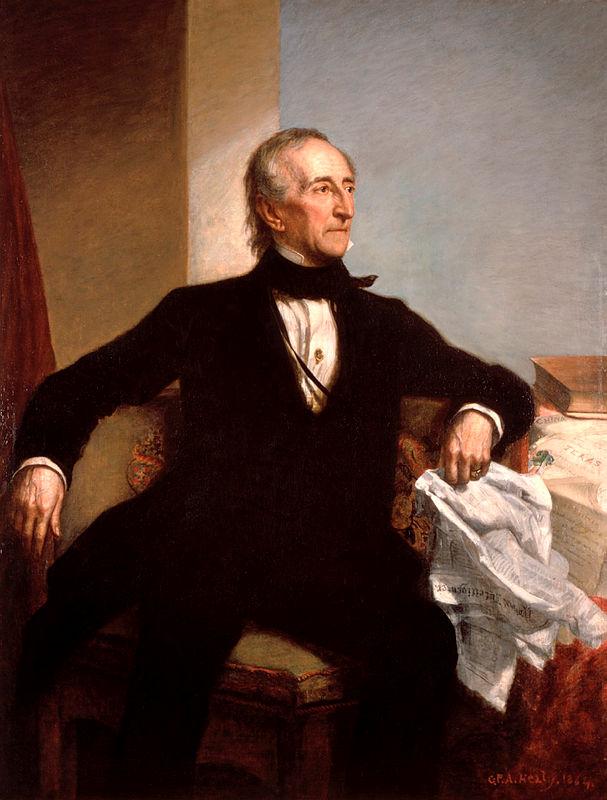
John Tyler
Doğum tarihi | 1790-03-29 | ||||||||
|---|---|---|---|---|---|---|---|---|---|
Eş | Julia Gardiner Tyler (m. 1844 – d. 1889) Letitia Christian Tyler (m. 1813 – d. 1842) | ||||||||
Place of Birth | Virginia - USA | ||||||||
Ölüm tarihi | 1862-01-18 | ||||||||
Place of Death | Virginia Richmond | ||||||||
Parents | Mary Marot Armistead Tyler John Tyler Sr. | ||||||||
Presidential Order | 10th President of the United States (1841–1845) | ||||||||
John Tyler was born on March 29, 1790, at Greenway, a family plantation in Charles City County, Virginia. He belonged to a wealthy and established political family; his father, John Tyler Sr., was a lawyer who served as Governor of Virginia. His mother, Mary Armistead Tyler, died in 1797 when John was only seven years old. He began his education at an early age, enrolled at the College of William and Mary at fourteen, and graduated in 1807. After completing his legal studies, he was admitted to the Virginia bar in 1809.
Tyler’s political career began in 1811 with his election to the Virginia House of Delegates. He was then elected to the United States House of Representatives in 1816 and served until 1821. Throughout his political career, he championed principles such as limited government, states’ rights, and a strict interpretation of the Constitution. In 1825, he was elected Governor of Virginia, but resigned from that office in 1827 after being appointed by the Virginia General Assembly to the United States Senate. He served in the Senate until 1836, during which time he gained attention for his opposition to President Andrew Jackson’s efforts to expand federal authority. In 1836, he resigned from the Senate due to criticism he directed at Jackson.
Following the death of William Henry Harrison on April 4, 1841, just one month into his term, John Tyler asserted his constitutional authority and assumed the full powers of the presidency. As the first vice president to succeed to the presidency, Tyler rejected arguments that he should serve only as an acting president and declared himself the legitimate president. During his presidency, he maintained his longstanding views favoring states’ rights and limited federal power. He vetoed two bills passed by the Whig Party aimed at establishing a national bank, which led to his expulsion from the party. Most of his cabinet resigned, with only Secretary of State Daniel Webster remaining in office. Webster signed the Webster-Ashburton Treaty in 1842, which resolved the border dispute between the United States and Britain over Maine.
During Tyler’s administration, the 1844 Treaty of Wangxia was signed, initiating commercial relations with China, and the Second Seminole War in Florida was brought to an end. Domestically, he supported measures such as the Tariff of 1842, which protected Northern industry, and pursued some political compromises. In the final days of his presidency in 1845, he signed the legislation annexing Texas, a decision that paved the way for the Mexican-American War. Tyler also approved measures such as the Log-Cabin Act, which encouraged westward migration. Politically isolated during his presidency, Tyler was not nominated by any party for the 1844 election. Although he considered running for re-election, he received no support and left office. His first marriage to Letitia Christian ended with her death in 1842. In 1844, he married Julia Gardiner of New York.
After leaving office, Tyler settled with his family on a plantation in Charles City County, Virginia, which he named Sherwood Forest. However, his retirement years were not politically quiet. Throughout the 1850s, as national politics became increasingly divided over slavery, he continued to defend the interests of the Southern states. He opposed the Wilmot Proviso and supported the Kansas-Nebraska Act and the 1857 Dred Scott decision.
In 1861, following the election of Abraham Lincoln, Tyler participated as a Virginia delegate in the Washington Peace Conference, convened to preserve the Union. However, believing that the proposed solutions would not sufficiently satisfy pro-slavery states, he voted against them. Later that year, he supported Virginia’s decision to secede and was elected to the Confederate Congress. John Tyler died on January 18, 1862, at the Ballard House hotel in Richmond. Although he requested a simple burial in his will, the Confederate government arranged a state funeral for him, and his body was interred at Hollywood Cemetery in Richmond.
American Battlefield Trust. "John Tyler." American Battlefield Trust. Accessed June 16, 2025. https://www.battlefields.org/learn/biographies/john-tyler
Crapol, Edward P. *John Tyler, the Accidental President*. Chapel Hill: University of North Carolina Press, 2012. Accessed June 16, 2025. https://uncpress.org/book/9780807872239/john-tyler-the-accidental-president/
Encyclopedia Virginia. "Tyler, John (1790–1862)." Encyclopedia Virginia. Accessed June 16, 2025. https://encyclopediavirginia.org/entries/tyler-john-1790-1862/
Miller Center. “John Tyler: Impact and Legacy.” Miller Center. Accessed June 16, 2025. https://millercenter.org/president/tyler
POTUS. "John Tyler." POTUS.com. Accessed June 16, 2025. https://potus.com/john-tyler/
The White House. “John Tyler.” The White House. Accessed June 16, 2025. https://bidenwhitehouse.archives.gov/about-the-white-house/presidents/john-tyler/
White House Historical Association. “John Tyler.” White House Historical Association. Accessed June 16, 2025. https://www.whitehousehistory.org/bios/john-tyler

John Tyler
Doğum tarihi | 1790-03-29 | ||||||||
|---|---|---|---|---|---|---|---|---|---|
Eş | Julia Gardiner Tyler (m. 1844 – d. 1889) Letitia Christian Tyler (m. 1813 – d. 1842) | ||||||||
Place of Birth | Virginia - USA | ||||||||
Ölüm tarihi | 1862-01-18 | ||||||||
Place of Death | Virginia Richmond | ||||||||
Parents | Mary Marot Armistead Tyler John Tyler Sr. | ||||||||
Presidential Order | 10th President of the United States (1841–1845) | ||||||||
Presidency (1841–1845)
Civil War and Later Years