

This article was automatically translated from the original Turkish version.
+1 More
Period(s) | Young Ottoman Period | ||||||||
|---|---|---|---|---|---|---|---|---|---|
Current Status | Partially standing | ||||||||
Events Experienced | Major fire in 1960 | ||||||||
Building Material | Cut stone | ||||||||
Plan Type | Open courtyard, (irregular rectangular plan) | ||||||||
Dating | Hijri 1322–1324 (Gregorian 1906–1908) | ||||||||
Building Type | Courtyard Han | ||||||||
Location | Erzurum Türkiye | ||||||||
Kamburoğlu Hanı is one of the urban caravanserais in the Gölbaşı neighborhood of Erzurum city center, located in the Köse Ömer Ağa Quarter and dated to the late Ottoman period. The building is considered among the examples reflecting Erzurum’s late Ottoman commercial architecture through its plan layout, ornamental portal, and inscribed entrance.
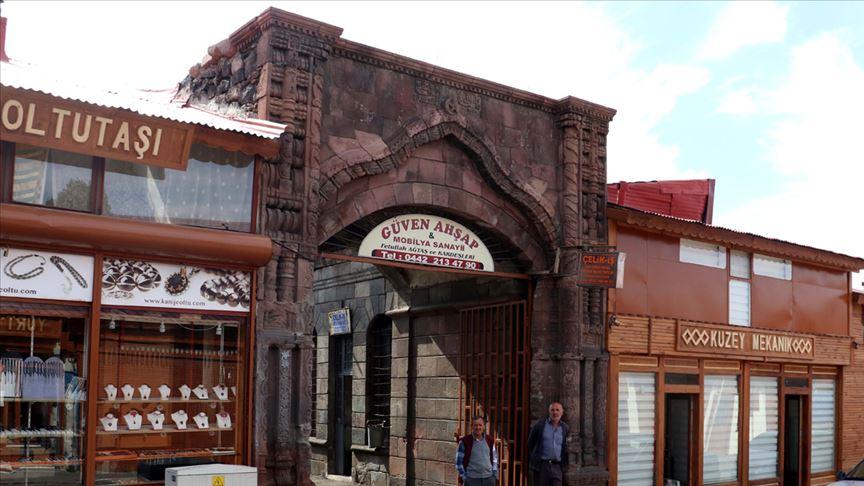
Kamburoğlu Hanı (AA)
Kamburoğlu Hanı is situated in the Gölbaşı neighborhood, along Erzurum’s historical trade axes. An inscription on the entrance portal on the eastern façade bears the dates 1322–1324 AH, corresponding to 1906–1908 CE. This inscription confirms that the building was constructed in the early 20th century. The inscription also includes the phrases “Maşallah” and “Ya Hafız”.
Kamburoğlu Hanı is designed as an irregular rectangular, open-court caravanserai oriented northeast–southwest. The spaces surrounding the courtyard exhibit an asymmetrical arrangement. A total of 21 rooms are arranged around the courtyard, varying in size and roofing system, with functional use prioritized over formal symmetry.
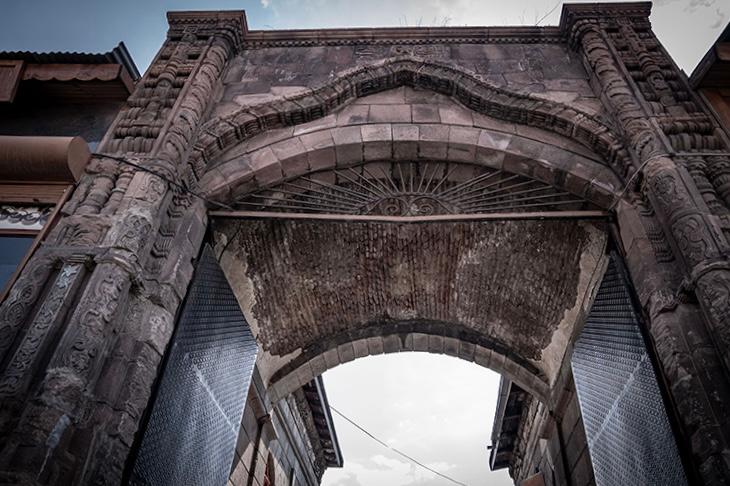
The most striking architectural feature of the building is the ornamental portal on the eastern façade. This portal projects forward and upward, exhibiting a more elaborate design compared to other caravanserai entrances in Erzurum. It consists of two nested arches; the upper section features a three-lobed arch adorned with geometric and vegetal motifs. The columns on either side and the refined stonework reflect the architectural style of the late Ottoman period.
Cut stone was the primary material used in the construction of the han. High-quality stonework is particularly evident on the entrance façade and the room facades facing the courtyard. Flat and hawk’s-beak roof types were employed. Decoration throughout the building was kept minimal, with functionality emphasized over ornamentation.
During the Ottoman period, Kamburoğlu Hanı served as an urban commercial structure. Caravanserais played a vital role in Erzurum’s economic life by providing lodging for merchants, storage for goods, and venues for commercial activity. Kamburoğlu Hanı contributed to this commercial network due to its location along Erzurum’s east–west trade routes.
The building suffered a major fire in 1960, which caused significant damage to its upper roofing system. Today, the structure remains partially standing but is in a state of neglect. Some sections continue to be used as shops. However, this current use has partially compromised the building’s original architectural integrity.
Due to its position along east–west overland trade routes, Erzurum became a major commercial center during the Ottoman period, leading to the construction of numerous caravanserais. Kamburoğlu Hanı is classified with the Rüstem Paşa Kervansarayı and Hacılar Hanı as part of the open-court caravanserai type. However, its ornamental portal distinguishes it prominently from other caravanserais in Erzurum.
Anadolu Ajansı. “Kamburoğlu Hanı tarihe tanıklık ediyor.” Accessed January 11, 2026. https://www.aa.com.tr/tr/kultur-sanat/kamburoglu-hani-tarihe-taniklik-ediyor-/1603599
Erzurum Ansiklopedisi. "Kamburoğlu Hanı." Accessed January 11, 2026. http://erzurumansiklopedi.com/kamburoglu-hani/
Köşklü, Zerrin. “Erzurum’da Osmanlı Dönemi Hanları.” *Sosyal Bilimler Enstitüsü Dergisi* 5 (2010): 113–134. Accessed January 11, 2026. https://dergipark.org.tr/en/pub/sbedergi/article/134505

Period(s) | Young Ottoman Period | ||||||||
|---|---|---|---|---|---|---|---|---|---|
Current Status | Partially standing | ||||||||
Events Experienced | Major fire in 1960 | ||||||||
Building Material | Cut stone | ||||||||
Plan Type | Open courtyard, (irregular rectangular plan) | ||||||||
Dating | Hijri 1322–1324 (Gregorian 1906–1908) | ||||||||
Building Type | Courtyard Han | ||||||||
Location | Erzurum Türkiye | ||||||||
Location and Dating
Architectural Features
Plan Layout
Entrance Portal
Materials and Construction Technique
Usage
Transformations and Current Condition
Place Among Erzurum’s Caravanserais