

This article was automatically translated from the original Turkish version.
+1 More
Location | Beyoğlu Türkiye Istanbul | ||||||||
|---|---|---|---|---|---|---|---|---|---|
Year of Construction | 1870-1880 | ||||||||
Architectural Style(s) | Art Nouveau Baroque | ||||||||
Patron | Kamondo family | ||||||||
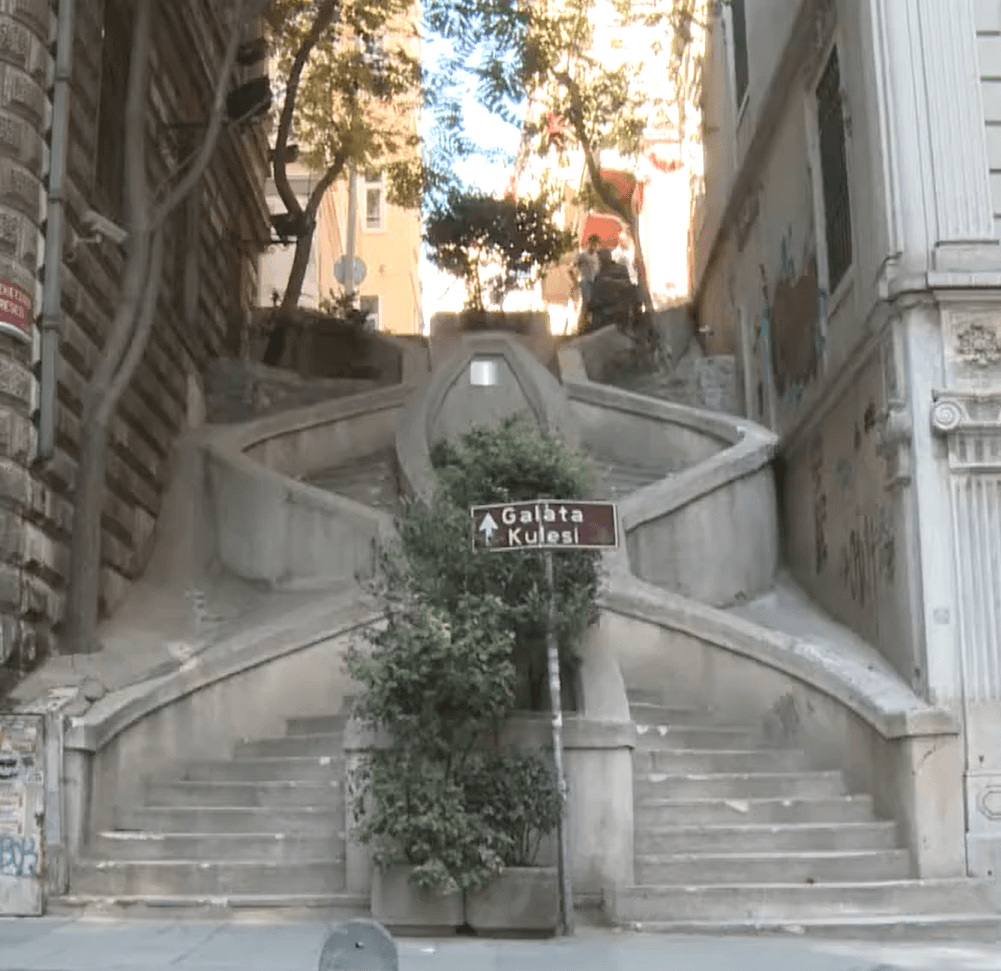
Kamondo Stairs are an urban outdoor staircase connecting Voyvoda Street (today’s Bankalar Caddesi) and Banker Street in the Karaköy neighborhood of Istanbul’s Beyoğlu district. They exhibit Art Nouveau and Baroque influences and have become one of the symbolic landmarks of Istanbul’s historical and architectural identity, serving not only as a functional vertical circulation element but also as a cultural icon.
The exact construction date of the Kamondo Stairs is unknown, but they were built between 1870 and 1880 by the Kamondo family, one of the prominent Jewish banking families of Galata.
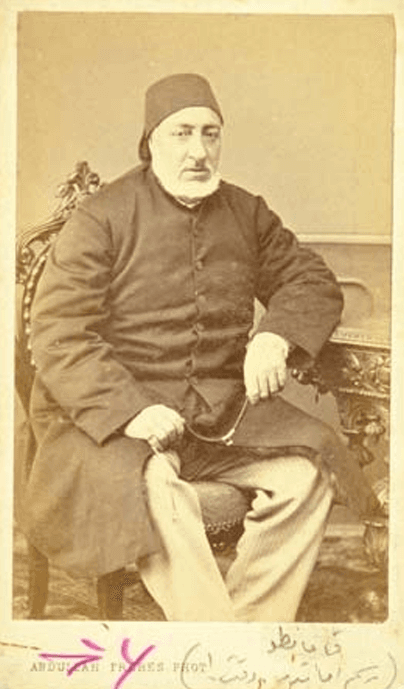
Abraham Salomon Kamondo, a leading member of the family, was instrumental in the construction of various buildings in Beyoğlu, leaving a lasting architectural imprint on the city. During this period, when Westernization was gaining momentum in the Ottoman State, the Kamondo family, of Sephardic Jewish origin, exerted considerable influence over the state’s financial and commercial policies.
The Kamondo family conducted their business activities along Voyvoda Street (today’s Bankalar Caddesi), the financial and commercial center of Galata during the Ottoman era. The stairs were constructed to connect the street where their business premises were located with the alley where their residences stood, facilitating access across the steep slope between them.
The Kamondo Stairs reflect the Westernizing sensibilities of their time through the influence of Baroque and Art Nouveau styles. Their design embodies both symmetry and a sense of rhythm.
The stairs consist of two curved arms that begin separately at the bottom, merge in the middle, and then split again into two separate arms, forming a fluid, continuous shape. The overall plan of the staircase ascends in a pattern resembling the letter “S.” This form not only enhances aesthetic appeal but also improves pedestrian safety.
Stone, a durable and fire-resistant material consistent with the urban planning principles of the era, was used in its construction.
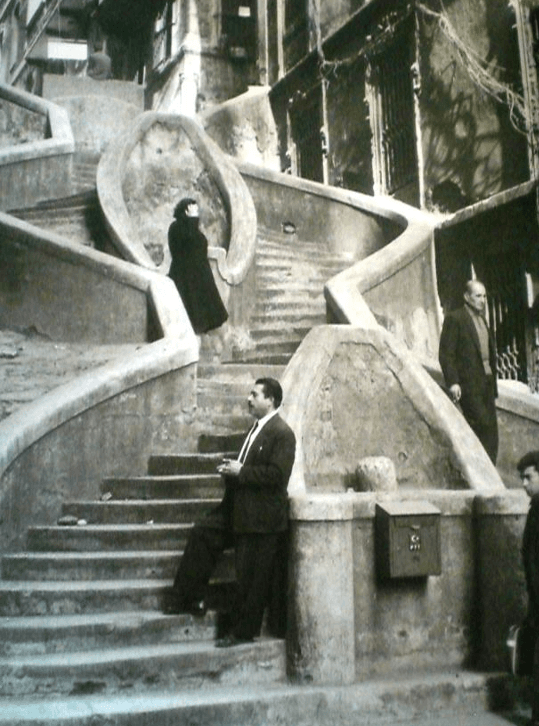
1964 Kâmpondo Stairs (Gülçin Demirkaya)
The Kamondo Stairs are more than a means of transportation; they are an urban symbol. Within Galata’s hilly topography, they function as both a practical and symbolic link. Due to their location, the stairs create visual harmony with surrounding Western-style civil architecture, such as banks and hans, and have become an integral part of the city’s collective memory.

Kamondo Stairs in 2017 (Photo: Neriman Sena Külünk)
The Kamondo Stairs are among the successful urban design examples that emerged in the 19th-century Ottoman city fabric, skillfully combining functionality and aesthetics. Built not only to facilitate the family’s own movement but also to reflect their legacy of philanthropy, the stairs remain a popular destination for both tourists and Istanbul residents today. They are recognized as one of the structures that have contributed to the historical texture of Galata and play a symbolic role in preserving and sustaining this heritage.
Aktemur, Ali Murat. *Karaköy’de Batı Üslubunda Yaptırılmış Sivil Mimari Örnekleri.* PhD thesis,Atatürk Üniversitesi Institute of Social Sciences, 2006. https://tez.yok.gov.tr/UlusalTezMerkezi/TezGoster?key=-L8ilcwn9ZRRc_YMKxXW1kFDPsCXwJFnNL87OuwsP6W84fnAQS_9yOZhgRACx5wm
Beyoğlu App YouTube Channel. "Kamondo Merdivenleri." Accessed July 19, 2025. https://www.youtube.com/watch?v=cDLcUBocGx0
Ciritci, İlke, and Gül Yücel. "Merdivenli Sokaklarda Sosyal Mekân Oluşumuna Etki Eden Unsurlar ve İstanbul’dan Üç Örnek İçin Değerlendirme." *İDEALKENT*, 12, no. 32, 2021, pp. 528–555. https://dergipark.org.tr/tr/pub/idealkent/issue/57686/780294
Demirkaya, Gülçin. *İstanbul Beyoğlu'nda 19. Yüzyılda Banker Camondo Yapıları ve Adahan'ın Özellikleri, Yeniden Kullanım Önerisi.* Master's thesis, Yıldız Teknik Üniversitesi Fen Bilimleri Enstitüsü, 2010. https://tez.yok.gov.tr/UlusalTezMerkezi/TezGoster?key=zqI_ZOq-b18GC2rT9c2JGnFf7h2fP8Kvxj_l8n8AEpsx8X_Phqc2DR-oQK1aTfO7
Ocak, Elif. *Gayrimenkul Yatırım Aracı Olarak Kentsel Dönüşüm: Beyoğlu Bölgesinde Kamondo Han Örneği.* Master's thesis, Istanbul Technical University Institute of Science and Technology, 2006. https://tez.yok.gov.tr/UlusalTezMerkezi/TezGoster?key=-Z0vbSUgrhM9fXoGkRe6QzWSeIE3QsNIFRQ6GjVhq9PXtWDTZQpPpgc-WpaV8BWS
İpek, Nurdan. *Selanik ve İstanbul'da Seçkin Yahudi Bankerler (1850-1908).* PhD thesis, İstanbul Üniversitesi Sosyal Bilimler Enstitüsü, 2011. https://tez.yok.gov.tr/UlusalTezMerkezi/TezGoster?key=zD1B0cW7zVr3VcnZjitVXnFB4-afqzXhP9ue4FNJF-3lretaGGzuSMHMfRMqjikJ

Location | Beyoğlu Türkiye Istanbul | ||||||||
|---|---|---|---|---|---|---|---|---|---|
Year of Construction | 1870-1880 | ||||||||
Architectural Style(s) | Art Nouveau Baroque | ||||||||
Patron | Kamondo family | ||||||||
History
Architectural Features
Urban and Cultural Significance