


This article was automatically translated from the original Turkish version.
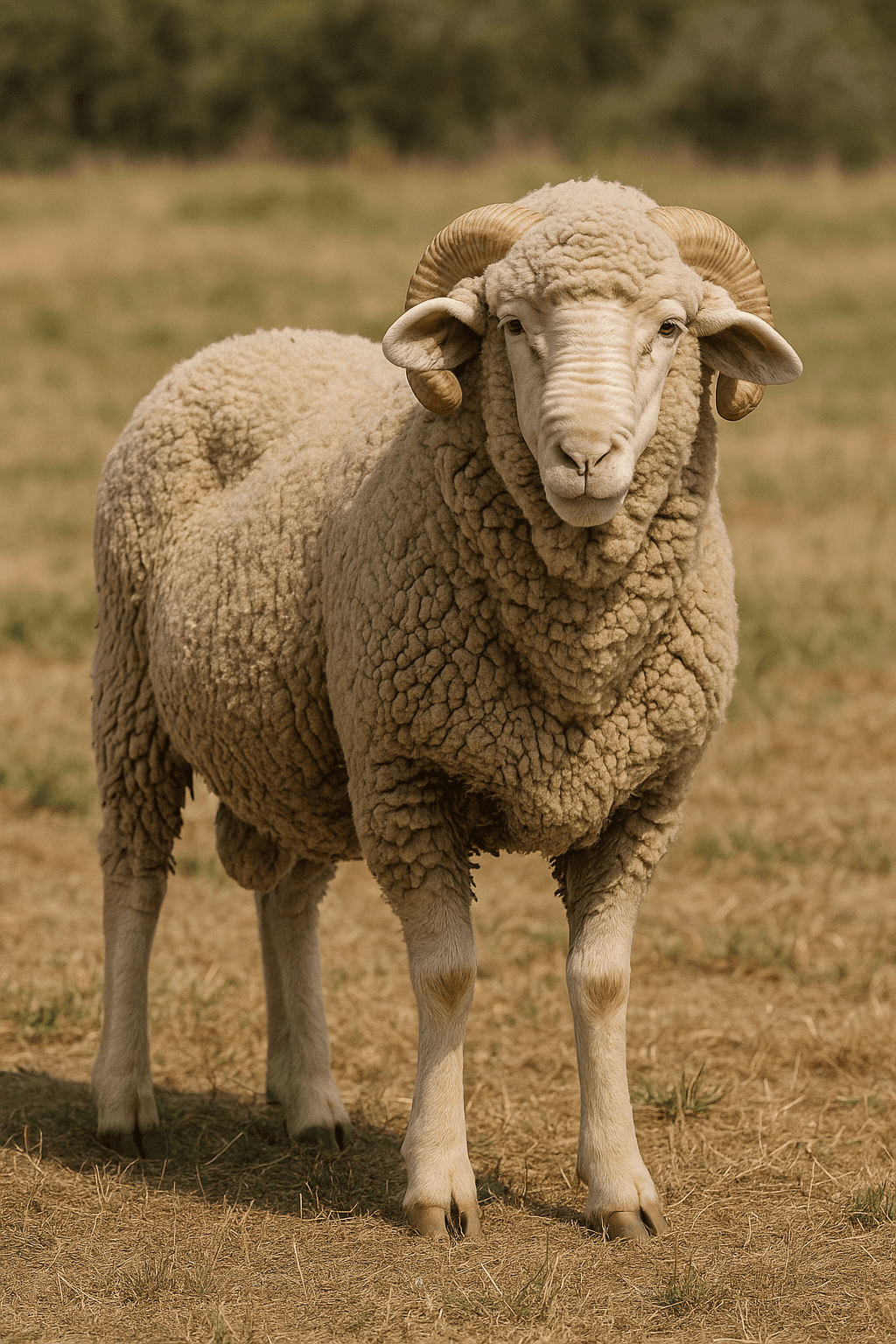
Karacabey Merino (Turkish Merino)
Origin(s) | Bursa Türkiye | ||||||||
|---|---|---|---|---|---|---|---|---|---|
Genetic Structure | 95% German Meat Merino, 5% Curly | ||||||||
Live Weight | 60–90 kg | ||||||||
Wool Quality | Fine - single row wool; staple length approximately 6.5–7 cm - sortima ~64 S | ||||||||
Karacabey Merinos, also known as Turkish Merinos, is a sheep breed developed in Türkiye for both meat and wool production. Breeding efforts began in 1933 as part of a project initiated to meet the high-quality wool needs of Türkiye’s textile industry. In 1935, German Meat Merino rams were introduced to the Karacabey State Farm in Bursa and crossed with local Kıvırcık ewes. The backcrossing method was employed, and the breed type was stabilized after the fifth backcross. The resulting Karacabey Merinos is reported to have approximately 95% German Meat Merino and 5% Kıvırcık genetic composition.
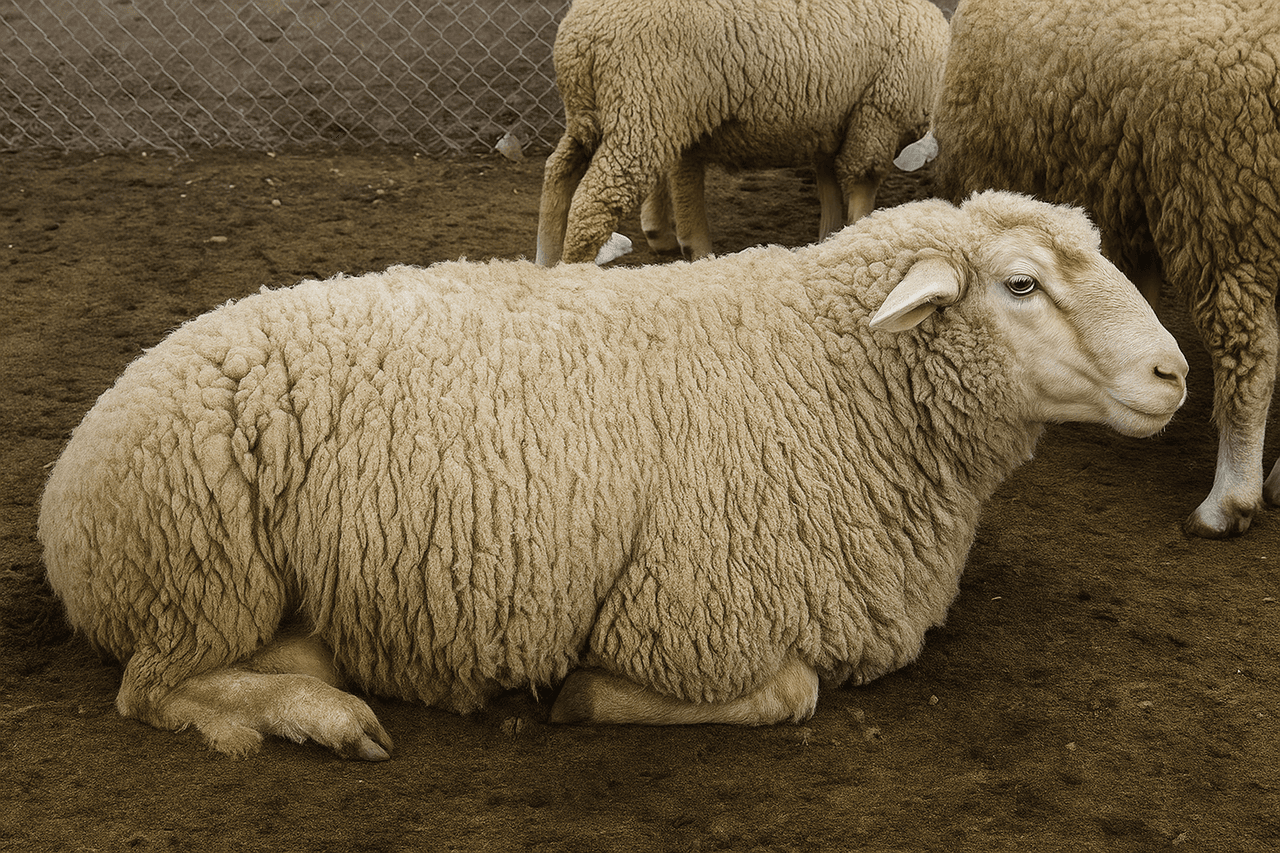
Karacabey Merinos. (Meat and Dairy Corporation)
Breeding of the Karacabey Merinos began in 1933 at the Karacabey State Farm. The breed was created through crossbreeding between German Meat Merino rams and Kıvırcık ewes. The backcrossing method was used, and the breed type was fixed after the fifth backcross. The Karacabey Merinos is reported to have approximately 95% German Meat Merino and 5% Kıvırcık genetic composition.
The Karacabey Merinos has a white body, head, and legs. Rams are typically horned, while ewes are polled. Their wool is fine and uniform. They possess a thin, long tail.
Research has shown that several factors significantly influence reproductive traits in Karacabey Merinos sheep. Lambing year and ewe age have had significant effects on fertility, number of lambs born (LSB), number of lambs weaned (LSW), lamb birth weight (LWB), and weaning weight (LWW). Studies on the Karacabey Merinos have also demonstrated that flock and birth year significantly affect lamb number. Factors such as flock, birth year, lamb sex, and birth type have been found to significantly influence lamb birth weight, live weight at 45 days, and live weight at 90 days. Similarly, average daily gain between birth and 45 or 90 days is affected by flock, birth year, sex, and birth type.
Data on these parameters were collected through projects involving breeding and base flocks in regions such as Balıkesir, Sındırgı, and Bigadiç, as well as from institutions such as the Marmara Livestock Research Institute.
Ekiz, Bülent, Özcan, Mustafa, Yılmaz, Alper, and Ceyhan, Ayhan. “Estimates of Phenotypic and Genetic Parameters for Ewe Productivity Traits of Turkish Merino (Karacabey Merino) Sheep.” *Turkish Journal of Veterinary & Animal Sciences* 29, no. 2 (2005): 557–64. Accessed May 22, 2025. https://journals.tubitak.gov.tr/veterinary/vol29/iss2/55/
Sezenler, T., Soysal, D., Yıldırır, M., Yüksel, M.A., Ceyhan, A., Yaman, Y., Erdoğan, İ., Karadağ, O. “Karacabey Merinos Koyunların Kuzu Verimi ve Kuzularda Büyüme Performansı Üzerine Bazı Çevre Faktörlerinin Etkisi.” *Tekirdağ Ziraat Fakültesi Dergisi* 10, no. 1 (March 2013): 40–47. Accessed May 22, 2025. https://dergipark.org.tr/en/pub/jotaf/issue/19037/201340
T.C. Et ve Süt Kurumu. "Karacabey Merinosu." Accessed May 22, 2025. https://www.esk.gov.tr/tr/11111/Karacabey-Merinosu

Karacabey Merino (Turkish Merino)
Origin(s) | Bursa Türkiye | ||||||||
|---|---|---|---|---|---|---|---|---|---|
Genetic Structure | 95% German Meat Merino, 5% Curly | ||||||||
Live Weight | 60–90 kg | ||||||||
Wool Quality | Fine - single row wool; staple length approximately 6.5–7 cm - sortima ~64 S | ||||||||
No Discussion Added Yet
Start discussion for "Karacabey Merino (Turkish Merino)" article
Origin and Development
Physical Characteristics
Productivity and Traits
Factors Affecting Productivity