This article was automatically translated from the original Turkish version.
+1 More
Province İt Belongs to | Sakarya | ||||||||
|---|---|---|---|---|---|---|---|---|---|
Population | 74.548 | ||||||||
Area(s) | 457 km² | ||||||||
Elevation(s) | 31 metre | ||||||||
District Governor | Mehmet Uğur ARSLAN | ||||||||
Mayor(s) | İshak SARI | ||||||||
Number of Neighborhoods | 40 | ||||||||
Karasu is a district located at the point where the Sakarya River flows into the Black Sea, within Sakarya Province, Türkiye. Situated at the boundary between the Western Black Sea Region and the Marmara Region, the district covers an area of 457 km² and has an average elevation of 31 meters above sea level. According to 2024 TÜİK data, its population is 74,548.

Karasu District (Karasu Municipality)
Karasu, known in historical sources by its former name "Pazar Suyu," gained the status of a nahiye in 1888. During the early years of the Republic, it was a bucak settlement, becoming a district subordinate to Kocaeli Province in 1933. With the establishment of Sakarya as a province on 22 June 1954, it was attached to Sakarya Province.
Walls were constructed by Hacı Abdi Bey, regarded as the founder of Karasu, in the southern part of the district to provide defense and protect the drinking water channel. Remnants of these walls have survived to the present day.

Historical Structures (Karasu Municipality)
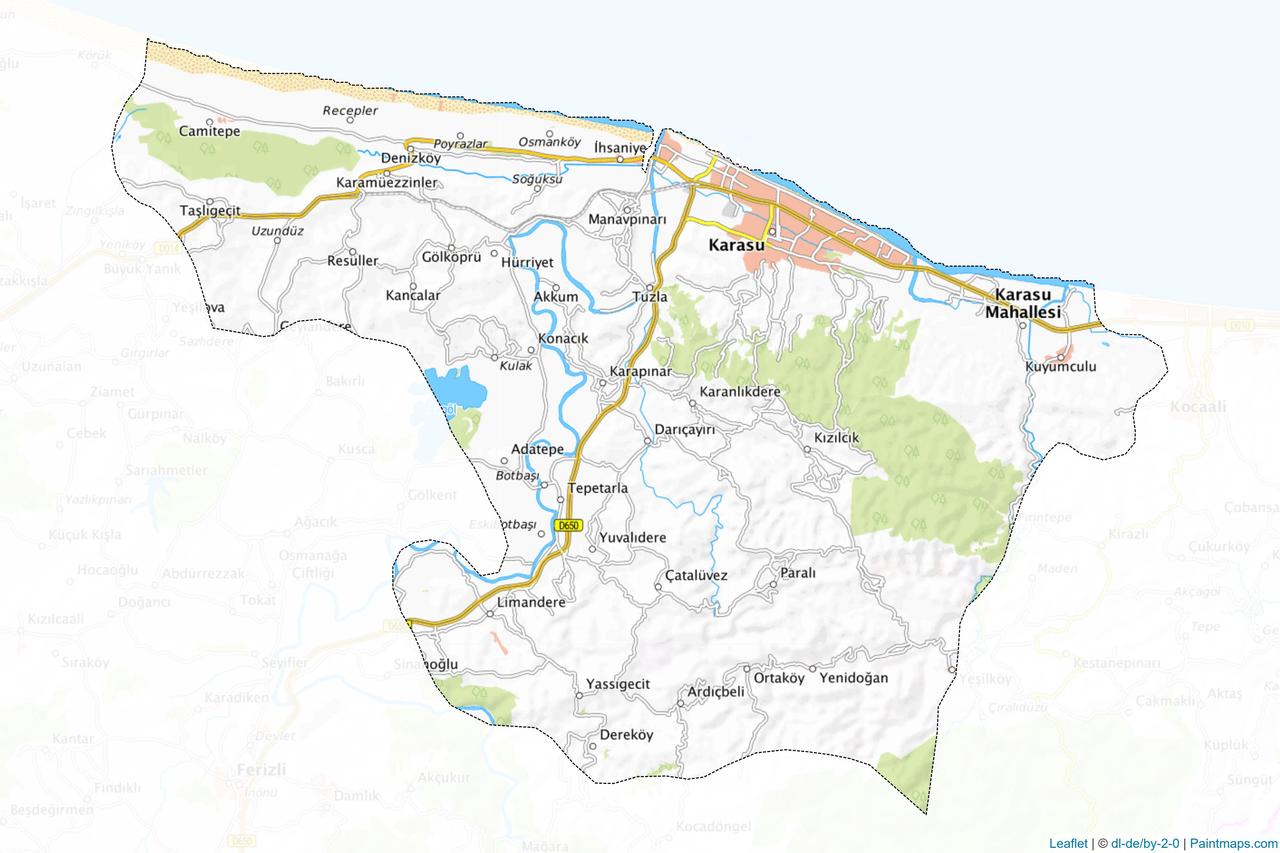
The district covers an area of 457 km² with an average elevation of 31 meters above sea level. It is located 48 km from the center of Sakarya Province, 190 km from Istanbul, and 315 km from Ankara. It shares borders with Kocaali to the east, Kaynarca to the west, Ferizli to the southwest, and Hendek to the south. Its northern boundary is entirely along the Black Sea coast.
The settlement is built on hilly terrain. The Demirli Mountain in the south and the Resuller Mountain in the west are significant elevations. The district has a natural beach stretching 20 kilometers in length, and its fine-grained sand is believed to have therapeutic benefits for rheumatic diseases.
Due to its location at the intersection of two geographical regions, Karasu exhibits transitional climate characteristics. Dominated by the Black Sea climate, it experiences rainfall throughout all seasons. The annual average precipitation is 1,200 mm.
The district’s forested area spans 12,465 hectares. These forests include numerous tree species such as beech, hornbeam, chestnut, oak, plane, and poplar, excluding Mediterranean vegetation.
This is the most important river in the district. It flows for 43 km within the district boundaries and empties into the Black Sea at the Yenimahalle locality. It can cause flooding during spring and autumn months.
This 30 km long stream originates from Çam Dağı and flows between Karasu and Kocaali districts. In the late Ottoman period, a French company conducted mining for lead, borax, zinc, and gold in the region. The stream has carved a canyon valley by eroding limestone blocks. A waterfall and remnants of a historical cave are found in its vicinity.
A first-degree natural conservation area and wildlife development zone located approximately 2 km inland from the sea. This 2,517-hectare wetland forest contains alder, black alder, and willow trees. Surveys have identified 235 different bird species inhabiting the area. Fish such as roach, rudd, and carp, along with mammals like hare, fox, and wild boar, form the region’s fauna.
A freshwater lake located along the Karasu-Adapazarı road where freshwater fishing is practiced.
A 50-hectare freshwater lake located 5 km from the district center. During periods of high water levels, it can connect with the sea.
An artificial lake constructed to protect Darıçayırı and surrounding villages from flash floods.

Karasu District (Karasu Municipality)
Key historical remains in the district include the ruins of Hacı Abdi Bey’s family bathhouse, the “Big Stone” from the old Sakarya Bridge, remnants of the wall extending toward Tuzla, the remains of a drinking water cistern, caves in Manavpınarı Village, and carved stones along Maden Stream.
Constructed in 1974 in the fevkani style (with a ground-floor market and upper-floor prayer hall), it has a rectangular plan and a stone minaret.
Named after Sultan Abdülaziz and built in the 19th century, the mosque suffered damage during the 17 August 1999 earthquake, resulting in the collapse of its minaret. The structure is currently closed for worship.
Located north of the district center, the cemetery contains 46 gravestones dating from Hijri 1113 (1697 CE) to 1249 (1833 CE), inscribed with Ottoman Turkish epitaphs and various motifs. These are characteristic of the late Ottoman period. The cemetery remains in active use.
Karasu cuisine reflects influences from the Eastern Black Sea and Caucasus populations. Dishes based on dough products and abundant use of squash and potato are prominent. Local specialties include Circassian Chicken, Circassian Pie, Keşkek, Ezme Beans, Dartı, Milk-Baked Squash Dessert, Üre Dessert, and Circassian Cheese.
Karasu District Governorship. "Mahalli İdareler." Accessed August 16, 2025. http://www.karasu.gov.tr/mahalli-idareler
Karasu District Governorship. *İlçe Tarihçesi*. Accessed August 16, 2025. http://www.karasu.gov.tr/ilce-tarihcesi
Karasu Kaymakamlığı. "Coğrafi Yapısı." Accessed August 16, 2025. http://www.karasu.gov.tr/cografi-yapisi
Karasu Municipality. "Karasu Manzaraları." Accessed August 16, 2025. https://www.karasu.bel.tr/karasu-manzaralari
Karasu Municipality. "Turizm." Accessed August 16, 2025. https://www.karasu.bel.tr/turizm
Karasu Municipality. *Tarihi*. Accessed August 16, 2025. https://www.karasu.bel.tr/tarihi
PaintMaps. "Şehir Haritası Grafiği." Accessed August 7, 2025. https://paintmaps.com/tr/harita-grafikleri/sehir-haritasi-grafigi.
Sakarya Valiliği. *Karasu*. Accessed August 16, 2025. http://www.sakarya.gov.tr/karasu
Türkiye İstatistik Kurumu (TÜİK). "Adrese Dayalı Nüfus Kayıt Sistemi Sonuçları, 2024." Publication No: 53783. Accessed August 16, 2025. https://data.tuik.gov.tr/Bulten/Index?p=Adrese-Dayali-Nufus-Kayit-Sistemi-Sonuclari-2024-53783
Province İt Belongs to | Sakarya | ||||||||
|---|---|---|---|---|---|---|---|---|---|
Population | 74.548 | ||||||||
Area(s) | 457 km² | ||||||||
Elevation(s) | 31 metre | ||||||||
District Governor | Mehmet Uğur ARSLAN | ||||||||
Mayor(s) | İshak SARI | ||||||||
Number of Neighborhoods | 40 | ||||||||
History
Geographical Location and Topography
Climate and Vegetation
Rivers and Lakes
Sakarya River
Maden Stream
Acarlar Wetland (Subasar Forest)
Akgöl
Küçükboğaz Lake
Darıçayırı Dam Lake
Cultural Heritage
Historical Remains
Religious Structures
Central Mosque
Aziziye Mosque
Aşağı İncilli Cemetery
Culinary Culture