This article was automatically translated from the original Turkish version.
+1 More
Sakarya River
Location | Türkiye Northwestern Anatolia | ||||||||
|---|---|---|---|---|---|---|---|---|---|
Length(s) | the third longest river in Türkiye 824 km | ||||||||
Place of Birth | Near Çifteler district of Eskişehir | ||||||||
Place of Deposition | Black Sea | ||||||||
Arms | Göynük Çayı Karasu Çark Suyu Mudurnu Çayı | ||||||||
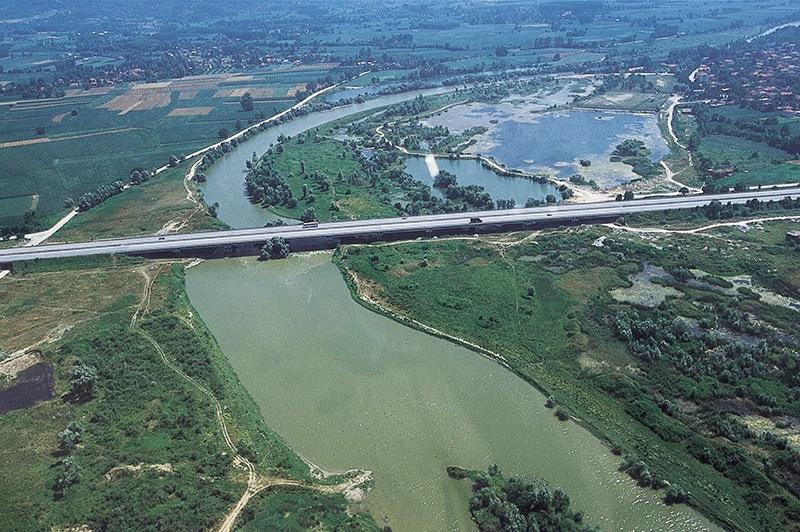
The Sakarya River is the third longest river in Türkiye, after the Kızılırmak and the Euphrates, and the largest river in northwestern Anatolia. With a total length of 824 kilometres, the river derives its name from Sangarius, the river god of Greek mythology. Originating near the Çifteler district of Eskişehir, the Sakarya River flows from south to north. Near the Osmaneli district of Bilecik, it adopts a meandering course and receives important tributaries such as the Karasu and Göynük Çayı. Within the boundaries of Sakarya province, it also collects the Mudurnu Çayı and the excess waters of Lake Sapanca via the Çark Suyu before emptying into the Black Sea at Karasu.

Sakarya Nehri (Sakarya Governorship)
The fertile alluvial soils formed along the course of the Sakarya River provide a suitable foundation for agricultural activities. Particularly the Pamukova and Geyve Plains, thanks to their microclimatic characteristics, enable the cultivation of a wide variety of fruits and vegetables beyond citrus.
Over its millions-of-years journey, the river has played a significant role in shaping the Earth’s surface; through the gorges it carved, it allowed marine influences to reach inland areas and directly influenced the region’s climate. This climatic effect has also been decisive in increasing agricultural diversity.
Throughout history, the Sakarya River has been an attractive region for settlement due to the numerous villages and towns established along its banks. It has also served as a boundary, witnessing strategically important events especially during the 13th century and the National Struggle period. Historically, the Sakarya River constituted a major natural barrier along the routes connecting Istanbul to Anatolia, prompting the construction of numerous bridges during the Roman and Ottoman periods to overcome this obstacle. Especially the bridges concentrated between Adapazarı and Osmaneli ensured the continuity of the transportation network.

Sakarya Nehri (Sakarya Governorate)
Today, the discharge of the Sakarya River is declining due to factors such as drought and the expansion of irrigated agriculture. Additionally, the dams constructed along its course have limited the river’s flooding and destructive impacts. Over time, changes have occurred in the riverbed, particularly in lowland areas where meanders have begun to form. Past flood events and bed modifications indicate that the river once had a more vigorous flow than it does today.
Arıkan, Refik. "Sakarya Nehri ve Osmaneli." *Sinop Üniversitesi Sosyal Bilimler Dergisi* 7, no. 2 (2023): 1394-1418. Date Published: October 15, 2023. Accessed June 24, 2025. https://doi.org/10.30561/sinopusd.1358454.
Sakarya Valiliği. "Sakarya Nehri." Accessed June 24, 2025. http://www.sakarya.gov.tr/sakarya-nehri.

Sakarya River
Location | Türkiye Northwestern Anatolia | ||||||||
|---|---|---|---|---|---|---|---|---|---|
Length(s) | the third longest river in Türkiye 824 km | ||||||||
Place of Birth | Near Çifteler district of Eskişehir | ||||||||
Place of Deposition | Black Sea | ||||||||
Arms | Göynük Çayı Karasu Çark Suyu Mudurnu Çayı | ||||||||
Agriculture and Ecological Interaction
Historical Significance and Settlement
Current Status and Changes