

This article was automatically translated from the original Turkish version.
Origin(s) | Turk | ||||||||
|---|---|---|---|---|---|---|---|---|---|
Religion(s) | Karai sect Judaism | ||||||||
Regions They Lived in | Crimea, Lithuania, Poland, Ukraine, Türkiye | ||||||||
Language(s) | Karaim (Kipchak Turkish) | ||||||||
Karay Turks are a Turkic ethnic group whose religious affiliation is with the Karaite sect of Judaism. They emerged historically in the region surrounding the Khazar Khaganate and today constitute a Turkic community whose numbers are steadily declining. Distinct in belief from other Turkic groups, the Karays have maintained both their Turkic identity and their religious system throughout history, developing a multifaceted cultural structure. The term “Karay” in the Turkic world denotes both an ethnic community and a specific dialect, while religiously it is directly linked to Karaism, the sect that recognizes only the Written Torah as authoritative.
The term “Karay” derives from the Hebrew verb “kara” (קרא), meaning “those who read” or “those who read the sacred text.” Although originally referring to the religious identity of the Karaite sect, over time it became an ethnic designation for Turkic peoples adhering to this faith. The name appears in folk usage and various sources as Karay, Karaim, Keray, or Karait. The Karay Turks descend from Turkic tribes that adopted Karaite belief within the Khazar Khaganate from the 8th century onward.
The emergence of the Karay Turks is directly linked to the Khazar Khaganate, which dominated the intersection of present-day Eastern Europe and Western Asia between the 7th and 11th centuries. The Khazars, successors to the Western Göktürks, gained independence and quickly established political relations with both the Byzantine and Islamic worlds.
Islamic historians note that in the Khazar capital, seven judges presided over legal matters: two applied Jewish law, two Christian law, two Islamic law, and one followed pagan traditions. This reflects widespread religious pluralism within the Khazars and the institutionalization of Judaism within this context.
In the 8th century, Khazar Khagan Bulan’s conversion to Judaism initiated a state-level transformation, and this faith spread particularly among the ruling elite and nobility. However, the Judaism adopted by the Khazars was not traditional Rabbinic Judaism but rather the Karaite sect, which bases its authority solely on the Written Torah. The Karay Turks trace their historical identity to the descendants of these Turkic tribes who embraced this belief.
In the 11th century, Cumans and Kipchaks launched invasions that weakened the Khazar state and led to its disappearance from history. Following this collapse, some Khazar communities adhering to Karaite belief established a principality centered on “Kırk Yer” near Bakhchisaray in Crimea, preserving their existence.
During this period, the Karay Turks developed a distinct identity in Crimea, blending their Turkic ethnic structure with Karaite belief. Their language retained strong Kipchak elements but was also influenced by Hebrew and Slavic languages.
The Karay Turks’ migration beyond Crimea dates to the late 14th century. Between 1397 and 1398, Grand Duke Vytautas of Lithuania, engaged in conflict with the Golden Horde, resettled hundreds of Karay families from Crimea to cities such as Trakai (Troki), Vilnius, and Lutsk. This migration was not forced but strategically motivated, aiming to utilize the Karays as guards and officials in the Lithuanian court.
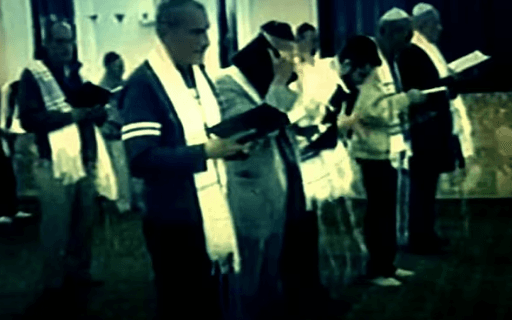
Settling in Lithuania and Poland, the Karay Turks preserved their religious freedom, established their own places of worship known as kenesas, and sustained their cultural identity. Trakai remains one of the central hubs of Karay identity to this day.
Following the Ottoman conquest of Crimea, a Karay community settled in Istanbul. This group primarily lived in the Galata and Hasköy areas and maintained distinct religious practices to avoid being confused with other Jewish groups. The Karays of Istanbul adapted to the multicultural structure of the Ottoman Empire while preserving their own traditions.
The defining religious element of the Karay Turks is the Karaite sect, a historical branch of Judaism. Unlike other Jewish denominations, this sect recognizes only the Written Torah as authoritative and rejects oral traditions and the Talmud. Karaite belief constitutes a system that intersects directly with both the Jewish heritage and early Turkic history.
The Karaite sect emerged in the second half of the 8th century under the leadership of Anan ben David. Its foundational principle was the rejection of all religious sources beyond the Tanakh (Torah, Nevi’im, Ketuvim), particularly the oral traditions embodied in the Talmud. Anan ben David argued that oral traditions could not serve as religious authority and insisted that adherence must be limited solely to the Written Word of God, the Torah.
The term “Karaite” (or “Karaim”), derived from the Hebrew verb “kara” (קרא), means “those who read” or “those who read the sacred text,” emphasizing fidelity to the written scripture. Karaite adherents also refer to themselves as “Baalei ha-Mikra” (Masters of the Scripture) or “Bene Mikra” (Children of the Scripture).
The fundamental principles of the Karaite sect are as follows:
Although the Karaite sect is of Jewish origin, the Karay Turks have integrated this faith with their own Turkic traditions and cultural codes. While maintaining fidelity to the Torah in rituals, they have preserved customs derived from Turkic traditions. For example, the practice of isolating the mother for forty days after childbirth parallels Anatolian Turkish beliefs. Marriage rituals have been shaped by both Karaite religious traditions and the Central Asian cultural heritage.
The Karaite sect differs from Rabbinic Judaism in the following ways:
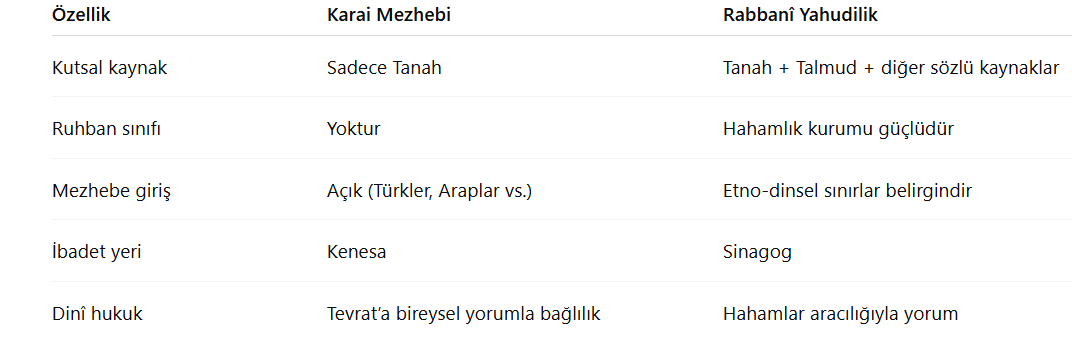
Table illustrating the distinctions between the Karaite sect and Rabbinic Judaism. (Generated by Artificial Intelligence.)
Due to these differences, the Karaite sect has historically been marginalized within the Jewish world while simultaneously finding greater ease in assimilating with Turkic communities.
Today, Karaite belief is sustained only in limited areas due to demographic and cultural factors. The kenesa in Trakai, Lithuania, remains active. The Karay community in Istanbul, though diminished, continues to strive to preserve its traditions. Transmission of the faith today relies as much on oral tradition and ritual practice as on written sources.
Throughout history, the Karay Turks have spread across a wide geographic area, dispersing into different regions due to migrations, political pressures, and religious preferences. Yet in every new settlement, they have consistently worked to preserve both their language and Karaite belief. Today, the Karay Turks primarily reside in Eastern Europe and the Black Sea region.
The emergence and institutionalization of the Karay Turks occurred largely through the Crimean Peninsula. After the fall of the Khazar Khaganate, Karay communities established their own principalities in areas such as Bakhchisaray, Gözleve (Evpatoria), Sudak, Mangup Castle, Çufut Kale, and Kefe (Feodosiya), forming strong local populations.
Çufut Kale, in particular, served for many years as the cultural and religious center of the Karays; the kenesas established there hold a significant place in the collective memory of the Karay community.
Lithuania became not only a refuge but also a new center for the Karay Turks. In the late 14th century, at the invitation of Grand Duke Vytautas, Karays from Crimea were resettled in cities such as Trakai (Troki) and Vilnius, where they served as guards and state officials.
Trakai continues to be one of the living centers of Karay culture. The stone kenesa in the city is one of the rare surviving examples of Karay architecture and remains open for worship. A Karay museum also operates there.
Traces of Karay Turks can be found in Ukraine in Lutsk (Luck) and Halicz (Galicia), and in Poland in Warsaw, Gdańsk, Wrocław, and Opole. These communities historically existed on a smaller scale but managed to sustain their presence through contact with Polish culture.
Following the Ottoman conquest, Karays relocated from Crimea to Istanbul, where they lived primarily in Hasköy, Galata, and surrounding areas from the 15th century onward. The Karays of Istanbul distinguished themselves from other Jewish communities—particularly Rabbinic Jews—through differences in belief and worship, establishing their own places of worship and maintaining their communal structure.
The Karay Turks are a Turkic community of considerable interest from both linguistic and sociolinguistic perspectives. Their language, Karay (Karaim), belongs to the Kipchak branch of Turkic languages. However, the Karays’ historical migration routes, cultural contacts, and religious distinctiveness have created a layered structure that distinguishes this language from other Turkic dialects.
Karay is classified under Kipchak Turkish and retains numerous features from Old Turkic. Although this dialect developed in isolation in Eastern Europe over centuries, it has preserved the fundamental syntax and inflectional system of Turkish.
Karay is divided into three main dialectal regions:
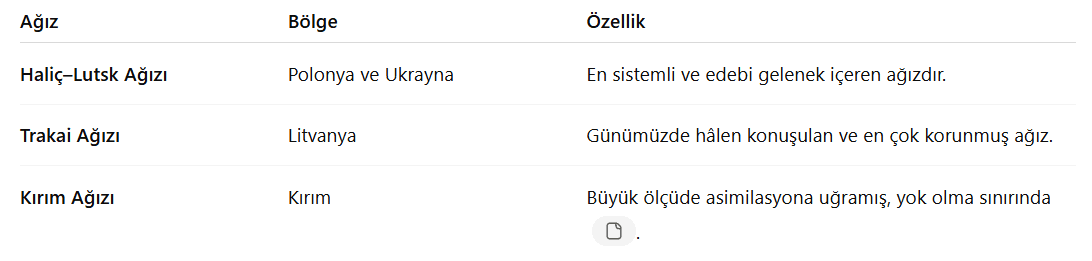
Distribution of Karay by Dialects. (Generated by Artificial Intelligence.)
Karay has borrowed vocabulary and structural elements from multiple languages according to the geographic regions where it is spoken:
Hebrew and Aramaic: Religious terminology (e.g., kenesa, Torah, Shabbat)
Arabic and Persian: Terms originating from madrasa education
Polish, Lithuanian, and Russian: Everyday life, administrative, and technical terms
Nevertheless, Karay preserves the archaic structure of Turkish, particularly in prayer texts and proverbs. In this sense, it serves as an example of both Turkish linguistic history and multilingual contact environments.
The Karays used the Hebrew alphabet for their written language. This makes Karay one of the rare examples of a Turkic language transmitted through a Jewish writing system. Prayers, poems, dictionaries, and prayer books constitute the written records of Karay.
Works compiled by the Karays, such as Kitab-ı Atalar, contain hundreds of proverbs written in Karay Turkish. These works are unique sources both linguistically and in the field of folk literature.
UNESCO and Turkology circles classify Karay as a “language on the verge of extinction.” Academic efforts are underway to preserve the Karay dialect, and cultural protection policies have been implemented in some countries, particularly Lithuania.
The Karay Turks are one of the rare communities that have blended Turkic oral traditions with Jewish religious codes. They have preserved and transmitted their cultural identity to subsequent generations through proverbs, wise sayings, poetry, and written sources such as prayer texts. This cultural structure carries traces of both Turkic heritage and Karaite belief.
Karay written culture has played a vital role in both religious life and education. Its main domains include:
The Karays wrote their language using the Hebrew alphabet, making it one of the rare instances of a Turkic language combined with a Jewish writing system. The majority of texts were written in this script in the form of prayers, wisdom sayings, and commentaries.
Karay oral and written culture is endangered due to its insular community structure and weakening intergenerational transmission. Today, this culture is:
Preserving these traditions is important not only academically but also as a matter of cultural memory.
Karay proverbs combine elements of Turkic national memory with the influence of Karaite belief. These sayings were spoken in Karay Turkish and are often recorded alongside their Turkish equivalents. They serve as essential sources for understanding the Karay worldview, belief system, and perspective on daily life.
Karay proverbs are grouped into four main themes:
In every society, key life transitions—birth, marriage, and death—are shaped by the community’s belief system, value judgments, and collective memory. The Karay Turks possess a ritual world informed by both Turkic transitional customs and Karaite Jewish beliefs.
In Karay belief, a child is seen not only as a source of joy for the family but also as a blessing and pride for the community. Rituals before and after birth blend religious and cultural elements:
Forty-Day Rule: After birth, the mother and infant are not taken outside for forty days and are kept away from strangers. This practice, similar to the Turkish concept of “alkarısı/albası,” stems from the belief in protection from malevolent forces.
Psalm Inscriptions on Walls: After birth, the father has a religious figure write selected passages from David’s Psalms and hangs them on the wall. This is believed to spiritually protect the child.
Naming Ceremony: The naming ceremony for girls takes place in the kenesa on Shabbat (Saturday). For boys, the ceremony is delayed until after circumcision. Since the 20th century, these distinctions have diminished, and naming rituals have become more equal.
Women’s Support Network: After childbirth, women visit the mother with gifts, offering moral support and advice on parenting. This reflects an expression of female solidarity.
In Karay society, marriage is not merely an individual matter but also a collective one. Traditional Turkic family structures merge with Karaite marriage customs in ritual practice:
Endogamous Marriage: Karays generally do not encourage marriage with Rabbinic Jews, Christians, or Muslim Turks. This is aimed at preserving both religious and ethnic identity.
Marriage Age and Process: Young adults become engaged through discussions between families. Passages from the Torah are recited during ceremonies.
Marriage Ceremony: During the Karay wedding, prayers are recited and religious texts are chanted. In some cases, men and women participated in separate areas of the ceremony.
Cultural and Religious Context: The wedding ceremony is not merely a union but also the acceptance of new social responsibilities, imbuing the ritual with sacred significance.
The transition of children into religious and social life is also an important rite:
First Visit to the Kenesa: A child’s first visit to the place of worship is celebrated collectively with communal prayers. This signifies “acceptance into the spiritual community.”
Prayer for Education: A prayer is recited for a child beginning formal education. These prayers are drawn primarily from Karay religious texts, reflecting the belief that the journey of learning begins with a sacred intention.
Death in Karay culture is a transitional process shaped by both the Torah and ancient Turkic conceptions of mortality:
Funeral Preparation: Burials typically occur on the same day. The deceased’s body is prepared simply, avoiding any display or extravagance.
Mourning Period: During mourning, specific foods are not prepared, and daily routines are suspended. Prayers at the grave express submission to God’s judgment.
Commemoration Rituals: Graves are visited on anniversaries and special days. Karay tombstones may bear inscriptions in both Turkish and Hebrew, reflecting the dual nature of their identity.
Alkaya, Ercan. “Dil ve Söz Bağlamında Kırım Karay Türklerinin Atasözleri.” *Fırat Üniversitesi Sosyal Bilimler Enstitüsü Dergisi* 20, no. 1 (2006): 89–99. https://www.academia.edu/45351740/D%C4%B0L_VE_S%C3%96Z_BA%C4%9ELAMINDA_KIRIM_KARAY_T%C3%9CRKLER%C4%B0N%C4%B0N_ATAS%C3%96ZLER%C4%B0_CRIMEAN_KARAY_TURKS_PROVERBS_IN_THE_CONTEXT_OF_LANGUAGE_AND_WORD
Atmaca, Emine. “Karai Mezhebi ve Bu Mezhebi Benimseyen Karay Türkleri.” *Mesos: Disiplinlerarası Ortaçağ Çalışmaları Dergisi* 2 (2020): 57–81. https://dergipark.org.tr/tr/pub/mesos/issue/59239/707664
Atmaca, Emine. “Karay Türklerinde Geçiş Dönemi Ritüeli: Evlilik.” *Millî Folklor* 137 (Spring 2023): 174–185. https://dergipark.org.tr/en/download/article-file/2417759
Koçak, Murat. “Atasözlerine Yansıyan Karay Kimliği.” Paper. International Middle East Congress, Yıldırım Beyazıt University, October 30–31, 2017. https://www.academia.edu/35560795/Atas%C3%B6zlerine_Yans%C4%B1yan_Karay_Kimli%C4%9Fi
Koçak, Murat. “Karay Türkleri ve Dilleri.” *Türkoloji* 1 (2018): 68–76. https://dergipark.org.tr/en/download/article-file/2376617
Koçak, Murat. “Karay Türklerinde ‘Çocuk’ İle İlgili Ritüeller.” *Uluslararası Türk Lehçe Araştırmaları Dergisi* 5, no. 2 (2021): 313–324. https://dergipark.org.tr/tr/pub/turklad/issue/66318/989415
Kuzgun, Şaban. “Karay Türkleri’nin Dünü Bugünü.” In Prof. Dr. Şaban Kuzgun Armağanı, 5: 1–18. Elazığ: Fırat Üniversitesi İlahiyat Fakültesi Yayını, 2000. https://dergipark.org.tr/tr/download/article-file/2313188

Origin(s) | Turk | ||||||||
|---|---|---|---|---|---|---|---|---|---|
Religion(s) | Karai sect Judaism | ||||||||
Regions They Lived in | Crimea, Lithuania, Poland, Ukraine, Türkiye | ||||||||
Language(s) | Karaim (Kipchak Turkish) | ||||||||
Ethonym and Origins
History
The Khazar Khaganate and the Emergence of the Karays
The Fall of the Khazars and the Settlement of the Karays in Crimea
Migration to Lithuania and a New Center: Trakai
The Ottoman Period and the Karays of Istanbul
Belief System: The Karaite Sect
Origins and Meaning of the Sect
Core Beliefs
Interpretation of Karaite Belief Among Karay Turks
Differences from Other Jewish Sects
Current Status of the Faith
Settlement Areas and Demographics
Historical Center: Crimea
Lithuania: Trakai and Vilnius
Scattered Communities in Ukraine and Poland
The Karay Community in Istanbul
Language and Dialectal Features
Classification of Karay
Distribution by Dialects
Linguistic Features and Influences
Written Language and Literary Heritage
Endangered Status of Karay
Oral and Written Culture
Proverbs
Transitional Rituals
Birth Rituals
Marriage Rituals
Childhood and Educational Transitions
Death and Mourning Rituals