This article was automatically translated from the original Turkish version.
Province(s) | Kars | ||||||||
|---|---|---|---|---|---|---|---|---|---|
Type of Geographical İndication | Mahreç İşareti | ||||||||
Application Date | 24 September 2021 | ||||||||
Registration Date | 17 September 2024 | ||||||||
Registration Number | 1640 | ||||||||
Product / Product Group(s) | Cheeses | ||||||||
Kars Gravyer Cheese is a matured (6–12 months) cheese variety produced in the Kars province of Türkiye, particularly around the village of Boğatepe. It features a hard rind and a porous structure. On 24 September 2021, following an application by the Kars Chamber of Commerce and Industry, it was officially registered as a Geographical Indication on 17 September 2024.
The production tradition was initiated in the village of Boğatepe by Swiss settlers as early as 1890 and later continued by the Malakan and Karapapak Turkish communities. The cheese maintains a strong cultural connection to the region, defined by its geographical boundaries and production history. Gravyer cheese holds a significant place in Kars cuisine and contributes to the agricultural economy of the province; its registration supports the institutionalization of its brand value.
Kars Gravyer Cheese was registered on 24 September 2021 and officially granted Geographical Indication status on 17 September 2024 under registration number 1640. The registration was carried out by the Kars Chamber of Commerce and Industry, and the geographical boundary encompasses the entire Kars province.
The designation “Kars Gravyer Cheese” and the Geographical Indication logo must be displayed prominently on the product or its packaging. In cases where packaging is not feasible, this information must be visibly displayed at the production facility. Products made using traditional methods must also include the phrase “Produced by Traditional Method.” Oversight of the product is conducted by a commission of at least three experts from the Kars Municipality and the Provincial Directorate of Agriculture, coordinated by the Kars Chamber of Commerce and Industry, with inspections carried out at least twice annually.
Kars Gravyer Cheese is a matured cheese made from raw or pasteurized cow’s milk obtained from animals grazing on high-altitude pastures above 1800–2000 meters. The milk originates from livestock raised on steppe and alpine meadows within the Kars province. The optimal production period spans from late April to mid-August.
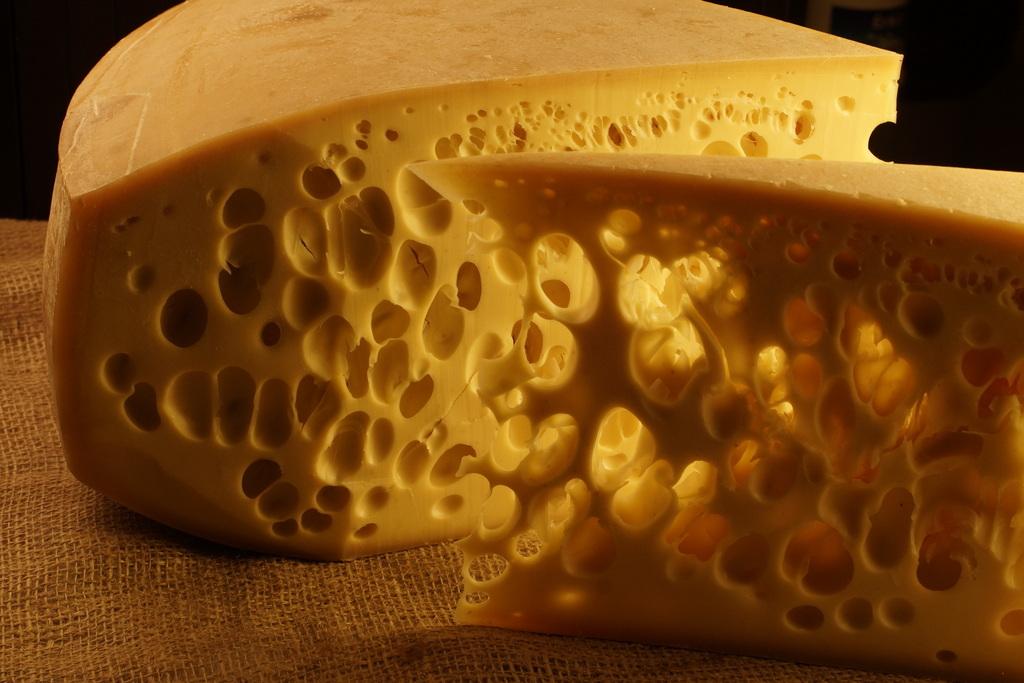
The cheese’s outer rind is hard and homogeneous, with a color ranging from golden yellow to light brown. There are no cracks, swelling, mold growth, or discolorations caused by manufacturing defects. The interior exhibits a color ranging from ivory to light yellow. Cross-sections reveal bright, evenly distributed pores with a maximum diameter of 1 cm; no more than four pores are permitted within a 15×15 cm area.
In terms of taste and aroma, the cheese is mildly salty with a slightly sweet, creamy texture and a pronounced hazelnut-like aroma. Sour, bitter, or yeasty flavors and odors are absent. Morphologically, the cheese is produced in wheel form with a diameter of 55–70 cm, a height of 15–17 cm, and a weight between 55 and 85 kg.
Chemically, Kars Gravyer Cheese contains 23–42% fat, 24–34% protein, and 63–80% dry matter. The salt content ranges from 1–4%, while the fat-free dry matter content is between 35–40%. The ash content of the dry matter is 3.90–6.70%, and the pH level ranges from 5.7 to 6.85. These characteristics reflect the distinctive structure shaped by regional production conditions and differentiate it from similar cheeses.
Both traditional (starter culture-free) and industrial (starter culture-added) methods are employed. In the industrial method, milk is pasteurized (65 °C for 30 minutes) or inoculated with a starter culture (Streptococcus thermophilus, Lactobacillus delbrueckii ssp. lactis, Propionibacterium shermanii) at 31–32 °C. Fermentation lasts 30–35 minutes. After curd formation, rapid heating (53–55 °C) and stirring are performed, followed by draining, salting, and aging.
After salting, the cheeses are dried for 10–14 days, during which their surfaces are regularly wiped and re-salted if necessary. They are then aged for 7–8 weeks in a “warm room” environment maintained at 15–24 °C and 80–83% humidity. This stage is followed by a “cold room” aging phase lasting at least 15 weeks at 10–12 °C. During this period, pore formation and the development of the characteristic aroma are completed. The matured product can be stored for up to one year at +4–6 °C.
In traditional production, no starter culture is used. Fermentation is initiated using yeast derived from previously made Gravyer cheese or a homemade şirden solution. The milk is typically used fresh and heated directly to 37 °C without prior cooling. Approximately 100 mL of şirden solution is added per 100 liters of milk. Fermentation lasts 35–40 minutes. The curd is then cut by hand, heated, drained, pressed, and salted. The aging and storage stages are similar to those in industrial production.
Turk Patent and Trademark Office. "Kars Gravyer Peyniri." *Coğrafi İşaretler Portalı*. Accessed July 30, 2025. https://ci.turkpatent.gov.tr/cografi-isaretler/detay/5064
Turkish Patent and Trademark Office. "Kars Gravyer Peyniri PDF." Coğrafi İşaretler Portalı. Accessed July 30, 2025. https://ci.turkpatent.gov.tr/Files/GeographicalSigns/71c224ad-6406-445f-b9db-a46d1e9f59c4.pdf

Province(s) | Kars | ||||||||
|---|---|---|---|---|---|---|---|---|---|
Type of Geographical İndication | Mahreç İşareti | ||||||||
Application Date | 24 September 2021 | ||||||||
Registration Date | 17 September 2024 | ||||||||
Registration Number | 1640 | ||||||||
Product / Product Group(s) | Cheeses | ||||||||
No Discussion Added Yet
Start discussion for "Kars Gravyer Cheese" article
History and Economic Contribution
Geographical Indication Process
Distinctive Characteristics
Chemical Properties
Production Method