This article was automatically translated from the original Turkish version.
+1 More
Registration Number | 880 | ||||||||
|---|---|---|---|---|---|---|---|---|---|
Registration Date | 03.09.2021 | ||||||||
Application Number | C2021/019 | ||||||||
Application Date | 18.01.2021 | ||||||||
Name of the Geographical Indication | Kemah Natural Resource Salt | ||||||||
Product / Product Group(s) | Source salt / Flavorings and seasonings for food sauces and salt | ||||||||
Type of Geographical Indication | Place of origin | ||||||||
Applicant/Registrant(s) | Kemah District Directorate of Agriculture and Forestry | ||||||||
Address of the Registrant | Çarşı Neighborhood, Kemal Cantürk Street, 2nd Street No:34, Kemah, ERZİNCAN | ||||||||
Geographical Boundary | Kemah District Erzincan Province | ||||||||
Kemah Natural Source Salt is a type of salt produced by evaporating natural saline waters originating from the geological structure of the Munzur Mountains in the Kemah district of Erzincan, registered under its place of origin. This saline water forms as underground waters pass through rock salt deposits and emerge at the surface, where it crystallizes under natural conditions—through sunlight and wind—to become a commercial product.
Kemah Natural Source Salt is a source salt derived from the utilization of natural saline springs arising from the geological structure of the Munzur Mountains in the Kemah district of Erzincan. This product is registered under its place of origin and is produced using traditional methods under the natural conditions specific to its production area. Geographically, only the Kemah district of Erzincan is recognized as the official production zone.
Kemah Natural Source Salt is produced through the evaporation of saline waters originating from rock salt deposits within the Kemah Formation, located over gypsum-rich areas of the Munzur Mountains. The contact of underground waters with rock salt deposits generates saline water that rises to the surface and is subsequently evaporated by solar energy, which are the primary factors in salt formation. The region is surrounded by Karadağ to the north and limestone-based Munzur Mountains to the south, which hinder the movement of moist air masses, thereby enhancing evaporation conditions and supporting crystallization. Low precipitation levels and high temperatures during dry periods further increase evaporation rates and improve production efficiency.
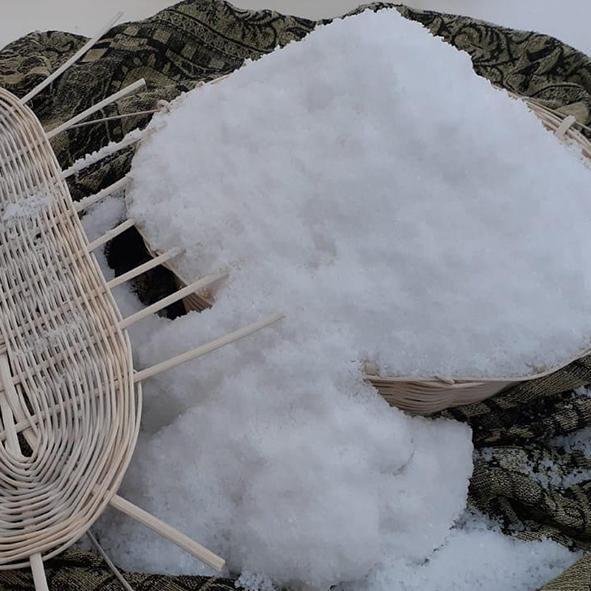
Kemah Natural Source Salt has an amorphous crystalline structure and forms physically as cubic crystals. It is easily crushable and dissolves rapidly in the mouth. It has a sharp salty taste and is odorless. It exhibits a bright appearance and color. Its chemical composition contains approximately 40% sodium (Na) and 60% chlorine (Cl), with moisture content ranging between 1.6% and 2.3%. Its specific gravity measures between 2.1 and 2.35 g/cm³, and its hardness is at a level of 2.5 mg/l. The salinity level (measured in Bomer degrees) varies between 14% and 24%, depending on the flow rate of the source.
The production of Kemah Natural Source Salt is carried out using traditional methods without any chemical additives. The saline water emerging at the surface is first directed into concentration ponds, where its salinity is gradually increased from 28% to 36%. During this stage, potential contaminants such as heavy metals are precipitated and separated. The saline water is then transferred to crystallization ponds constructed from natural clay and stone, where it is evaporated by sunlight and wind. As evaporation progresses, cubic salt crystals begin to form on the water surface and gradually sink to the bottom as they grow. The salt deposited on the pond floor is collected at the edges and left to dry. During the resting period, the salt’s moisture content is reduced to approximately 2%. The final product consists of crystals ranging in size from 1 mm³ to 18 mm³ and is packaged without any grinding process in 5 kg, 10 kg, and 20 kg units. The product is stored under conditions where moisture content does not exceed 5%.
Kemah Natural Source Salt contains no additives. The permissible limits for residual heavy metals in the product are as follows:
These values demonstrate that the product is manufactured under controlled conditions and complies with health and safety standards.
Kemah Natural Source Salt is particularly preferred in the food industry, especially in cheese production and various food processing applications. Its easy solubility and intense flavor profile enhance its value for culinary use.
The production and marketing of Kemah Natural Source Salt are monitored by a four-member oversight committee coordinated by the Kemah District Directorate of Agriculture and Forestry. The committee comprises representatives from the Kemah District Directorate of Agriculture and Forestry, Binali Yıldırım University Kemah Vocational School, Kemah Municipality, and Kemah Forest Management Office. Inspections are conducted at least once annually, primarily between May and October, and at any time of the year if deemed necessary. Inspection criteria include the salinity of the source water, production method, physical characteristics, contaminant levels, packaging conditions, and proper use of the place-of-origin designation.
Kemah Natural Source Salt is presented on its packaging with the designation “Kemah Natural Source Salt” alongside the official place-of-origin emblem, as required by its registered designation. In cases where labeling on the packaging is not feasible, these markings must be visibly displayed at the production site.
Türk Patent ve Marka Kurumu. "Kemah Doğal Kaynak Tuzu." Accessed July 20, 2025. https://ci.turkpatent.gov.tr/cografi-isaretler/detay/3303
Türk Patent ve Marka Kurumu. *Kemah Doğal Kaynak Tuzu. Türk Patent ve Marka Kurumu*. Accessed July 20, 2025. https://ci.turkpatent.gov.tr/Files/GeographicalSigns/c6fdb3b2-6a79-4325-adb7-3688e07f3cc3.pdf

Registration Number | 880 | ||||||||
|---|---|---|---|---|---|---|---|---|---|
Registration Date | 03.09.2021 | ||||||||
Application Number | C2021/019 | ||||||||
Application Date | 18.01.2021 | ||||||||
Name of the Geographical Indication | Kemah Natural Resource Salt | ||||||||
Product / Product Group(s) | Source salt / Flavorings and seasonings for food sauces and salt | ||||||||
Type of Geographical Indication | Place of origin | ||||||||
Applicant/Registrant(s) | Kemah District Directorate of Agriculture and Forestry | ||||||||
Address of the Registrant | Çarşı Neighborhood, Kemal Cantürk Street, 2nd Street No:34, Kemah, ERZİNCAN | ||||||||
Geographical Boundary | Kemah District Erzincan Province | ||||||||
No Discussion Added Yet
Start discussion for "Kemah Natural Resource Salt" article
Origin
Geological and Ecological Characteristics
Physical and Chemical Properties
Production Process
Contaminant Levels
Applications
Monitoring and Control Mechanism
Packaging and Labeling