


This article was automatically translated from the original Turkish version.

Directed by Zeki Ökten in 1976, Kapıcılar Kralı, starring Kemal Sunal, is one of the most well-known apartment comedies in Turkish cinema. The film centers on the daily life of Seyit, the building’s doorman, and his relationships with the other residents. Although a comedy, the production contains significant sociological references to class relations, everyday forms of power, and survival strategies of the lower classes. In this regard, the film offers a rich narrative that can be read through the frameworks of maduniyet and metis.
In the film, the apartment functions as a model of a small-scale society. Seyit is the building’s doorman; he cleans, runs errands, and fulfills various demands of the residents. A clear hierarchical distance exists between Seyit and the residents living on the upper floors. Many characters, beginning with the building manager, occupy positions of control and authority over Seyit.
However, as the narrative progresses, it becomes clear that Seyit is not merely a passive servant. Observing the relationships among the residents and sensing the tensions within them, Seyit occasionally uses this knowledge to gain small advantages. Thus, the power dynamics within the apartment are revealed through humor.
In the film, the apartment functions as a model of a small-scale society. Seyit is the building’s doorman; he cleans, runs errands, and fulfills various demands of the residents. A clear hierarchical distance exists between Seyit and the residents living on the upper floors. Many characters, beginning with the building manager, occupy positions of control and authority over Seyit.
However, as the narrative progresses, it becomes clear that Seyit is not merely a passive servant. Observing the relationships among the residents and sensing the tensions within them, Seyit occasionally uses this knowledge to gain small advantages. Thus, the power dynamics within the apartment are revealed through humor.
The concept of maduniyet refers to social and economic groups positioned at the bottom of the hierarchy who are excluded from direct participation in decision-making processes. Seyit is a quintessential figure of maduniyet. His residence on the ground floor, his economic dependence, and his subordinate position relative to the other residents clearly illustrate this status.
Yet the film also demonstrates that maduniyet is not merely a passive condition. Within the hierarchical structure, Seyit develops various strategies. Here, the concept of metis comes into play.
Metis refers to the practice of operating within the rules of the powerful rather than openly resisting them, instead exploiting gaps and loopholes. It encompasses tactics such as cunning, role-playing, opportunism, and strategic behavior.
Throughout the film, Seyit’s most important power is not physical or economic but knowledge. He closely observes the weaknesses, rivalries, and conflicts among the residents. This knowledge enables him to subtly influence the balance of power.
For example, in one scene, he relays a neighbor’s words to another neighbor with a different tone, creating tension. This demonstrates his ability to manipulate the environment without provoking open conflict.
Similarly, the egg scene in the film is an excellent example of metis in everyday practice. A resident gives Seyit money to buy eggs. Seyit, however, borrows the eggs from another neighbor and gains profit without incurring any cost. This behavior is not direct resistance; rather, it can be read as a small tactic that exploits the system’s trust relationships to his advantage.
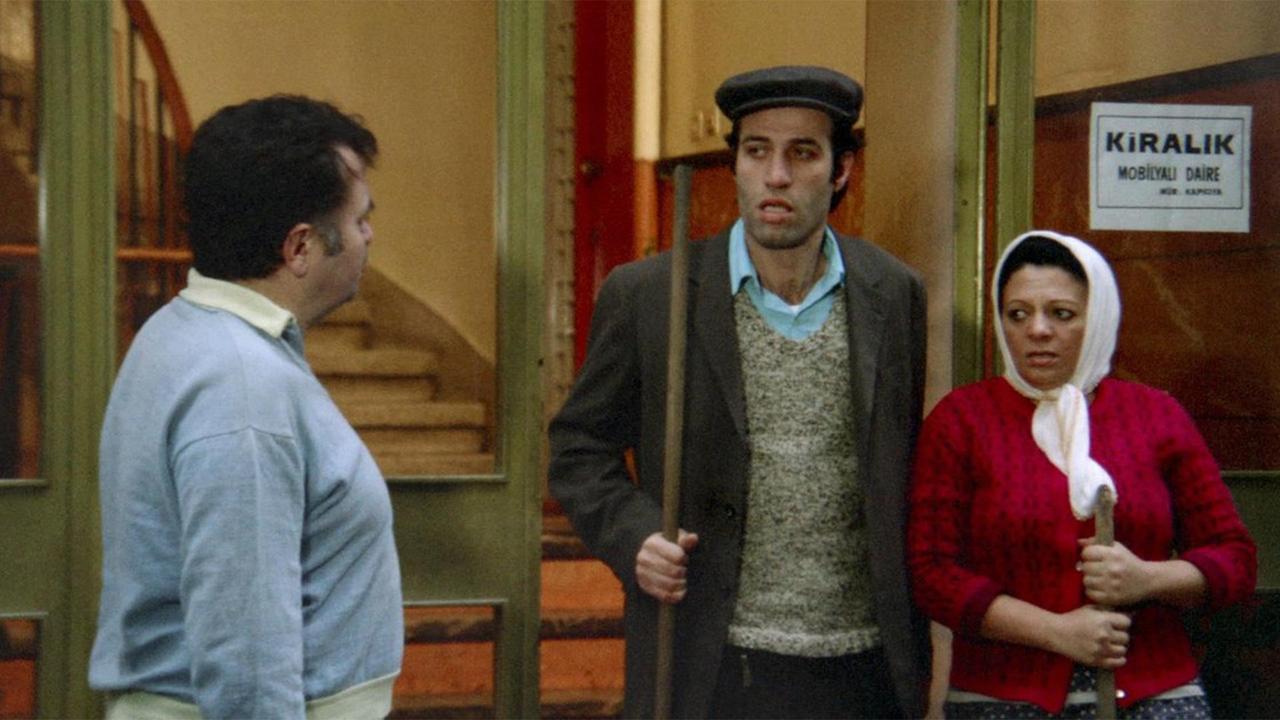
Kapıcılar Kralı (1976). (IMDB)
Likewise, when Seyit gives an alcoholic neighbor fruit juice instead of alcohol while still collecting payment, this illustrates the “simulation” dimension of metis. The appearance of service continues; in reality, a strategic redirection is taking place.
The film can also be interpreted in terms of the debate between structure and agency. Structure places Seyit in a subordinate position: low income, low status, and dependence. Yet through the tactics he develops, Seyit carves out a space for action within this structure.
Seyit is not a character who seeks to dismantle the system; instead, he creates his own domain by exploiting the gaps within it. The film does not romanticize the lower class; Seyit is not an entirely innocent figure. What makes him compelling is his ability, despite his subordinate position, to occupy a strategic place within the network of relationships.
Kapıcılar Kralı demonstrates that maduniyet is not merely about being crushed; it also encompasses the tactical intelligence developed in everyday life. The character of Seyit is neither an open rebel nor a completely submissive figure. He survives by exploiting the gaps within the system. In this sense, the film can be regarded not only as a comedy but also as a powerful sociological narrative that reveals how class relations are shaped through everyday practices.
Erdoğan, Necmi. Devleti İdare Etmek: Maduniyet ve Metis. İstanbul: İletişim Yayınları, 2001. Accessed March 3, 2026.
Giddens, Anthony. The Constitution of Society: Outline of the Theory of Structuration. Berkeley: University of California Press, 1984.
Ökten, Zeki. *Kapıcılar Kralı*. 1976. IMDb. Accessed March 12, 2026. https://www.imdb.com/title/tt0252591/
Ökten, Zeki. *Kapıcılar Kralı*. İstanbul: Arzu Film, 1976. Accessed March 5, 2026. https://www.beyazperde.com/filmler/film-212702/oyuncular/
The Apartment and Class Relations
Maduniyet and Everyday Life
Maduniyet and Everyday Power
Metis: Strategies of Navigation
Structure and Agency
Evaluation