


This article was automatically translated from the original Turkish version.
+2 More
Kitsch is a term used to describe visual or auditory products that are aesthetically inferior, excessively emotional, clichéd, and easily consumable. When evaluated in an artistic context, kitsch encompasses productions that may appear aesthetically appealing but are considered artistically inadequate or artificial. Although its etymology is uncertain, the term is often linked to the German verb kitschen, meaning “to collect trinkets,” or to the English word sketch, meaning “sketch.”

Example of a Kitsch Product (Pexels)
The visibility of kitsch as an artistic concept became prominent in the second half of the 19th century, following the Industrial Revolution, as urbanization accelerated and literacy rates rose. Particularly in Western Europe and America, producers targeting the art market widely created products with low aesthetic quality and high emotional intensity, aiming to make art accessible to broader audiences. According to Clement Greenberg, kitsch refers to consumer-oriented products such as “magazine covers, advertisements, printed books on cheap paper, melodramas, and Hollywood films” that emerged in industrialized Western societies.
However, it has also been argued that the historical origins of kitsch extend beyond industrial society to earlier periods. Kitsch is said to share formal similarities with Mannerist and Baroque art but is more directly associated with the Romantic movement of the 19th century, which emphasized emotional expression. Furthermore, in the postmodern era following modernism, kitsch began to be interpreted as an ironic and critical mode of expression.
Aesthetically, kitsch is generally positioned as ugly or artificial beauty within the tension between “beautiful” and “ugly.” Aesthetic values have always been relative; concepts such as beauty, ugliness, preference, and pleasure have transformed over time and across cultures. In this context, kitsch can be defined as a product of an environment in which aesthetic judgments have weakened, and formal elements are reproduced and consumed independently of content.
Scruton notes that the purpose of kitsch is “to convince the consumer that they are experiencing intense emotion, even though it actually evokes nothing.” In this sense, kitsch functions as an instrument of aesthetic illusion: it does not contain genuine emotional or intellectual depth but instead offers superficial pleasures that require no mental effort or reflection.
Evaluated within Jean Baudrillard’s concept of “hyperreality,” kitsch produces counterfeit representations that imitate reality yet appear more effective than reality itself. In this framework, kitsch has become not only a part of art but also an integral component of social life.
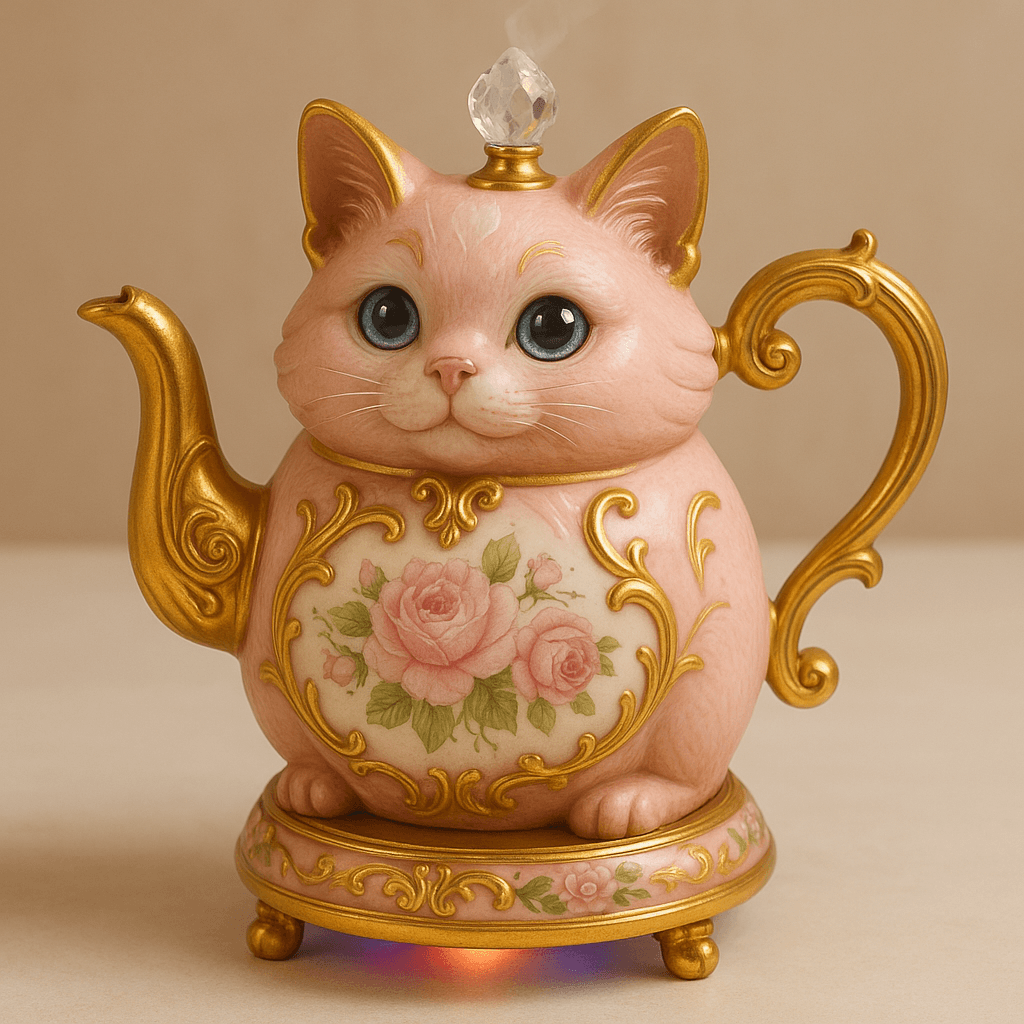
Example of a Kitsch Product (Generated by Artificial Intelligence)
Sociocultural conditions play a decisive role in the formation of kitsch. It is often observed more frequently in societies marked by intense class transitions and cultural uncertainty. In capitalist consumer societies, aesthetic preferences are shaped by mass audiences, and market dynamics guide artistic production. In this context, as art transforms into a tool of entertainment, kitsch becomes a widespread mode of expression.
According to Greenberg’s definition, kitsch is “mechanical and artificial experience driven by formulas.” This structure, dominated by imitative products, clichéd narratives, and easily triggered emotional scenes, is designed for rapid mass consumption. It aims solely to provide aesthetic pleasure without prompting critical reflection.

Example of a Kitsch Product in an Amusement Park (Photo: Zeynep Duvar)
In the 21st century, kitsch is no longer merely a subject of criticism but has become a deliberate mode of expression adopted by some artists. Particularly in contemporary art practices, kitsch elements are employed with the intent of irony, critique, and reinterpretation, thereby challenging the distinction between “high” and “low” art. This has expanded the meaning of kitsch, transforming it into a multilayered structure nourished not only by aesthetic preference but also by conceptual discourse.
Example of aKitsch Ürün in the Playground, photo: Zeynep Duvar, August 2025.
Julio Lopez. “Heykellerle Lüks Antik Altın Saat.” Photograph. *Pexels*. https://www.pexels.com/tr-tr/fotograf/heykellerle-luks-antik-altin-saat-31566172/. Accessed June 22, 2025.
Karagüzel, Rabia, and Gülçin Karaca. “Kitsch ve Estetik.” *SDÜ ART-E Sanat Dergisi* 14, no. 28 (2021): 672–676. https://dergipark.org.tr/tr/pub/sduarte/article/976973. Accessed June 22, 2025.
Mamur, Nuray. “Kitsch Olgusunun Sanat Eğitiminde Estetik Beğeniler Açısından Sorgulanması.” *Mersin Üniversitesi Eğitim Fakültesi Dergisi* 8, no. 3 (2012): 70–79. https://dergipark.org.tr/tr/pub/mersinefd/issue/17381/181489. Accessed June 22, 2025.
Sevgül, Özden. “Ürün Tasarımında Kitsch.” *Mimarlık & Planlama & Tasarımda Araştırma ve Değerlendirmeler-I*. Ankara: Gece Kitaplığı, 2022. Accessed June 22, 2025.

Historical Background and Development
Aesthetic and Theoretical Evaluation
Social and Cultural Dimensions
Contemporary Art and Kitsch