


This article was automatically translated from the original Turkish version.
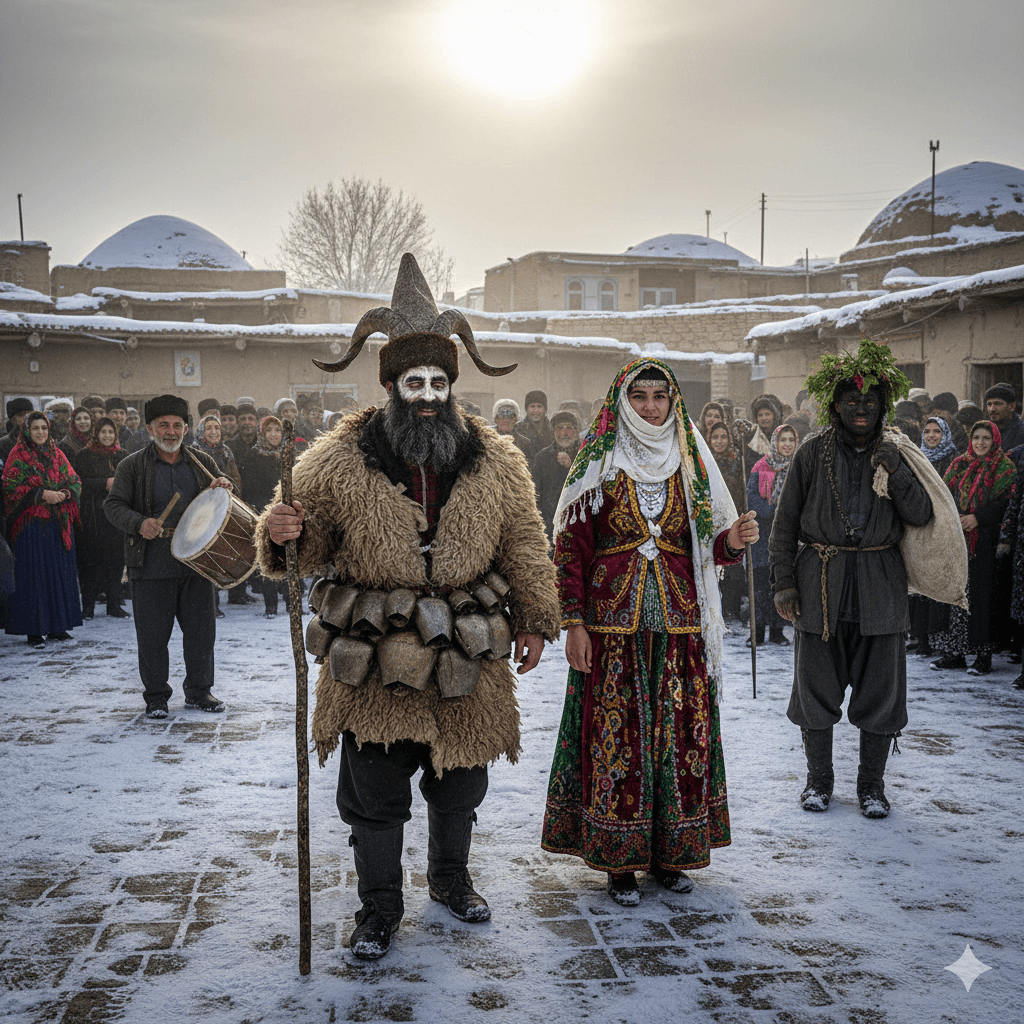
Köse Gelin Oyunu (Bu görsel yapay zeka aracılığıyla oluşturulmuştur)
Köse Gelin Oyunu is a ritualistic village performance performed across the Eastern Anatolian region (Van, Iğdır), primarily in Turkish-populated areas of Iran (South Azerbaijan, Karadagh, Hamadan, Zanjan, etc.), marking the end of winter and the arrival of spring. This dramatic spectacle is typically staged around January 29–30, according to the traditional folk calendar, which marks the beginning of “Küçük Çille.” The performance centers on themes of fertility, proliferation, and nature’s renewal. Particularly among communities engaged in animal husbandry, the play serves to alleviate the economic hardships of shepherds during winter, foster social solidarity, and transmit cultural identity to future generations.
Although the performance is found across a wide geographic area, it is concentrated primarily in two main regions:
In Iranian regions with significant Turkish populations, the play is known by local dialectal names such as “Kosa-Gelli,” “Kosa-Kosa,” or “Kosa-Gelin.” It is widely performed in South Azerbaijan and surrounding areas, including Tabriz, Urmia, Zanjan, Ardabil, and Karadagh. Variants of the play are also found in the Central Provinces and Khorasan regions, among communities in Hamadan, Save, Qazvin, Tafresh, and Khorasan Turks. In settlements such as Milacerd, Serbend, and Hoveyzeh, the ritual character of the performance is preserved.
Within the borders of Türkiye, the play retains its vitality especially in border regions. In Van, villagers perform it during winter months as a traditional winter entertainment, visiting households door to door dressed in traditional costumes and masks. In Iğdır, the play known as “Kosa-Gelin” is considered an inseparable part of the pre-Nowruz celebrations and winter festivities.

Köse Gelin Oyunu (This image was generated by artificial intelligence)
Folk beliefs link the origins of the play to prophetic narratives and natural cycles. According to one legend, the tradition traces back to Prophet Moses; when his sheep gave birth to twins while he was tending them, his father-in-law Shuayb hosted a feast, establishing the core of the tradition as a symbol of abundance.
The timing of the performance is determined by the traditional solar calendar, specifically following the division of winter. It is staged after the 40-day “Büyük Çille,” which begins on December 21, during the harshest phase of winter, around January 30. This period, when animals cannot be grazed and shepherds face income shortages, makes the performance also a pragmatic source of income for the performers.
The Köse Gelin Oyunu is performed by a group of three to six individuals, varying by region.

Köse Gelin Oyunu (This image was generated by artificial intelligence)
The performance begins with the actors going door to door, reciting rhymes and poems such as “Forty days have passed, fifty remain,” announcing the approach of spring. The crowd gathers around Köse and his companions, who enact humorous skits and dramatic roles. The most important moment of the play is the “death and resurrection” motif. According to the script, either Köse or Gelin suddenly falls to the ground and “dies,” symbolizing nature’s winter slumber. When butter or a similar offering is placed on the “dead” character’s lips by the household host, the character “revives.” This rebirth symbolizes nature’s awakening with Nowruz. At the end of the play, Ak Köse and Kara Köse engage in a struggle; Ak Köse’s victory proclaims light overcoming darkness. The collected food is sometimes consumed collectively to strengthen community bonds, or distributed to those in need to fulfill the social function of the ritual.
Anadolu Ajansı. "Van'da Köylülerin Kış Eğlencesi 'Köse Gelin' Geleneği Yaşatılıyor." Accessed March 5, 2026. https://www.aa.com.tr/tr/kultur-sanat/vanda-koylulerin-kis-eglencesi-kose-gelin-gelenegi-yasatiliyor/2537988.
T.C. Ministry of Culture and Tourism Culture Portal. "Kosa-Gelin - Iğdır." Accessed March 5, 2026. https://www.kulturportali.gov.tr/turkiye/igdir/kulturatlasi/kosa-gelin.
Önler, Zafer. "Van’da Kose Oyunu." *Türk Kültürü ve Hacı Bektaş Velî Araştırma Dergisi*, no. 94 (2020): 213–220. Accessed March 5, 2026. https://dergipark.org.tr/en/download/article-file/1150388.
Özdamar, Fazıl. "İran Türklerinde Baharı Muştulayan Bir Köy Seyirlik Oyunu: Köse-Gelin." *Türkiye İran Araştırmaları Dergisi* 2, no. 3 (2023): 26–44. Accessed March 5, 2026. https://d1wqtxts1xzle7.cloudfront.net/97481803/IRAN_TURKLERINDE_BAHARI_MUSTULAYAN-libre.pdf.
Özdamar, Fazıl. "İran Türklerinde Oynanan Köse Gelin Oyunu ve Şiirleri." *Kültür Araştırmaları Dergisi*, no. 13 (2022): 114–129. Accessed March 5, 2026. https://d1wqtxts1xzle7.cloudfront.net/123526754/Iran_Turklerinde_Oynanan_Kose_Gelin_Oyunu_ve_Siirleri-libre.pdf.
Köse Gelin Oyunu (Bu görsel yapay zeka aracılığıyla oluşturulmuştur)
Geographical Spread and Local Variations
Iranian Regions
Eastern Anatolian Region
Origins and Timing of Performance
Characters and Costume Structure
Performance Flow and Symbolic Rituals