


This article was automatically translated from the original Turkish version.
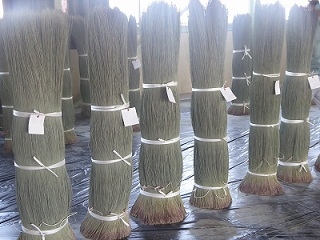
Kumamoto Kensan Igusa (Yapay Zeka ile Oluşturulmuştur.)
Kumamoto Kensan Igusa is a variety of soft rush (a type of reed) cultivated in Kumamoto Prefecture, Japan, and used in the production of traditional tatami (Japanese straw matting). This product is registered as a Geographical Indication (GI). Kumamoto Kensan Igusa represents Japan’s largest rush production region, accounting for approximately 90 percent of the country’s total tatami mat output.
The cultivation of soft rush (igusa) in the Yatsushiro region dates back to ancient times. According to tradition, cultivation was initiated in the 1500s by a local daimyo and was actively promoted under special protection. Until the Meiji Restoration, cultivation remained limited to a few villages. Over time, however, igusa farming evolved into a local industry, spreading to the Uki and Kuma areas surrounding Yatsushiro. By 1970, the Kumamoto region had become Japan’s largest rush-producing area. The product was officially registered and granted Geographical Indication protection on 2 February 2016.
08 Kumamoto Kensan Igusa (YouTube-Geographical Indication Product Information Website)
Kumamoto Kensan Igusa is a soft rush processed using the traditional “mud-dyeing” (dipping) method to produce tatami mats. The inner core of the rush stem contains a white, honeycomb-like structure that imparts moisture-regulating and pollutant-absorbing properties to the final product. High-quality igusa is distinguished by its luster and consistent color tone. Additionally, long-stemmed soft rushes, when woven into tatami surfaces, produce a uniform color appearance. The mud-dyeing process involves immediately after harvest dipping the rushes evenly into a solution of natural soil dissolved in water at an optimal concentration. The mud adhering to the rushes ensures uniform drying and prevents damage to chlorophyll and internal structures, thereby preserving quality.
The production area of Kumamoto Kensan Igusa encompasses Yatsushiro City, Hikawa Town, and Uki City in Kumamoto Prefecture. This paddy field region is supported by the Kuma River flowing into the Yatsushiro Plain and abundant groundwater sources, enabling the largest production volume in the country. The region’s climatic conditions are critical to product quality: temperatures in the paddy fields drop nearly to freezing from January to March during winter and rise again in summer. Furthermore, the contrast between long hours of sunlight in May and shorter daylight hours in June promotes elongation of the rush stems and facilitates the cultivation of high-yield, high-quality rush.

Kumamoto Kensan Igusa (Yapay Zeka ile Oluşturulmuştur.)
No Discussion Added Yet
Start discussion for "Kumamoto Kensan Igusa" article
History
Product Characteristics and Quality
Production Area and Natural Conditions