


This article was automatically translated from the original Turkish version.
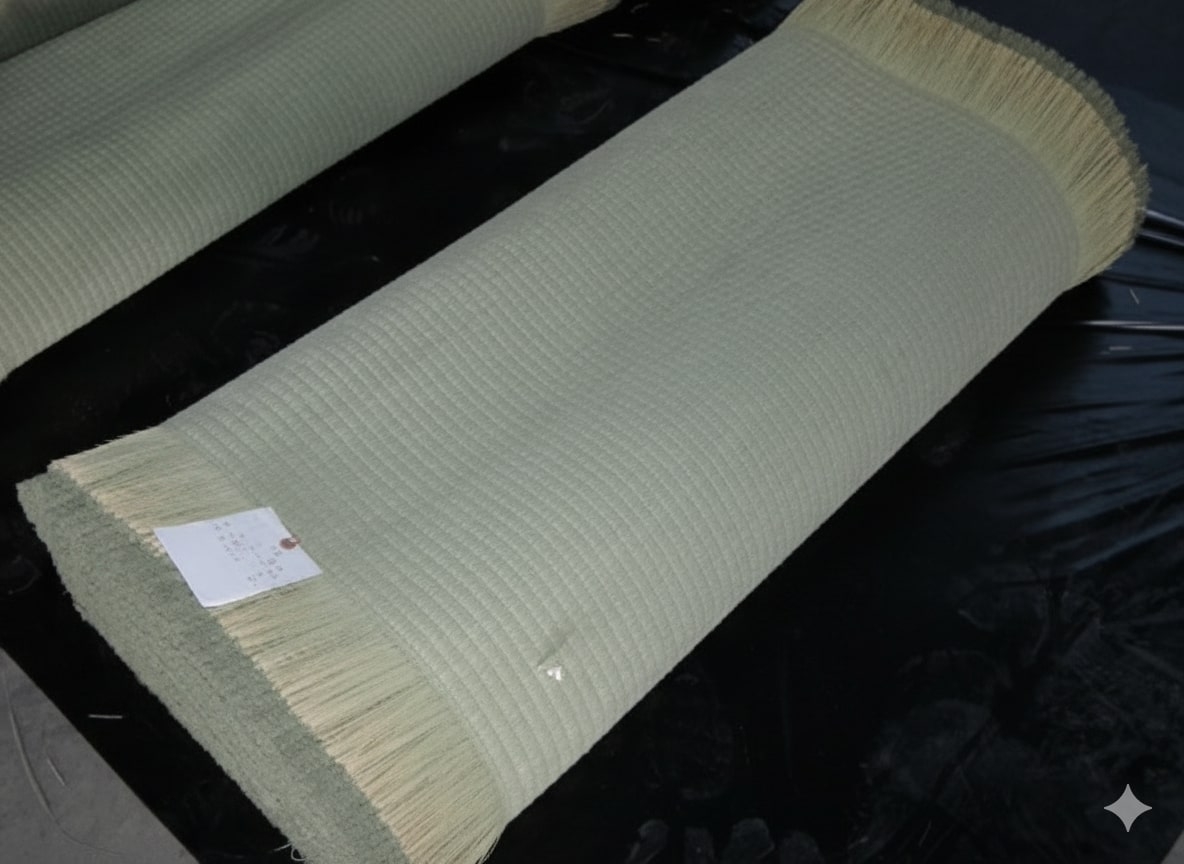
Kumamoto Kensan Igusa Tatami-omote (Yapay Zeka ile Oluşturulmuştur.)
Kumamoto Kensan Igusa Tatami-omote is a tatami surface made from Kumamoto rush (KUMAMOTO-RUSH), processed and woven using the traditional “mud dyeing” method. The white, cotton-like substance inside the soft reeds forms a high-density honeycomb structure with moisture-regulating and pollutant-absorbing properties.
The history of cultivating soft reeds in the Yatsushiro region dates back many centuries. It is said to have begun in the 1500s when a local lord encouraged cultivation on his own lands and promoted its spread under special protection. Although planting remained limited to a few villages until the Meiji Restoration, it gradually evolved into a local industry and expanded to the Uki and Kuma areas surrounding Yatsushiro. By 1970, it had become the largest production area in Japan.【1】
09 Kumamoto Kensan Igusa Tatami-omote (Geographical Indication Product Information Website)
The production area for Kumamoto Kensan Igusa Tatami-omote encompasses Yatsushiro City, Hikawa-cho, and Uki City in Kumamoto Prefecture. Kumamoto Prefecture is recognized as the region of Japan that produces approximately 90 percent of the country’s tatami rush. The climatic conditions in this area are ideal for the growth of this reed. During the winter months from January to March, temperatures drop just below the point at which rice paddies would freeze, then rise again during the summer months. The contrast between the long hours of sunlight in May and the shorter daylight hours in June promotes the elongation of the reed stems, a factor that contributes to the even color and aesthetic quality of the finished tatami surface.
The core traditional process used in production is “mud dyeing,” in which the harvested soft reeds are immediately immersed in water containing moderately concentrated natural soil. This ensures that the mud coats all parts of the reeds, resulting in a uniform luster and consistent color tone. Before weaving, the KUMAMOTO-RUSH-MATS are sorted into four distinct lengths: 97 cm or longer, 110 cm or longer, 120 cm or longer, and 140 cm or longer. Each length is woven separately to produce tatami surfaces with consistent color tones and even texture.
[1]
Information Website on Japan Geographical Indication Products, “Kumamoto Kensan Igusa Tatami-omote”, Information Website on Japan Geographical Indication Products, Son erişim tarihi 24 Ekim 2025, https://pd.jgic.jp/en/register/entry/9.html

Kumamoto Kensan Igusa Tatami-omote (Yapay Zeka ile Oluşturulmuştur.)
No Discussion Added Yet
Start discussion for "Kumamoto Prefecture Igusa Straw Mat Covering" article
History
Production Area and Climate
Traditional Processing Method