


This article was automatically translated from the original Turkish version.
+1 More

Learned Helplessness
Definers | Steven F. Maier Martin E. Seligman | ||||||||
|---|---|---|---|---|---|---|---|---|---|
Defined Year | 1967 | ||||||||
First Experiment | Shock experiments conducted on dogs (Seligman & Maier, 1967) | ||||||||
Neurobiological Basis | It is associated with the prefrontal cortex, amygdala, and serotonin-dopamine imbalances. | ||||||||
Common Outcomes | Indifference Hopelessness Performance decline | ||||||||
Intervention Approaches | Empowering leadership approaches Establishment of supportive social networks Self-efficacy development programs Cognitive behavioral therapy | ||||||||
Learned helplessness is the generalized expectation that an individual develops as a result of repeated negative experiences, believing that their efforts have no effect on outcomes. This expectation leads to multifaceted consequences such as passivity, loss of motivation, and emotional distress. First identified in experiments conducted by Martin Seligman and Steven Maier in 1967, this phenomenon is now recognized as a significant explanatory theory in the development of psychological disorders and social behavioral patterns.
Seligman and colleagues sought to understand how organisms alter their behavior after encountering painful situations they cannot control.
Dogs were divided into three groups:
The dogs in Group 3 developed a learning that control over the situation was absent.
The dogs were then placed in a shuttle box, one side of which delivered electric shocks while the other did not. They could escape the shocks by jumping over a barrier. Dogs from Groups 1 and 2 quickly learned to escape. However, the dogs from Group 3 remained passive despite being able to escape; they made no effort to avoid the shocks.
This behavior demonstrated that they had “learned helplessness” and that this learning influenced their subsequent actions.
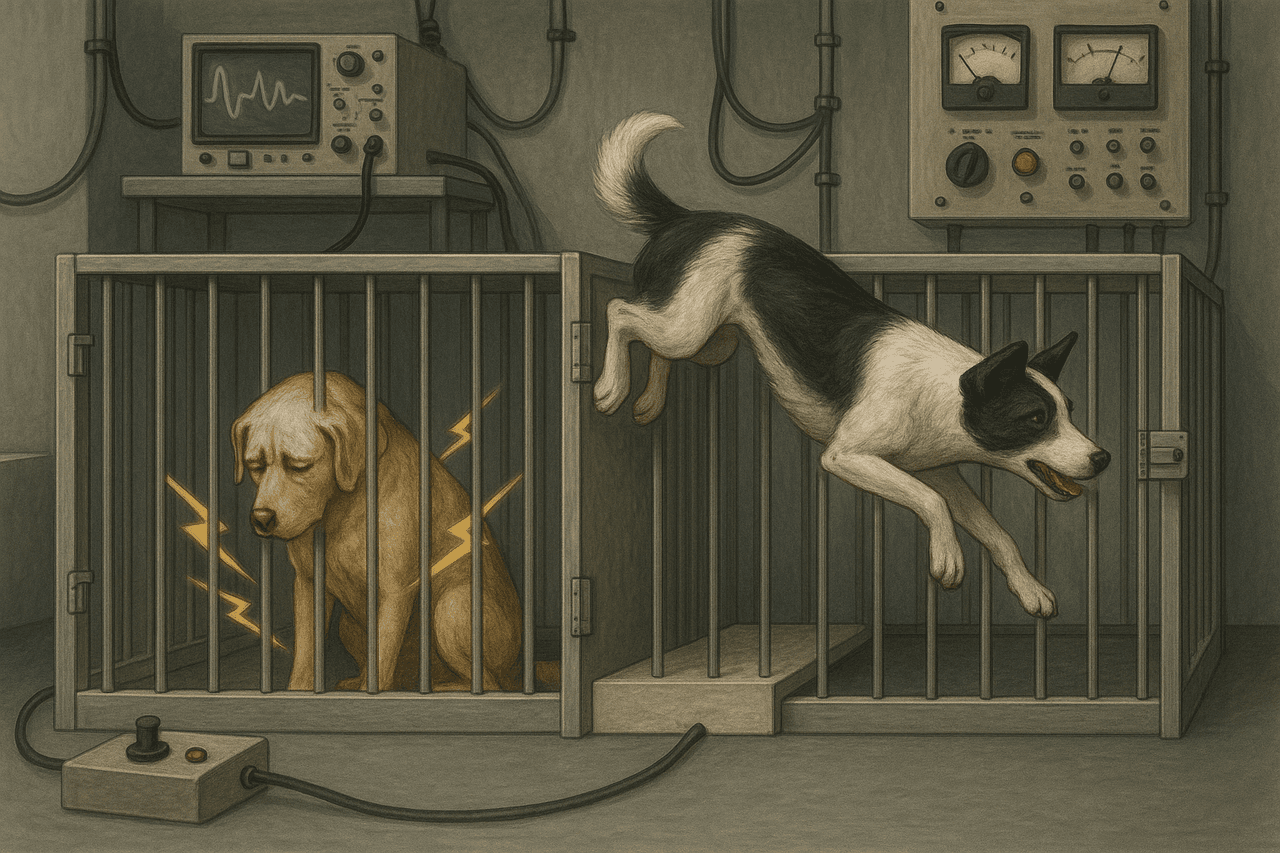
Visual related to Seligman and colleagues’ dog experiments (generated by YZ)
In Seligman and Maier’s classic experiments, animals exposed to inescapable electric shocks remained passive even in environments where escape was possible. These experimental observations formed the foundation of the learned helplessness theory. Over time, the theory has been applied not only in experimental psychology but also in numerous disciplines including education, health, and organizational behavior.
Neurobiological processes associated with learned helplessness include hyperactivation of hypothalamus【1】 – hypothalamic-pituitary-adrenal (HPA) axis【2】 and imbalances in neurotransmitter systems such as serotonin【3】 and dopamine【4】. Research indicates that changes in activation occur in brain regions such as amygdala【5】 and prefrontal cortex【6】 during states of helplessness. These changes negatively affect stress responses and decision-making processes, leading individuals to become passive in the face of environmental stimuli.
Learned helplessness manifests in individuals through loss of motivation, low self-efficacy, chronic stress, depressive symptoms, and avoidance of initiative. It significantly impairs an individual’s ability to plan, make decisions, and solve problems. This condition particularly creates a foundation for reduced performance and burnout in educational and professional settings.

Visual related to learned helplessness (generated by YZ)
Factors that increase susceptibility to learned helplessness include trauma experienced during childhood, chronic stress, low socioeconomic status, lack of a supportive social environment, and internalized failure schemas.
Current research on learned helplessness examines its effects not only in individual psychopathology but also within organizational and societal contexts. Intervention strategies include cognitive behavioral therapy【7】, self-efficacy development programs, the creation of supportive social networks, and empowering leadership approaches.
Aktan, C. C. (2021). *Learned Helplessness and Passive Resistance to Change*. Working Notes Series, no. 2021/1.
Burger, Jerry M. *Kişilik*. Trans. İnan Deniz Erguvan Sarıoğlu. 1st ed. İstanbul: Kaktüs Yayınları, 2006.
Ersever, H. (2005). *Öğrenilmiş Çaresizlik*. Gazi Üniversitesi Eğitim Fakültesi Dergisi, 25(3), 175–189.
[1]
Beyinde, temel yaşam fonksiyonlarını düzenleyen yapıdır.
[2]
HPA ekseni, stres tepkilerini düzenleyen bir sistemdir.
[3]
Mutluluk hormonu olarak bilinir.
[4]
Motivasyon, zevk ve ödülle ilişkilendirilen bir hormondur.
[5]
Beyinde, duygulardan sorumlu bölgedir. Özellikle tepkisel duygular yani; korku, kaygı, öfke gibi duygulardan sorumludur.
[6]
Beynin ön kısmında yer alır ve yüksek düzey bilişsel işlevlerden sorumludur.
[7]
Bireyin olumsuz düşüncelerini ve davranışlarını fark edip bunları daha sağlıklı olanla değiştirmeyi amaçlayan yöntemdir.

Learned Helplessness
Definers | Steven F. Maier Martin E. Seligman | ||||||||
|---|---|---|---|---|---|---|---|---|---|
Defined Year | 1967 | ||||||||
First Experiment | Shock experiments conducted on dogs (Seligman & Maier, 1967) | ||||||||
Neurobiological Basis | It is associated with the prefrontal cortex, amygdala, and serotonin-dopamine imbalances. | ||||||||
Common Outcomes | Indifference Hopelessness Performance decline | ||||||||
Intervention Approaches | Empowering leadership approaches Establishment of supportive social networks Self-efficacy development programs Cognitive behavioral therapy | ||||||||
No Discussion Added Yet
Start discussion for "Learned Helplessness" article
Theoretical Foundations and Historical Development
Seligman’s Experiment (1967) – Experimental Basis
Objective
Experiment 1 – Initial Phase with Dogs
Experiment 2 – Escape Learning
Neurobiological Mechanisms
Symptoms and Behavioral Outcomes
Risk Factors Increasing Susceptibility
Research Agenda and Intervention Recommendations