


This article was automatically translated from the original Turkish version.
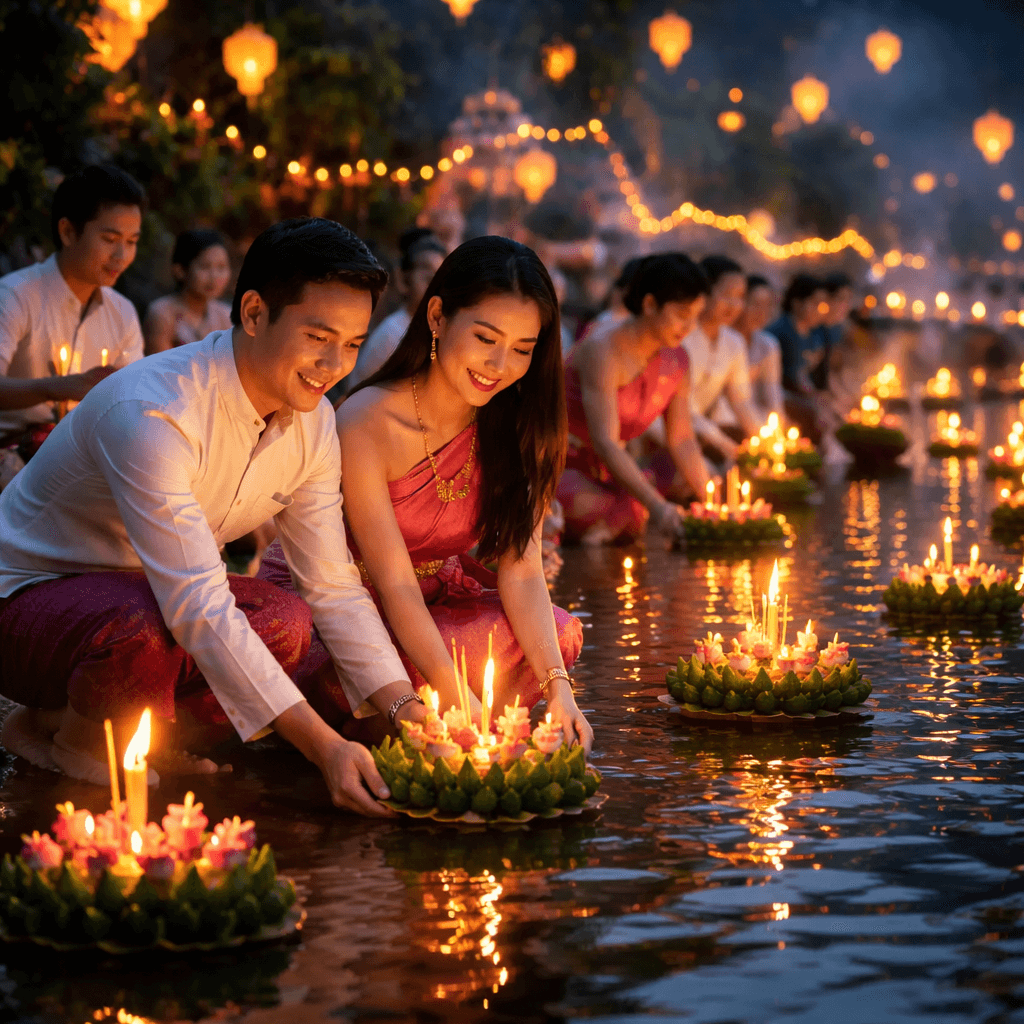
Loy Krathong (Yapay Zeka İle Oluşturulmuştur.)
Loy Krathong is a festival celebrated in Thailand and takes place on the full moon night of the twelfth month according to the Thai lunar calendar. The central practice of the festival involves releasing small floating devices called “krathong” onto rivers, canals, or other bodies of water. Traditionally, krathongs are made from the trunk of a banana tree and banana leaves, adorned with flowers, candles, and incense. Participants make wishes as they release their krathongs into the water.
Loy Krathong (Royal Thai Embassy)
The festival is recognized as one of Thailand’s national festivals and was inscribed in 2011 on the country’s list of intangible cultural heritage under the category of social practices, rituals, traditions, and festivals.【1】 Celebratory practices vary across different regions of Thailand; in some areas, entertainment events and fireworks displays are organized, and people typically gather along river or canal banks to release their krathongs.
There are various interpretations regarding the origins of the Loy Krathong festival. One view links it to a ceremony known in earlier times as “Chong Pa Rieng,” performed within the framework of Brahmanical beliefs.【2】 This ceremony is said to have been dedicated to deities such as Shiva, Vishnu, and Brahma. After Buddhism became established in Thai society, these practices were reinterpreted in Buddhist contexts as acts of reverence toward the Buddha.
Another narrative connects the festival to the Sukhothai period. According to this account, a court lady named Nang Noppamas crafted a krathong in the shape of a lotus flower, which was then released into the water by the king.【3】 The narrative emphasizes the continuation of the practice of releasing a lotus-shaped lantern on the full moon night.
The festival’s origins are also associated with lifestyles dependent on water sources. In regions where agricultural activities rely on water, people release various offerings into water bodies as an expression of gratitude and to invoke abundance.

People Releasing Krathongs into Water (Flickr)
The Loy Krathong festival is celebrated on the full moon night of the twelfth month of the Thai lunar calendar, which typically falls in November. The festival occurs on the full moon night, and releasing krathongs into water constitutes its central practice. Celebrations take various forms across different regions of Thailand. In central areas, festivities often include entertainment performances, shows, and fireworks.
In northeastern Thailand, the festival may be observed at a different time and under a different name. In this region, the celebration is known as the “Illuminated Boat Procession” and is held as part of an event associated with the Buddhist Lent period.【4】 During this practice, communities gather near temples to organize boat races and illuminated boat processions.

Woman Holding a Krathong (Pxhere)

Hand of a Person Lighting a Krathong (Pexels)
The central practice of Loy Krathong is the release of krathongs into water. A krathong is a small device typically constructed from a piece cut from a banana tree trunk, covered with banana leaves, and decorated with flowers, candles, and incense. On the night of the festival, people release their krathongs into rivers, canals, or other bodies of water.
While releasing krathongs, participants express wishes for good fortune or seek forgiveness for polluting the water. The movement of krathongs across the water’s surface is considered a key element of the ritual. During the celebrations, various activities are organized. In some regions, entertainment shows and fireworks displays take place. People commonly gather along water edges to release their krathongs together.
In certain areas, the festivities are linked to religious observances. Practices include cleaning homes, decorating areas around Buddha statues with flowers, and lighting lamps in temples. Rotating lanterns known as “Khom Phat” are crafted and used for decoration, and in some celebrations, sky lanterns are released into the air.

Thai Couple Making a Wish After Lighting a Krathong (Flickr)
The practices associated with Loy Krathong are linked to various beliefs and religious meanings. Releasing krathongs into water is commonly interpreted as an act of reverence and gratitude toward the water goddess. The role of water sources in agriculture, transportation, and daily life forms part of the symbolic interpretation of this practice.
Through the release of krathongs into water, participants express wishes for forgiveness for polluting water sources and for the fulfillment of good intentions. This act is closely associated with showing respect and gratitude toward water bodies.
Some practices are also connected to Buddhist beliefs. The act of releasing krathongs may be interpreted as an offering of respect to the Buddha. In certain northern Thai traditions, releasing krathongs is linked to honoring Arahant Upagupta, believed to reside beneath the water.【5】 During such observances, religious activities are held in temples and various religious narratives are recited.
The Loy Krathong festival serves as an occasion for interaction among families and communities through social and cultural activities. During the festival, family members participate together in making and releasing krathongs. These practices encourage shared activities among family members and sometimes include rituals to honor deceased ancestors.
At the community level, the festival brings people together through various social events and collective activities. Events held during the festival foster interaction among community members. The festival also involves activities related to the production and display of local handicrafts and artisanal products.
The festival is also linked to tourism activities. Water festivals are among the cultural events in Thailand that attract tourist participation. Celebrations during the festival period include activities open to both local and international visitors.
Activities during Loy Krathong can have various environmental impacts. The release of krathongs into rivers and canals contributes to the accumulation of debris on water surfaces. Some materials used in krathong construction may decompose in water and affect water quality. A portion of the released krathongs may accumulate on the water surface, leading to organic decomposition and reduced oxygen levels, which in some cases are associated with negative effects on aquatic life.
During the festival, other types of waste such as plastic bottles and food containers may also be generated. The collection and disposal of these wastes fall under the responsibility of local authorities. In major cities, efforts are undertaken after the festival to collect krathongs from water surfaces, and the number of collected items is reported.
Activities such as fireworks, firecrackers, and sky lanterns during the festival are associated with air pollution. Smoke and particulate matter released during these events have been linked to temporary declines in air quality. Measurements of PM2.5 and PM10 levels during the festival period have been shown to rise compared to normal periods.【6】
As part of environmental management, certain measures aim to reduce environmental impacts. These include using natural materials in krathong construction, collecting krathongs after the festival, and separating waste. Cleanup and waste collection efforts are also conducted in festival areas.
Demidov, Alexey. "Crop Person Burning Candle on Krathong." Pexels. Accessed March 5, 2026. https://www.pexels.com/photo/crop-person-burning-candle-on-krathong-7774126/
Q000024. "Asia woman in Thai dress traditional hold kratong. Loy krathong festival." PxHere. Accessed March 5, 2026. https://pxhere.com/en/photo/1632996
Royal Thai Embassy, Ottawa. “The General Information about ‘Loy Krathong Festival’.” Royal Thai Embassy, Ottawa. (2023): Accessed March 5, 2026. https://ottawa.thaiembassy.org/en/content/the-general-information-about-loy-krathong-festiva?cate=5f069ee272a783584326eaf8&
Saiping, Watcharapong. "Environmental Impacts from Administrative Actions of Local Government Organizations: A Case Study of Loy Krathong Festival." University of Phayao, 2025.
Shedrick, John. "Thai couple saying a prayer before setting their candle-lit krathongs into the river during Loy Krathong." Flickr. Accessed March 5, 2026. https://www.flickr.com/photos/cm_john/8512692046
Shedrick, John. "Thai people setting their candle-lit krathongs in the Ping river at night during Loy Krathong 2015-97." Flickr. Accessed March 5, 2026. https://www.flickr.com/photos/cm_john/22976504319/
Thadaniti, Suwattana. “Learning the Greatness of Mother Nature Festival Tourism: A Case of Loy Krathong Water Festival in Thailand.” SHS Web of Conferences. 12. (2014): 01050. Accessed March 5, 2026. https://www.shs-conferences.org/articles/shsconf/pdf/2014/09/shsconf_4ictr2014_01050.pdf
[1]
Ottawa Royal Thai Embassy, “The General Information About Loy Krathong Festival,” Royal Thai Embassy, Ottawa (2020): Access Date: 12 March 2026, https://ottawa.thaiembassy.org/en/content/the-general-information-about-loy-krathong-festiva?cate=5f069ee272a783584326eaf8&
[2]
Suwattana Thadaniti, “Learning the Greatness of Mother Nature Festival Tourism: A Case of Loy Krathong Water Festival in Thailand,” SHS Web of Conferences 12 (2014): 3. https://www.shs-conferences.org/articles/shsconf/pdf/2014/09/shsconf_4ictr2014_01050.pdf
[3]
Thadaniti, “Learning the Greatness of Mother Nature Festival Tourism: A Case of Loy Krathong Water Festival in Thailand,” 3.
[4]
Royal Thai Embassy, Ottawa. “The General Information About Loy Krathong Festival.” (2020),
[5]
Royal Thai Embassy, Ottawa. “The General Information About Loy Krathong Festival.” (2020),
[6]
Watcharapong Saiping, “Environmental Impacts From Administrative Actions of Local Government Organizations A Case Study of Loy Krathong Festival,” 2.

Loy Krathong (Yapay Zeka İle Oluşturulmuştur.)
Origins and Historical Background
Timing of the Celebration
Krathong and Celebration Practices
Beliefs and Religious Meanings
Social, Cultural, and Economic Dimensions
Environmental Impacts and Environmental Management