


This article was automatically translated from the original Turkish version.
+1 More
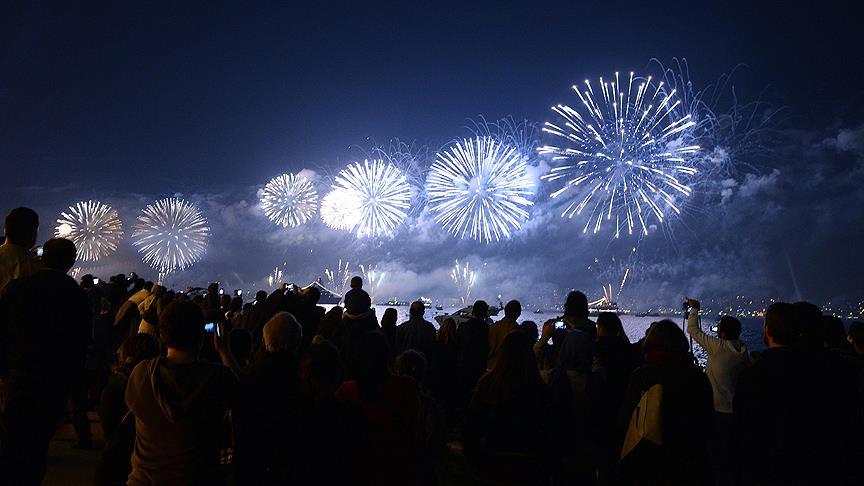
Fireworks
Type(s) | Pyrotechnic product | ||||||||
|---|---|---|---|---|---|---|---|---|---|
Origin(s) | 9th century China | ||||||||
Main Component(s) | Gunpowder oxidizers metal salts | ||||||||
Purpose(s) | Entertainment military display ceremony celebration | ||||||||
Effect Types | Light, color, sound, pattern (flower, ring, star, etc.) | ||||||||
Color Formation | Strontium (red), copper (blue), barium (green), sodium (yellow) | ||||||||
Risks | Hearing loss, burns, stress in animals, environmental pollution | ||||||||
Legal Status | Prohibited in certain areas subject to permits and regulations | ||||||||
Fireworks are pyrotechnic devices typically used for entertainment and celebration, containing gunpowder and various chemical compounds. Their primary function is to create visual and auditory effects, providing an engaging spectacle. This technology, first developed in 9th-century China to ward off evil spirits, is closely linked to the discovery of gunpowder. Over time, it reached Europe and evolved into its modern, elaborate form through advanced chemical formulations developed particularly in Italy. Today, fireworks are used in both military ceremonies and civilian events.
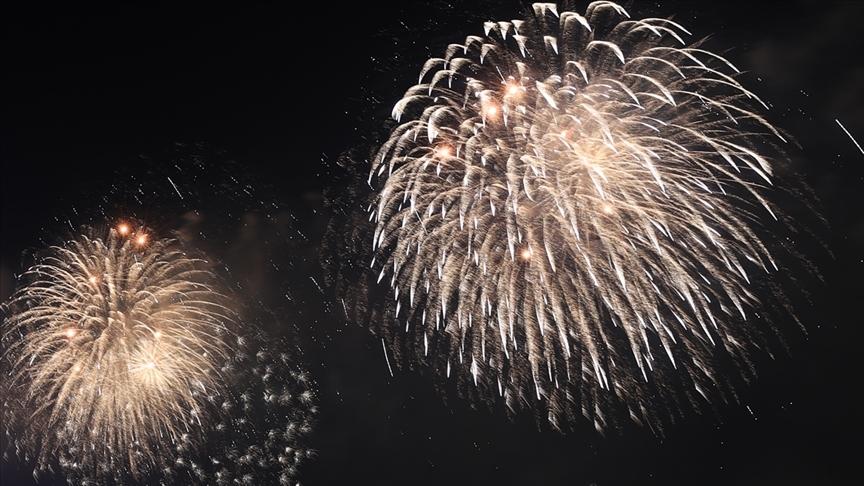
Visual of a fireworks event (AA)
A typical firework consists of an outer shell (capsule), a propellant charge, a time-delay fuse, and effect stars.
When ignited, the firework is propelled upward by the burning propellant. The time-delay fuse triggers the effect stars at the correct altitude, initiating a series of combustion and explosion reactions. This produces striking colors and patterns in the sky.
The colors in fireworks originate from specific wavelengths of light emitted by metallic salts when heated.
These colors result from photon emission caused by electrons transitioning between energy levels when heated. Additionally, metals such as magnesium and aluminum enhance spark intensity and brightness.
The geometric arrangement of effect stars determines the shape produced during detonation. For example:
Auditory effects such as chain explosions or crackling are achieved by adding additional compounds to the stars. These visual effects depend on both physical design and chemical composition.
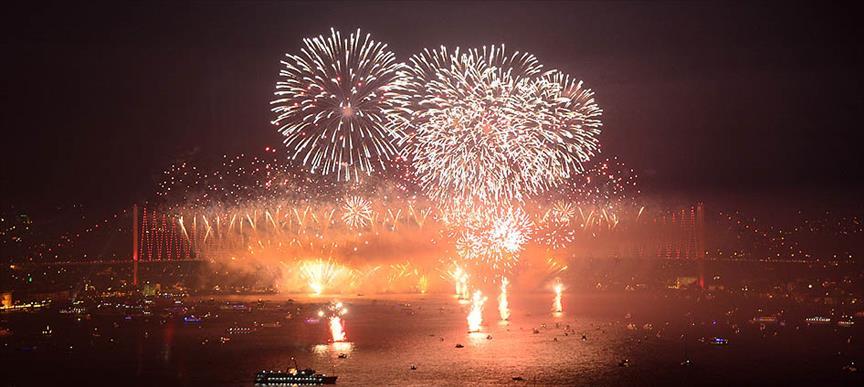
Fireworks display over the Bosphorus during Republic Day celebrations, October 29, 2013 (AA)
Although visually impressive, fireworks pose health risks due to high sound pressure levels and chemical emissions. The sudden, intense noise from explosions can cause hearing loss, tinnitus, increased blood pressure, and anxiety. For individuals with epilepsy, the bright flashes may act as a seizure trigger.
Animals, particularly domestic pets and birds, are highly sensitive to fireworks. The loud noises and sudden light changes can disorient them, induce fear behaviors, and trigger mass flight responses. Nighttime displays can also lead to navigation errors and collisions among birds.
Metallic particles, perchlorates, and other chemicals released during fireworks displays can contaminate soil, water, and air, causing long-term environmental damage. These substances can affect living organisms through inhalation and accumulate with toxic effects over time.
Serious physical injuries occur due to improper use, inadequate safety measures, and illicit manufacturing.
Such incidents increase significantly during peak display periods such as New Year’s Eve and holidays. According to a study published in the Forensic Medicine Bulletin, in Türkiye these injuries are most commonly observed in males aged 15 to 25. Additionally, the illegal use of homemade fireworks presents a serious safety hazard.
In many countries, the sale and use of fireworks are subject to special permits. In Türkiye, these products are classified as Class 1.3 and 1.4 pyrotechnics and fall under the supervision of the Ministry of Interior.
In recent years, growing environmental awareness and animal rights advocacy have led some cities to implement complete bans on fireworks.
As alternatives:
Fireworks are visual and auditory spectacles rooted in ancient history, emerging from the convergence of chemistry and engineering. However, they are no longer viewed solely as entertainment; they have become a subject of debate across multiple domains including public health, environmental protection, animal welfare, and safety. The chemical compounds they contain and the noise levels they generate can harm human health and cause significant stress in animals. Moreover, improper use can lead to severe injuries and environmental pollution. Therefore, evaluating technological alternatives, strengthening regulatory measures, and raising public awareness are essential for adopting a safer and more sustainable approach.
Adli Tıp Bülteni. "Havai Fişek ve El Yapımı Patlayıcı Maddelerin Neden Olduğu Yaralanmalar: Bir Olgu Serisi." Adli Tıp Bülteni 27, no. 1 (2022): 47–51. Accessed May 15, 2025. https://adlitipbulteni.com/index.php/atb/article/view/1087.
Bilim Genç. "Havai Fişekler Nasıl Farklı Şekillerde ve Renklerde Patlar?" TÜBİTAK Bilim Genç. Accessed May 15, 2025. https://bilimgenc.tubitak.gov.tr/makale/havai-fisekler-nasil-farkli-sekillerde-ve-renklerde-patlar.
Penn Today. "The Chemistry behind Fireworks." University of Pennsylvania. Accessed May 15, 2025. https://penntoday.upenn.edu/news/chemistry-behind-fireworks.
Sabit ve Mobil Veri Transfer Teknolojileri ISDN Sistemleri. "06_havaifisek_arastirma." PDF file. Accessed May 15, 2025. https://www.mmo.org.tr/sites/default/files/a362c4caa75f0da_ek.pdf.
Üsküdar University. "Havai Fişekler İnsanlarda ve Hayvanlarda Stresi Artırıyor." Üsküdar Üniversitesi Haberler. Accessed May 15, 2025. https://uskudar.edu.tr/tr/icerik/8750/havai-fisekler-insanlarda-ve-hayvanlarda-stresi-artiriyor.

Fireworks
Type(s) | Pyrotechnic product | ||||||||
|---|---|---|---|---|---|---|---|---|---|
Origin(s) | 9th century China | ||||||||
Main Component(s) | Gunpowder oxidizers metal salts | ||||||||
Purpose(s) | Entertainment military display ceremony celebration | ||||||||
Effect Types | Light, color, sound, pattern (flower, ring, star, etc.) | ||||||||
Color Formation | Strontium (red), copper (blue), barium (green), sodium (yellow) | ||||||||
Risks | Hearing loss, burns, stress in animals, environmental pollution | ||||||||
Legal Status | Prohibited in certain areas subject to permits and regulations | ||||||||
Structure and Working Principle
Chemical Composition and Color Formation
Visual and Shape Effects
Environmental and Biological Impacts
Effects on Human Health
Effects on Animals
Chemical Pollution and the Environment
Forensic Medicine and Injuries
Legal Regulations and Ethical Debates