
This article was automatically translated from the original Turkish version.
+2 More
Foundation | 1921, Taksim | ||||||||
|---|---|---|---|---|---|---|---|---|---|
Founder(s) | Frederick Bruce Thomas | ||||||||
First Closure | 1927 | ||||||||
Relaunch | 28 October 1961 | ||||||||
Relauncher | Fahrettin Aslan | ||||||||
Important Event(s) | Bebek Maxime Fire (1974) | ||||||||
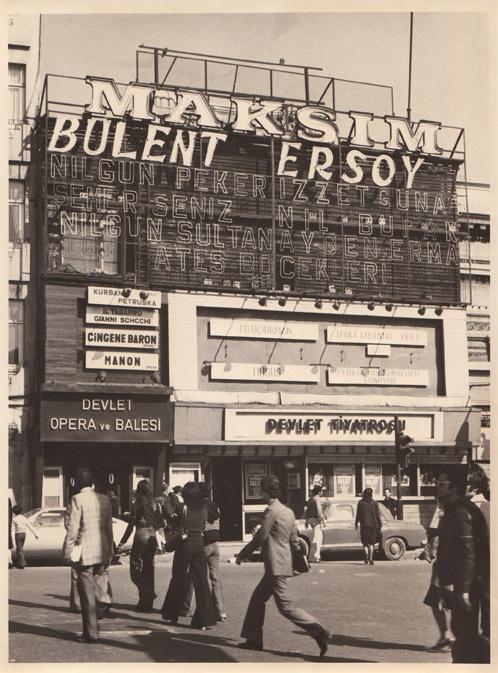
Maksim Gazino is a musical and dance venue established in Istanbul in 1921 that played a decisive role in shaping Turkey’s entertainment culture throughout the 20th century. Its first location was opened in Taksim, and in subsequent years, various branches were established in different districts of Istanbul and other cities. It became the most well-known chain of gazinos in Turkey and served as a cultural center for many years through its musical programs, soloists, fasıl ensembles, cabaret performances, and dance-based entertainment format.
Maksim Gazino was founded by Frederick Bruce Thomas (Fyodor Fyodorovich Tomas), an Afro-American citizen of Russia who migrated to Istanbul after the 1917 Bolshevik Revolution. Having previously operated entertainment venues in Moscow, Thomas sought refuge in Istanbul and in 1919 opened a seasonal dance and music venue called Stella Club in Şişli. In 1921, he transformed this experience into a permanent business by launching Maksim Gazino. The venue was established by renting a large hall located beneath the Majik (Cine Magic) Cinema on Sıraselviler Street.
Thomas’s goal was to introduce Western-style jazz orchestras to Istanbul and to present the fashionable dances of the era—foxtrot, shimmy, and charleston—as part of a cohesive program. The first Maksim Gazino employed musicians brought from Russia, France, and the United States and adopted the concept of a nightclub where dancing was central. For this reason, the venue was advertised in contemporary publications as “dancing”.
Following financial difficulties, the business weakened after 1927, and Thomas died in 1928 in Sultanahmet Prison.
On 28 October 1961, Maksim Gazino was reopened by Fahrettin Aslan, laying the foundation for a modern gazino chain. From this period onward, the name Maksim became synonymous with gazino entrepreneurship in Turkey.
Between 1961 and 2000, the following branches were established:
The first branch in Taksim was later converted into the Swiss de Bosphorus Hotel.
The Bebek Maksim Gazino closed after a fire in 1974. The Caddebostan Maksim Gazino building was converted into a supermarket after its closure in 1997. The Maksim chain operated until the 2000s and continues to live on in Turkey’s cultural memory as a symbolic element of its entertainment history.
Maksim Gazino hosted many of the most renowned soloists and vocalists of Turkish music history, including:
Some artists, such as Münir Nureddin Selçuk, performed only on special nights.
The venues presented fasıl ensembles, jazz orchestras, dance groups, and comedy-cabaret performances together. This diversity transformed Maksim into a multi-layered center of stage culture. Instruments from both Turkish and Western music traditions were used side by side, including violin, clarinet, ney, ud, tanbur, kanun, darbuka, tef, bendir, cümbüş, and electric bağlama. The original Maksim was decorated according to Russian aesthetic principles and featured a dance floor, stage, and American-style bar, making it a modern entertainment space for its time.
White Russians who arrived in Istanbul after the 1917 Bolshevik Revolution played a decisive role in shaping the city’s entertainment life, influencing cabaret and dance culture, café and restaurant customs, and the modernization of collective entertainment venues. Maksim Gazino is one of the most visible symbols of this cultural transfer.
Maksim Gazino:
It became a “cultural continuum” where the 1920s nightclub format merged with the soloist-centered gazino tradition of 1960–2000.
In the Caddebostan Maksim example, programs generally followed this structure:
Family matinees were held on Sundays, and women’s matinees on Wednesdays. Caddebostan Maksim had a capacity of approximately 300 people and was recognized as a high-standard entertainment venue offering meals, service, and stage performances.
Altuncu, Damla. "1917 Bolşevik Devrimi Sonrasında İstanbul’a Göç Eden Beyaz Rusların Eğlence Kültürüne Etkileri: Maksim Gazinosu." *Sosyologca* 23 (2022): 59-67. Accessed December 9, 2025. https://sosyologca.org/files/sosyologca/929409fc-4aed-4bc9-8edc-9e6b49f91d33.pdf
Ceylan, Feyza. "Eğlence Kavramının İstanbul’da Geçirdiği Değişim Süreci ve Mekana Etkisi." Master's thesis, Istanbul Technical University Institute of Science and Technology, 2004. Accessed December 9, 2025. https://tez.yok.gov.tr/UlusalTezMerkezi/tezDetay.jsp?id=AzMzDLg2q1dIVMbqpVoStg&no=F0SZMJLfT_TAekTsMAXbfg
Ersoy Çak, Şeyma. "Maksim Gazinosu." Türkiye Turizm Ansiklopedisi. 2019. Accessed December 9, 2025. https://turkiyeturizmansiklopedisi.com/maksim-gazinosu?ya_src=serp300
Salt Research. "Maxim Night Club, İstanbul." Flickr. Accessed December 9, 2025. https://www.flickr.com/photos/saltonline/12966915284/

Foundation | 1921, Taksim | ||||||||
|---|---|---|---|---|---|---|---|---|---|
Founder(s) | Frederick Bruce Thomas | ||||||||
First Closure | 1927 | ||||||||
Relaunch | 28 October 1961 | ||||||||
Relauncher | Fahrettin Aslan | ||||||||
Important Event(s) | Bebek Maxime Fire (1974) | ||||||||
History
Frederick Bruce Thomas Era (1921–1927)
Fahrettin Aslan Era (1961–2000)
Branches
Closure
Artists on Stage
Spatial and Cultural Features
Program Flow and Entertainment Format