

This article was automatically translated from the original Turkish version.
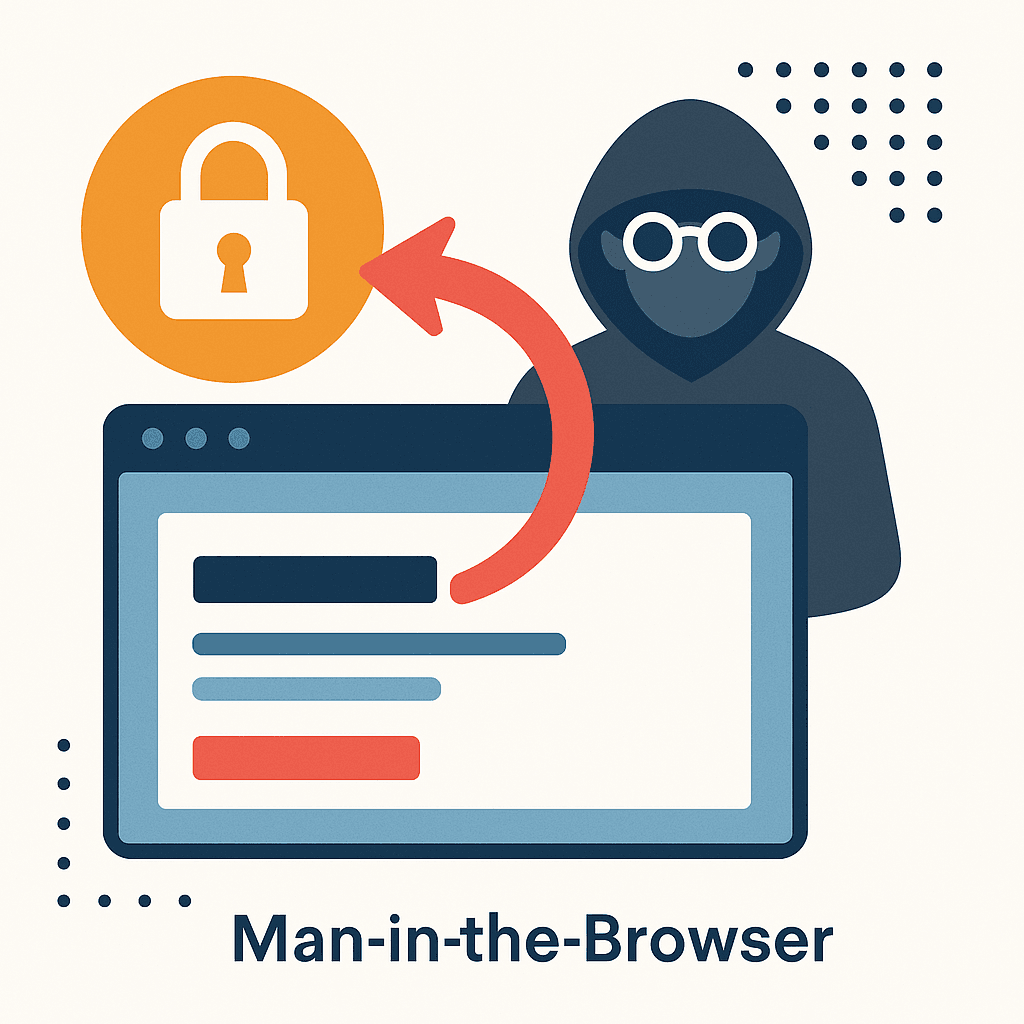
Cybersecurity, digital has become one of the most critical areas of the era. With the increasing digitization of together, issues such as protection of personal data, security of financial transactions, and corporate data integrity have gained greater importance. In this context, cyberattacks have also become more complex and sophisticated. One such type of attack, Man-in-the-Browser (MitB), is less visible but equally dangerous compared to others.
The Man-in-the-Browser (MitB) attack is based on the principle of modifying communication between the user and the internet service provider through malicious software (a Trojan horse) that has infiltrated the user’s browser. These attacks typically occur during sensitive operations such as accessing accounts. The attacker alters transaction details without the user noticing any anomaly, producing results that serve their own purpose. The success of the attack depends on the user’s belief that their session and browser are legitimate. MitB attacks are carried out via Trojan horses integrated into the browser, enabling these malicious programs to monitor and manipulate users’ online activities in real time.
Man-in-the-Middle (MitM) attacks and Man-in-the-Browser (MitB) attacks are often confused. In MitM attacks, the attacker intercepts or alters data flow between two side, typically at the network level. In MitB attacks, however, the attack occurs at the browser level. Malicious software infects the user’s browser and directly modifies operations performed during the session within the browser itself. As a result, network encryption protocols such as SSL/TLS become ineffective. MitB attacks can alter web pages or transaction content without the user or server noticing, exploiting security vulnerabilities within the browser.
MitB attacks usually begin with a phishing email or a download containing malicious software. Once the malicious software infects the user’s device, it integrates with the browser and begins monitoring the user’s activities as if they were shadow. For example, when a user intends to transfer 1000 TL to their bank account, the Trojan can silently redirect the transaction in the background to 5000 TL and a different account. Meanwhile, the user still sees on their screen that only 1000 TL was transferred. This demonstrates how insidious the attack is. MitB attacks are executed by exploiting browser features such as browser extensions, user scripts, or ActiveX controls.
Zeus, SpyEye, and Tinba are malicious software commonly used in MitB attacks. The Zeus Trojan, between 2007 and 2010, caused significant financial damage by stealing the information of thousands of bank customers. SpyEye copied Zeus’s functionalities and was used in next-generation banking attacks. Tinba, due to its small size and ability to appear harmless, could evade detection by many antivirus software. Zeus is a MitB attack designed to steal online banking credentials and carry out unauthorized money transfers.
MitB attacks primarily threaten the banking sector, e-trade systems, corporate portals, and authentication systems. Online banking systems are especially vulnerable to intrusions that occur while the user session is active. These attacks can bypass two-factor authentication systems and cause severe financial losses. MitB attacks can alter web pages or transaction content without the user or server noticing, exploiting security vulnerabilities within the browser.
MitB attacks are among the most difficult to detect. Most do not produce any anomalies in network traffic, and everything appears normal within the browser. As a result, users remain unaware of the attack. Behavior-based analysis systems can detect these attacks by analyzing unusual activities performed within the browser. However, such systems are both complex and expensive. MitB attacks are specifically designed to evade traditional antivirus software, making them harder to detect.
The most fundamental ways to protect against MitB attacks include using up-to-date antivirus software, avoiding software downloads from unknown sources, and adopting multi-factor authentication place. Additionally, browser isolation, virtual keyboard usage, and confirmation of transactions via mobile devices are recommended security measures.
Advanced security solutions include hardware-based authentication devices, digital signatures, browser security modules (Secure Execution Environments), and transaction verification protocols. In applications requiring high security such as banking, these layered solutions play a critical role.
“The most effective defense against MitB attacks is the adoption of multi-layered security policies and the provision of secure transaction environments.” (Entrust, 2014)
Recent academic research has developed various methods to detect and prevent MitB attacks. Among these, systems such as DOMtegrity lead the way. DOMtegrity continuously monitors the DOM (Document Object Model) structure to detect client-side browser manipulation and checks for unauthorized changes on page. Similarly, artificial intelligence and machine learning-based behavioral analysis systems can detect deviations in user interactions and predict possible attacks before they occur. These systems have the potential to identify patterns that traditional antivirus programs fail to detect.
“Behavioral analysis systems supported by machine learning offer a promising approach for detecting MitB attacks.” (SCSU Master’s Theses, 2015)
Corporate-level measures should be more comprehensive than individual solutions. These measures may include:
These measures can also be effective against other browser-based attacks, phishing, and malware infections.
Arxiv.org. (2019). *DOMtegrity: Ensuring Web Page Integrity against Malicious Browser Extensions.* Accessed Adresi.
Entrust Inc. (2014). *Man-in-the-Browser Attacks: The hidden threat*. Accessed Adresi.
Natheir, S. (2015). *Man-in-the-browser attacks*. Master's thesis, St. Cloud State University. Accessed Adresi.
Techtarget. (n.d.). *Man-in-the-browser (MitB)*. Accessed March 30, 2025. Accessed Adresi.
Zhu, S., Setia, S., & Jajodia, S. (2006). LEAP+: Efficient security mechanisms for large-scale distributed sensor networks. ACM Transactions on Sensor Networks (TOSN), 2(4), 500–528. Accessed Adresi.

No Discussion Added Yet
Start discussion for "Man-in-the-Browser (MitB) Attacks" article
MitB Attack
Difference Between MitM and MitB
Attack Mechanism
Real Examples
Threat Areas
Detection Challenges
Protection Methods
Academic Approaches
Corporate Measures