This article was automatically translated from the original Turkish version.
Scientific Name(s) | Manihot esculenta Crantz | ||||||||
|---|---|---|---|---|---|---|---|---|---|
Family | Euphorbiaceae (Sütleğengiller) | ||||||||
Plant Type | Perennial, tuberous plant with a shrub form | ||||||||
Distribution Area | Tropical and subtropical regions – Africa, Asia, Latin America | ||||||||
Cassava (Manihot esculenta Crantz) is a tuberous plant from the Euphorbiaceae family, rich in starch. Its native homeland is the western-central regions of South America, and it is believed to have been domesticated approximately 10,000 years ago. This plant, which thrives in tropical and subtropical regions, serves as a staple food for millions of people worldwide.
Today, cassava is primarily cultivated in Africa, Asia and Latin America, and is regarded as a “food security crop” due to its high carbohydrate content. In Türkiye, it has recently been the subject of research as an energy crop and food alternative.

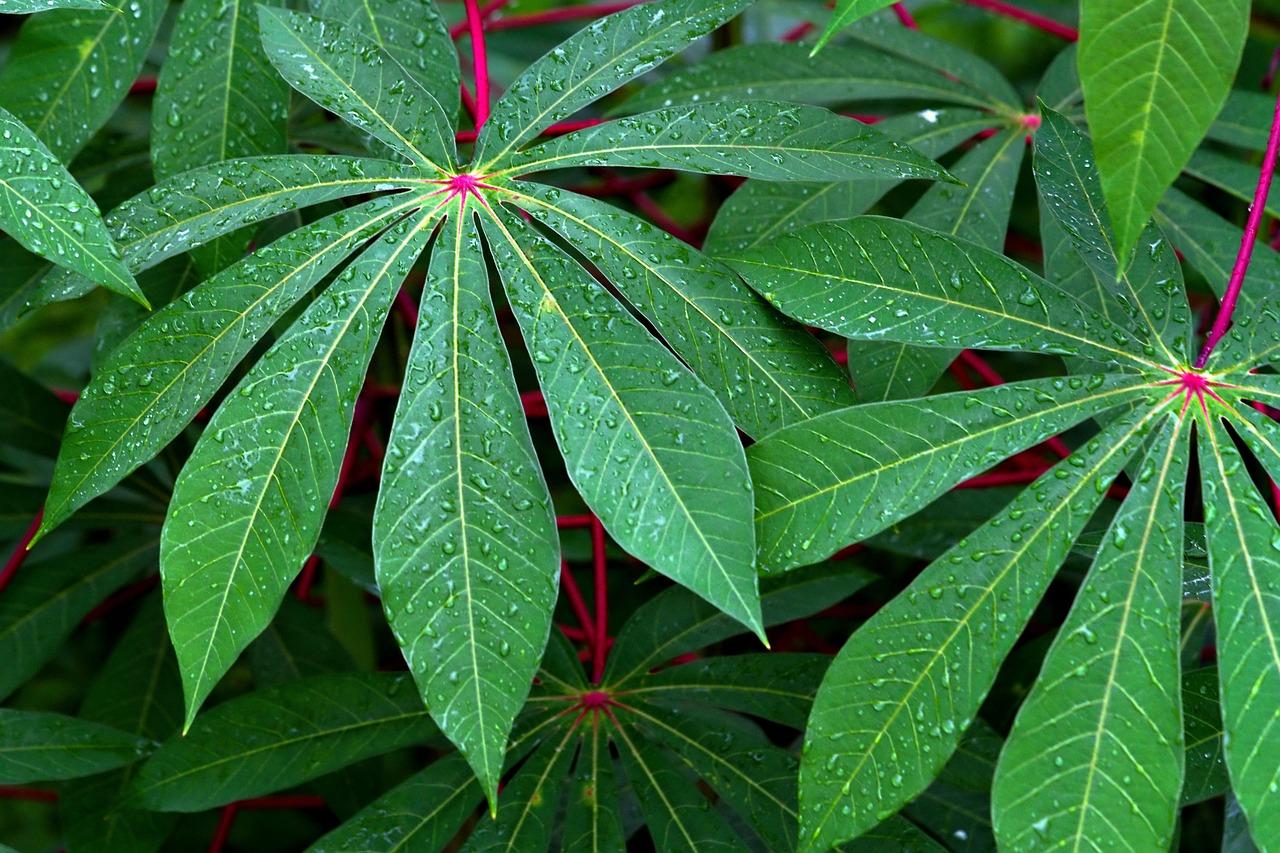
Cassava (Pixabay)
Cassava is a perennial, semi-woody shrub that can grow 1–3 metres tall. Its palmate leaves are divided into five to nine lobes. The tubers are cylindrical, covered externally by a brown skin and internally white or cream-coloured. The dry matter content of the roots ranges between 30–40 percent, approximately 90 percent of which consists of starch and sugars. The plant is highly rich in starch, with the energy value of dried roots reaching 3500–4000 kcal/kg. Cassava tubers are used both as human food and as industrial raw material. Starch granules are particularly valuable in the food, textile, paper and biofuel industries.
Cassava exhibits high adaptability to tropical climatic conditions.
Due to its drought tolerance, cassava can grow in areas with low rainfall and nutrient-poor soils. It is cultivated between 30° North and 30° South latitudes.
Türkiye’s climatic conditions show limited suitability, particularly in the Mediterranean, Aegean and Southeastern Anatolia Regions. In these areas, summer temperatures reaching 25–35 °C, high annual sunshine duration, and relatively light soil structure enable trial production. However, since cassava is sensitive to frost, outdoor cultivation is risky in regions where winter temperatures fall below 10 °C. Therefore, controlled cultivation in greenhouses or microclimate zones is recommended.
Cassava is propagated vegetatively using stem cuttings.
The harvest period varies between 8–12 months. Since tubers are stored underground, they can remain in the soil for extended periods when needed.
Cassava tubers contain high levels of starch. One hundred grams of fresh cassava root provides approximately 160–170 kcal of energy. It also contains small amounts of calcium, phosphorus, iron and vitamin C.
Cassava varieties are divided into two types: sweet and bitter. The difference lies in the levels of hydrogen cyanide (HCN) in the roots.
To reduce toxicity, processes such as boiling, soaking and drying must be applied. In Türkiye, cyanide concentration limits for imported or processed cassava products are regulated under the Turkish Food Codex.
Cassava is cultivated in over 100 countries worldwide and has an annual production volume of approximately 300 million tons. According to 2015 data, it was grown on 22.7 million hectares. In Africa, it is a staple food, while in Asian countries it serves primarily as an industrial raw material. In Türkiye, it is being evaluated as an alternative energy crop within the framework of agricultural innovation and climate-resilient product research, with potential contributions to rural development programs.

The “Cassava Stick,” a staple food in Africa, is commonly used in traditional dishes in countries such as Cameroon, Nigeria and Ghana (
Cassava (Manihot esculenta Crantz) is a strategically important plant both agriculturally and industrially due to its high starch content, climatic flexibility, low maintenance requirements and versatile applications. Although commercial production has not yet been established in Türkiye, it is regarded as a resilient, energy-efficient and sustainable alternative in the face of climate change and drought. With appropriate policy support and adaptation programs, it is emerging as a new crop with potential to enhance Türkiye’s agricultural diversity.
Warning: The content presented here is intended solely for general encyclopedic information. This information must not be used for diagnosis, treatment or medical advice. Before making any decisions regarding health matters, you must consult a physician or qualified healthcare professional. The author and KÜRE Encyclopedia assume no responsibility for any consequences arising from the use of this information for diagnostic or therapeutic purposes.
Anadolu Ajansı. “Kamerun’da Temel Gıda Maddesi ‘Manyok Çubuğu’ Asırlardır Sofraların Vazgeçilmezi.” Anadolu Ajansı, November 10, 2023. Accessed November 15, 2025. https://www.aa.com.tr/tr/dunya/kamerunda-temel-gida-maddesi-manyok-cubugu-asirlardir-sofralarin-vazgecilmezi/3049733
Kızıl Aydemir, Serap, Yeter Çilesiz, Muhammad Azhar Nadeem, and Tolga Karaköy. “Enerji Bitkisi Manyok’ın (Manihotes culenta Crantz) Önemi ve Yetiştirilemesi.” Uluslararası Anadolu Ziraat Mühendisliği Bilimleri Dergisi 1, no. 5 (2019): 121–125. Accessed November 15, 2025. https://dergipark.org.tr/tr/pub/uazimder/issue/51011/666197
Pixabay. "Yapraklar, Manyok, Tapyoka, Kökü, Doğa." Photograph, 2024. Accessed November 15, 2025. https://pixabay.com/tr/photos/yapraklar-manyok-tapyoka-kökü-doğa-7890110/
Sike-Ezo, Okeoghene. “Manyok Bitkisinin İklim ve Toprak Gereksinimleri.” Wikifarmer Kütüphanesi, 2024. Accessed November 15, 2025. https://wikifarmer.com/library/tr/article/manyok-bitkisinin-iklim-ve-toprak-gereksinimleri
Sike-Ezo, Okeoghene. “Manyok Çoğaltımı ve Ekimi.” Wikifarmer Kütüphanesi, 2024. Accessed November 15, 2025. https://wikifarmer.com/library/tr/article/manyok-cogaltimi-ve-ekimi
Sike-Ezo, Okeoghene. “Manyok: Tarihçesi, Besin Değerleri ve Bitki Hakkında Bilgiler.” Wikifarmer Kütüphanesi, 2024. Accessed November 15, 2025. https://wikifarmer.com/library/tr/article/manyok-tarihcesi-besin-degerleri-ve-bitki-hakkinda-bilgiler

Scientific Name(s) | Manihot esculenta Crantz | ||||||||
|---|---|---|---|---|---|---|---|---|---|
Family | Euphorbiaceae (Sütleğengiller) | ||||||||
Plant Type | Perennial, tuberous plant with a shrub form | ||||||||
Distribution Area | Tropical and subtropical regions – Africa, Asia, Latin America | ||||||||
No Discussion Added Yet
Start discussion for "Manioc (Manihot esculenta Crantz)" article
Morphological Characteristics
Ecological Characteristics and Cultivation Conditions
Adaptability under Türkiye Conditions
Propagation and Planting
Nutritional Value and Uses
Toxicity and Food Safety
Cultural and Economic Importance