


This article was automatically translated from the original Turkish version.
+1 More
Martin Marietta X-24B is an experimental aircraft developed under a joint research program by the United States Air Force (USAF) and NASA, representing the final phase of the "lifting body" concept. Its design was intended to test aerodynamic principles that enable a spacecraft returning from outside the atmosphere to land precisely on a runway without engine power. Although built on the fuselage framework of its predecessor, X-24A, its external structure was radically modified to enhance aerodynamic performance.
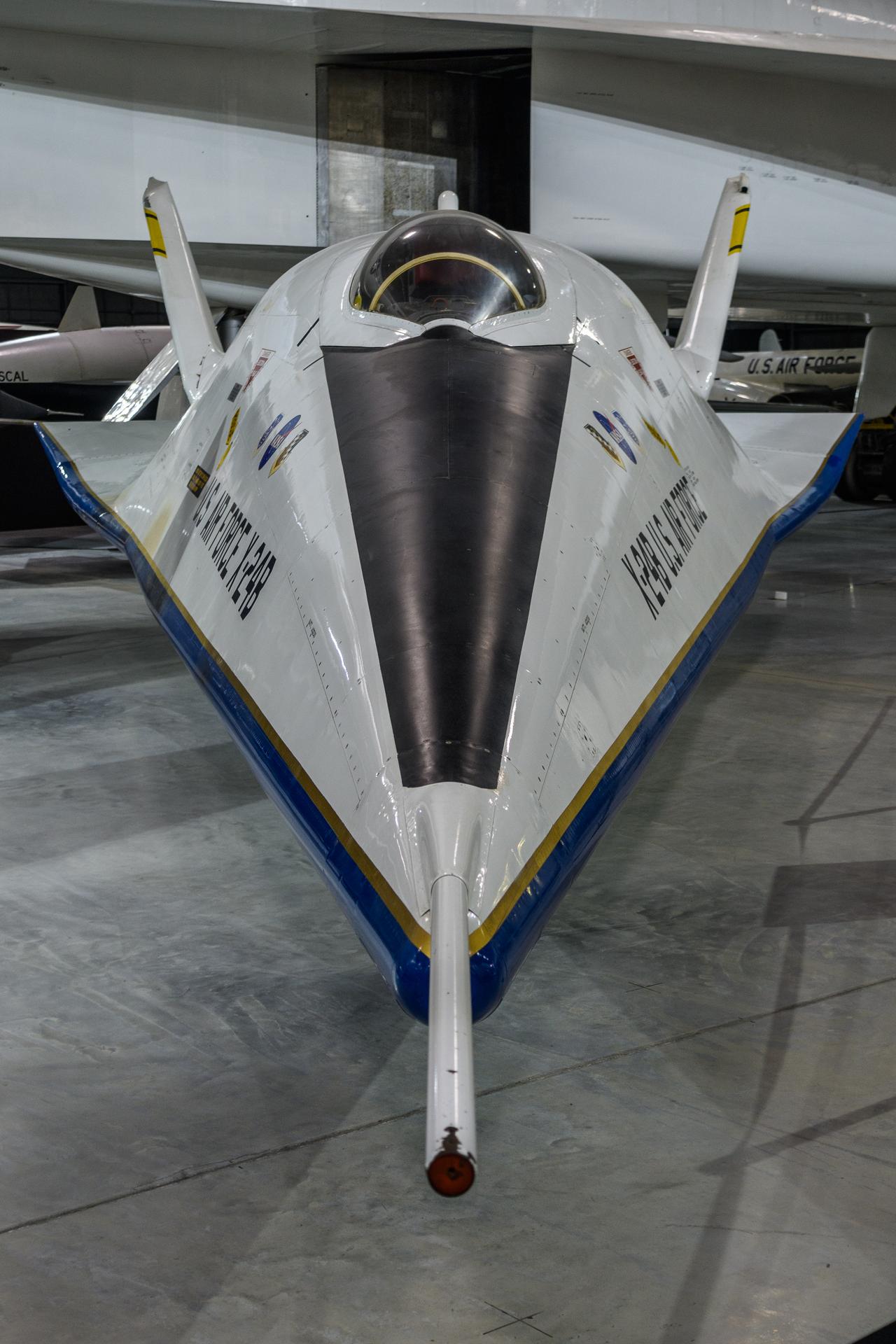
Martin Marietta X-24B (Peter Miller)
The design of the Martin Marietta X-24B represents a turning point in lifting body research. Unlike earlier models such as the M2-F3 and HL-10, the X-24B was based on the FDL-8 configuration developed by the Air Force Flight Dynamics Laboratory. This design philosophy relies on a "sharpened" geometry aimed at achieving a higher lift-to-drag ratio across a range from hypersonic to subsonic speeds. The X-24B was not constructed as a completely new aircraft; instead, it was created by mounting a completely new outer shell onto the existing internal systems and primary structure of the X-24A, which had completed its flight tests in 1971.
The aircraft’s most distinctive physical feature is its extremely long and pointed nose, replacing the blunt and rounded nose of earlier models. The underside of the fuselage is entirely flat, while the upper surface features a slight convex curvature. This aerodynamic configuration enabled the vehicle to cover greater glide distances in the upper atmosphere and improved the pilot’s maneuverability during landing. Control surfaces included upper and lower flaps at the rear of the fuselage, rudders on the vertical stabilizers, and winglet-like panels for glide control.
Structurally, the X-24B features an aluminum alloy fuselage capable of withstanding extreme aerodynamic heating and mechanical stress. It measures approximately 11.4 meters (37.5 feet) in length and 5.8 meters (19.1 feet) in width. The vehicle is powered by four-chambered Thiokol XLR11-RM-13 rocket engines, each producing 8,000 lbf (35.6 kN) of thrust. The landing gear consists of a modified system featuring a nose wheel and main skids for emergency landings. The design of the X-24B provided critical data demonstrating that a wingless vehicle could perform a precise runway landing, a key objective of the final stages of the Space Shuttle program.【1】
The physical structure of the Martin Marietta X-24B was shaped according to the "sharpened lifting body" concept to maximize aerodynamic efficiency at high speeds. Its fuselage, measuring 11.4 meters (37.5 feet) in length and 5.8 meters (19.1 feet) in width, weighed approximately 6,260 kilograms (13,800 pounds) at launch. The fuselage design is characterized by a flat lower surface and a long, pointed nose; this geometry significantly increases the lift-to-drag ratio by managing shock waves generated at hypersonic speeds. These structural features enabled the vehicle to achieve a wider cross-range capability during glide descent from the upper atmosphere.
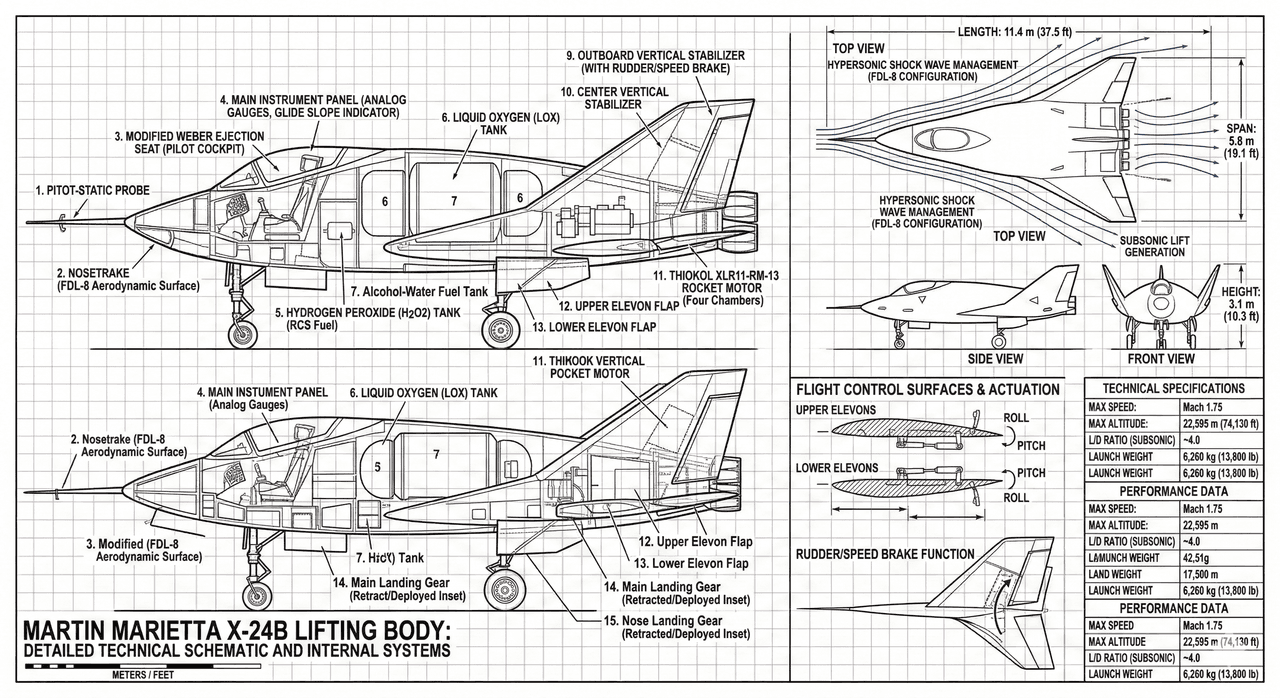
Martin X-24B Technical Drawing (Generated by Artificial Intelligence)
The propulsion system of the X-24B consists of four-chambered, liquid-fueled Thiokol XLR11-RM-13 rocket engines, commonly used in many experimental X-planes of the era. These engines burn a mixture of ethyl alcohol and liquid oxygen to produce approximately 35.6 kN (8,000 lbf) of thrust at sea level. Their primary function is to accelerate the vehicle from separation at the NB-52B mothership to supersonic speeds and target altitudes. The rocket motors provide full-thrust burn for about 130 seconds, after which the vehicle becomes a completely unpowered glider. Additional small hydrogen peroxide thrusters are included for precise maneuvering and stability control at low speeds.【2】
In terms of performance parameters, the X-24B achieved the highest efficiency levels recorded in lifting body research. During test flights, the vehicle reached a maximum speed of Mach 1.75 (approximately 1,873 km/h) and a service ceiling of 22,595 meters (74,130 feet). Its most significant technical achievement was stability during the transition from supersonic to subsonic speeds. During landing, the X-24B glided unpowered and touched down at approximately 310 km/h (193 mph). These technical data scientifically demonstrated that a wingless aircraft could both achieve hypersonic flight and land precisely on a runway like a conventional airplane.
The control mechanism of the Martin Marietta X-24B consists of multifunctional aerodynamic surfaces integrated into the rear section of the fuselage, differing from conventional aircraft. Three vertical stabilizers (fins) are located at the rear to ensure directional stability. The rudders mounted on the two outer stabilizers control yaw movement and can also function as air brakes. Large flaps are positioned on the upper and lower surfaces at the extreme rear of the fuselage. These flaps can be moved synchronously or independently to control pitch and adjust the glide angle. Additionally, elevon-like structures mounted on the fuselage sides enable roll maneuvers, providing full three-axis control of the aircraft.
Martin Marietta X-24B (Periscopefilm)
The aircraft’s avionics and control systems are supported by a hydraulic power unit and an advanced artificial feel system to counteract instability at high speeds. The X-24B features a sophisticated flight control system capable of compensating for shifts in the aerodynamic center during the transition from hypersonic to subsonic speeds. The cockpit instrument panel includes conventional analog instruments for monitoring speed (Mach), altitude, angle of attack, and rocket engine parameters, as well as a specialized guidance indicator for tracking the glide slope. These systems were specially calibrated by NASA and USAF engineers to provide the high-precision data required by the pilot during unpowered landings.【3】
The landing gear system of the X-24B was designed as a simple yet robust structure to reduce weight and preserve fuselage volume. The nose wheel was adapted from the T-38 trainer aircraft, while the main landing gear consists of reinforced wheeled skids with shock absorbers capable of dissipating the energy of hard landings. The landing gear remains retracted during flight and is deployed only during the final phase of landing, activated by the pilot’s command using gravity and spring mechanisms. All these technical components ensured that the X-24B was not merely an experimental platform but a technological marvel capable of being operated with the precision of a conventional aircraft.
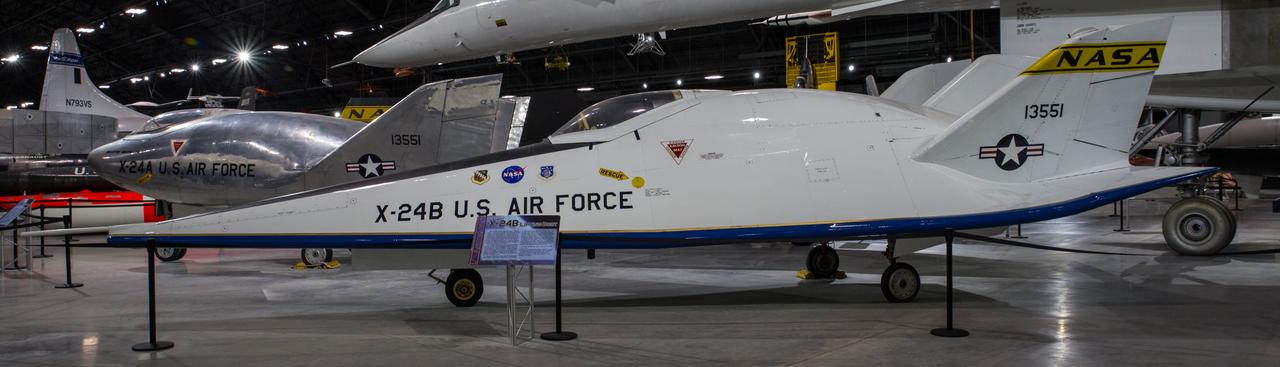
Martin Marietta X-24B (Clemens Vasters)
The Martin Marietta X-24B is not merely an experimental aircraft but a technical validation platform for the concept of reusable spacecraft. Its sectoral legacy lies in proving that a vehicle returning from outside the atmosphere could generate aerodynamic lift solely through its fuselage structure (lifting body) and land precisely on a runway like a conventional aircraft. This success eliminated one of the greatest uncertainties in the design phase of the Space Shuttle program. Data from the X-24B served as the primary reference for modeling the flight dynamics of the Shuttle’s final approach and landing phases.
Another critical contribution to the aerospace sector was the demonstrated efficiency of the "sharpened" lifting body (FDL-8) geometry at hypersonic speeds. The X-24B tested controllability and thermal load management at high Mach numbers, establishing a design roadmap for subsequent generations of hypersonic research vehicles. This design philosophy forms the aerodynamic foundation for later projects such as the X-38 Crew Return Vehicle developed in the 1990s and the Dream Chaser currently developed by Sierra Space. In particular, the mathematical models for unpowered glide descent in autonomous or piloted landing systems have been refined using data from the X-24B’s 36-flight test series and incorporated into modern engineering standards.
The X-24B program is also regarded as one of the most successful examples of operational collaboration between military and civil aviation authorities (USAF and NASA). Precise landings on concrete runways, instead of dry lakebeds at Edwards Air Force Base, strengthened confidence in the aerospace industry regarding the "wingless flight" concept. Today, projects such as the Lockheed Martin X-59 silent supersonic technology initiative and the Boeing X-37B unmanned space vehicle continue to reflect the aerodynamic control surfaces and fuselage stabilization principles tested by the X-24B over half a century ago.
[1]
The Little Aviation Museum.Martin Marietta X-24B.The Little Aviation Museum.Erişim 28 Şubat 2026.
https://thelittleaviationmuseum.au/planes/martin-marietta-x-24b/.
[2]
National Museum of the United States Air Force. “Martin X-24B".National Museum of the United States Air Force Erişim 28 Şubat 2026. https://www.nationalmuseum.af.mil/Visit/Museum-Exhibits/Fact-Sheets/Display/Article/195762/martin-x-24b/.
[3]
Lockheed Martin. “Controlling Descent From on High: The X-24".Lockheed Martin. 28 Mart 2018. Erişim 28 Şubat 2026. https://www.lockheedmartin.com/en-us/news/features/history/x-24.html.

No Discussion Added Yet
Start discussion for "Martin Marietta X-24B" article
Design and Development Process
Technical Specifications
Control Surfaces and Avionics Systems
Sectoral Legacy and Contributions to Aviation Technology