


This article was automatically translated from the original Turkish version.
+1 More
Maragheh Observatory was an astronomical center established in the city of Maragheh in Azerbaijan in the 13th century by the renowned scholar Nasir al-Din al-Tusi on the orders of the Ilkhanid ruler Hulagu Khan.
Recognized as one of the most important scientific institutions of the medieval Islamic world the observatory functioned both as a research center for observational activities and as a higher education institution. Some historians have regarded it as the “first modern observatory” that served as a model for subsequent observatories built after its establishment.
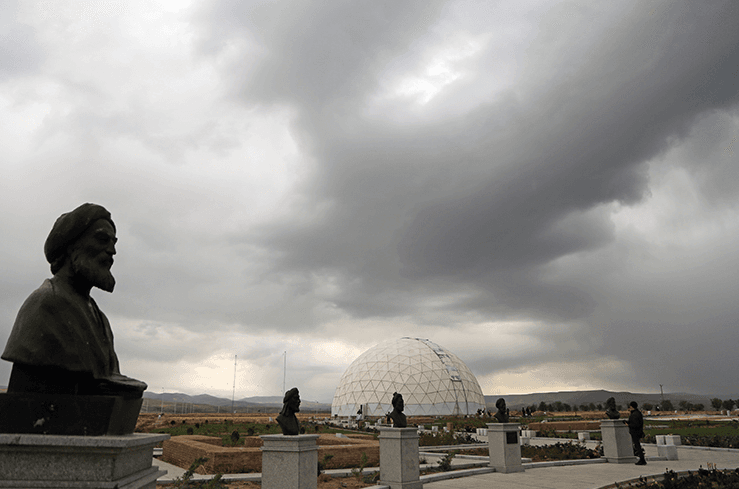
Maragheh Observatory (AA)
The founding of the observatory is linked to the capture of Alamut Castle by Hulagu Khan in 1256 during which Nasir al-Din al-Tusi came under his protection. After the conquest of Baghdad in 1258 Hulagu Khan requested that Tusi establish an observatory. Some sources also report that Tusi convinced Hulagu that understanding the movements of celestial bodies would aid in predicting future events. Construction began in 1259 on a fortified hill west of Maragheh. Although Tusi estimated that observational work would take about thirty years Hulagu limited the timeframe to twelve years. The observatory officially began operations around 1271 during the reign of Hulagu’s son Abaqa Khan following Hulagu’s death.
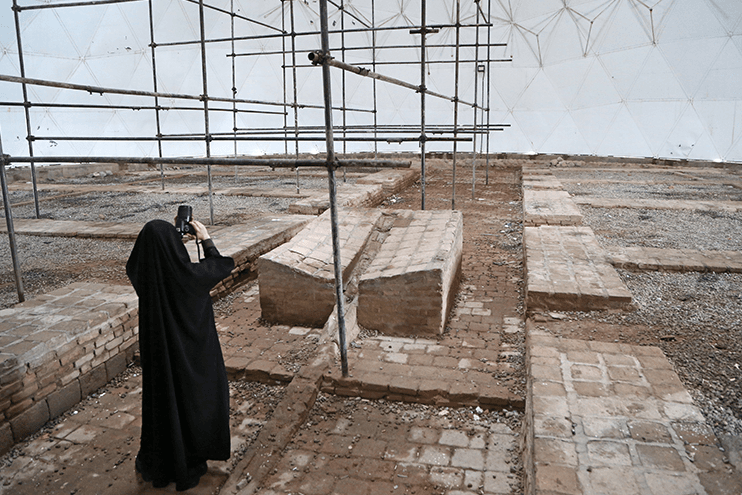
Maragheh Observatory (AA)
The observatory held a distinctive position among the scientific institutions of its time due to its funding model and organizational structure. Hulagu Khan allocated endowments to cover operational expenses and entrusted their administration to Tusi ensuring long-term and consistent financial support.
The observatory housed an extensive library where manuscripts collected from regions such as Syria Iraq Iran Baghdad and Alamut were gathered. The library was placed under the management of Ibn al-Fuwati and remained operational until the reign of Abu Sa'id Khan.
The observatory also functioned as an educational center known as “Dar al-Ilm.” Nasir al-Din al-Tusi taught there and it is reported that during the opening ceremony Abaqa Khan awarded approximately one hundred successful students.
Maragheh Observatory was a cosmopolitan center where an international scholarly community gathered. Researchers of Turkish Arab Persian Mongol Chinese Georgian and Syrian origin worked together here. Among the leading figures of its staff were:
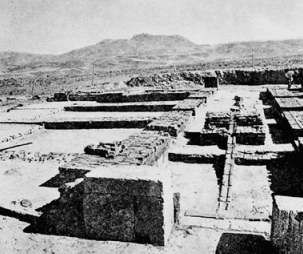
Archaeological remains of Maragheh Observatory (Science and Technology in Islam)
The observatory was a complex of sixteen buildings constructed on a hilltop. Archaeological findings have revealed the presence of a central observation tower a library meeting areas and residential quarters for researchers. Some scholars suggest that underground structures on the hillside were used to protect large and sensitive observational instruments from environmental influences.
A significant portion of the observational instruments used at the observatory were designed and developed by Mu’ayyad al-Din al-Urdi. Urdi himself documented his inventions in treatises. Additionally Nasir al-Din al-Tusi developed a device of the torquetum type for measuring latitude and altitude. Other instruments included celestial spheres astrolabes armillary spheres and sundials. The only surviving original instrument is a celestial sphere made by Urdi’s son Muhammad in 1273 or 1279 which is now preserved in Dresden.

Maragheh Observatory (AA)
The primary goal of the observatory was to correct errors in existing astronomical tables and to construct new tables based on fresh observational data. The result of these efforts was the compilation of the Zij-i Ilkhani completed around 1270–1271.
Maragheh Observatory established an important tradition of mathematical criticism of Ptolemaic planetary models and the development of alternative models. This scientific approach known as the Maragheh School particularly challenged Ptolemy’s use of the “equant” in planetary motion. Key contributions in this context include Nasir al-Din al-Tusi’s “Tusi Couple” motion model and Mu’ayyad al-Din al-Urdi’s geometric “Urdi Lemma.” These mathematical models were later developed by Ibn al-Shatir and show similarities to certain mathematical devices used by Copernicus in his De revolutionibus.
After Tusi’s death in 1274 the observatory’s activity began to decline. His son Sadr al-Din Ali succeeded him but the establishment of a new observatory in Tabriz by Ghazan Khan around 1300 led to a weakening of activities at Maragheh. Around 1340 Hamdallah Mustawfi described the observatory as being in ruins. Although Shah Ismail initiated a reconstruction effort in the early 16th century the project was never completed due to cost and time constraints.
Maragheh Observatory occupied a central position in the history of Islamic science through its institutional structure scientific instruments educational activities and the astronomical models it developed. It particularly influenced subsequent astronomical traditions through the legacy of the Maragheh School.
Anadolu Ajansı. "İran'da henüz teleskobun icat edilmediği devirlerde kurulan bilim yuvası: Merağe Rasathanesi." Accessed November 12, 2025. https://www.aa.com.tr/tr/kultur/iranda-henuz-teleskobun-icat-edilmedigi-devirlerde-kurulan-bilim-yuvasi-merage-rasathanesi/3116098
Dedeyev, Bilal. "Ortaçağ İslam Uygarlığının En Büyük Bilim Ocağı Olan Merağa Rasathanesi." In *1. Uluslararası Prof. Dr. Fuat Sezgin İslâm Bilim Tarihi Sempozyumu Bildiriler Kitabı*, edited by F. Başar, M. Kaçar, C. Kaya, and A. Z. Furat, pp. 201–15. Istanbul: İstanbul University Press, 2020. Accessed November 11, 2025.
Kaya, Seyfettin. "İlhanlılar Dönemi'nde Meraga ve Tebriz Gözlemevleri." *Turkish Studies - Historical Analysis* 14, no. 4 (2019): 929–46. Accessed November 11, 2025.
Köprülü, M. Fuad. “XIII. Asırda Marâga Rasathanesi Hakkında Bâzı Notlar”. BELLETEN 6, no. 23-24 (October 1942): 207-28. Accessed November 11, 2025.
Sawah, Rihab. "History of the Observatory as an Institution: From Maragha to Mount Wilson." Master's thesis, University of Missouri - St. Louis, 2011. Accessed November 11, 2025. https://irl.umsl.edu/cgi/viewcontent.cgi?article=1170&context=thesis
Sezgin, Fuat. *İslam’da Bilim ve Teknik*. Volume II. Istanbul: Prof. Dr. Fuat Sezgin İslam Bilim Tarihi Araştırmaları Vakfı, 2010. Accessed November 11, 2025.

Founding
Institutional Structure
Scientific Personnel
Architectural Structure and Observational Instruments
Scientific Work and the Maragheh School
Decline and Destruction