


This article was automatically translated from the original Turkish version.
+1 More

Mesosphere
Altitude Range | Approximately 50 km - 85 km | ||||||||
|---|---|---|---|---|---|---|---|---|---|
Temperature Range | -5°C (stratopause) to -125°C (mesopause) | ||||||||
Main Component(s) | Metal Atoms Water Vapor (H₂O) Ozone (O₃) Oxygen (O₂) Nitrogen (N₂) | ||||||||
Dynamic Properties | Atmospheric Tides Gravity Waves Zonal Winds | ||||||||
Significant Events | Electric Fields Noctilucent Clouds Meteor Burning | ||||||||
Climate Change Impact | Increase in Noctilucent Clouds Cooling Trend | ||||||||
Mesosphere is the layer of Earth’s atmosphere located approximately between 50 and 85 kilometers above the surface, situated between the stratosphere and the thermosphere. This region is the coldest part of the atmosphere, with temperature decreasing with altitude and reaching as low as approximately -90°C at its upper boundary, known as the mesopause.
The mesosphere is a region where dynamic processes such as gravity waves, atmospheric tides, and planetary waves are active. Additionally, it serves as Earth’s natural shield against incoming space objects, as meteoroids burn up and disintegrate within this layer. Studying the mesosphere is essential for understanding the general dynamics and energy transfer mechanisms of the atmosphere.
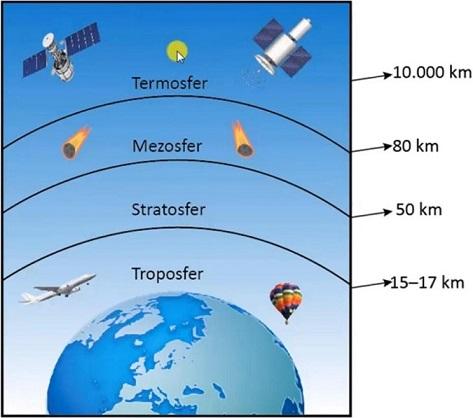
Earth’s Atmosphere and Its Layers (TUA)
The mesosphere is a critical layer in Earth’s atmospheric temperature profile, exhibiting an inverse gradient. Beginning at the stratopause, the upper boundary of the stratosphere, temperature continuously decreases with increasing altitude. This decline occurs because the mesosphere lacks any persistent heat source, unlike other atmospheric layers.
At the lower boundary of the mesosphere (approximately 50 km altitude), temperatures average around -5°C. However, as altitude increases, temperature drops dramatically, reaching between -90°C and -125°C at its upper boundary, the mesopause, located at approximately 85 to 100 kilometers. This makes the mesosphere the coldest layer of the atmosphere.
The temperature decrease is due to the inability of electromagnetic energy from the Sun to reach these altitudes in sufficient quantities, combined with the low molecular density, which prevents effective absorption. In the stratosphere, temperature increases due to ozone absorbing ultraviolet radiation, but no comparable heat source exists in the mesosphere. Furthermore, carbon dioxide gas plays a significant role in cooling the mesosphere by radiating energy in infrared wavelengths into space.
The thermal structure of the mesosphere varies significantly with seasons and geographic latitudes. Particularly during summer, temperatures at the polar regions can drop as low as -125°C, creating conditions favorable for the formation of polar mesospheric clouds (noctilucent clouds). Thus, the thermal structure of the mesosphere is shaped not only by altitude but also by seasonal circulation patterns and atmospheric wave activity.
Radar and lidar observations have revealed seasonal semiannual oscillations and temperature variations linked to atmospheric wave refraction in the upper mesosphere. These variations interact with wind systems and contribute to the dynamic equilibrium of the mesosphere.
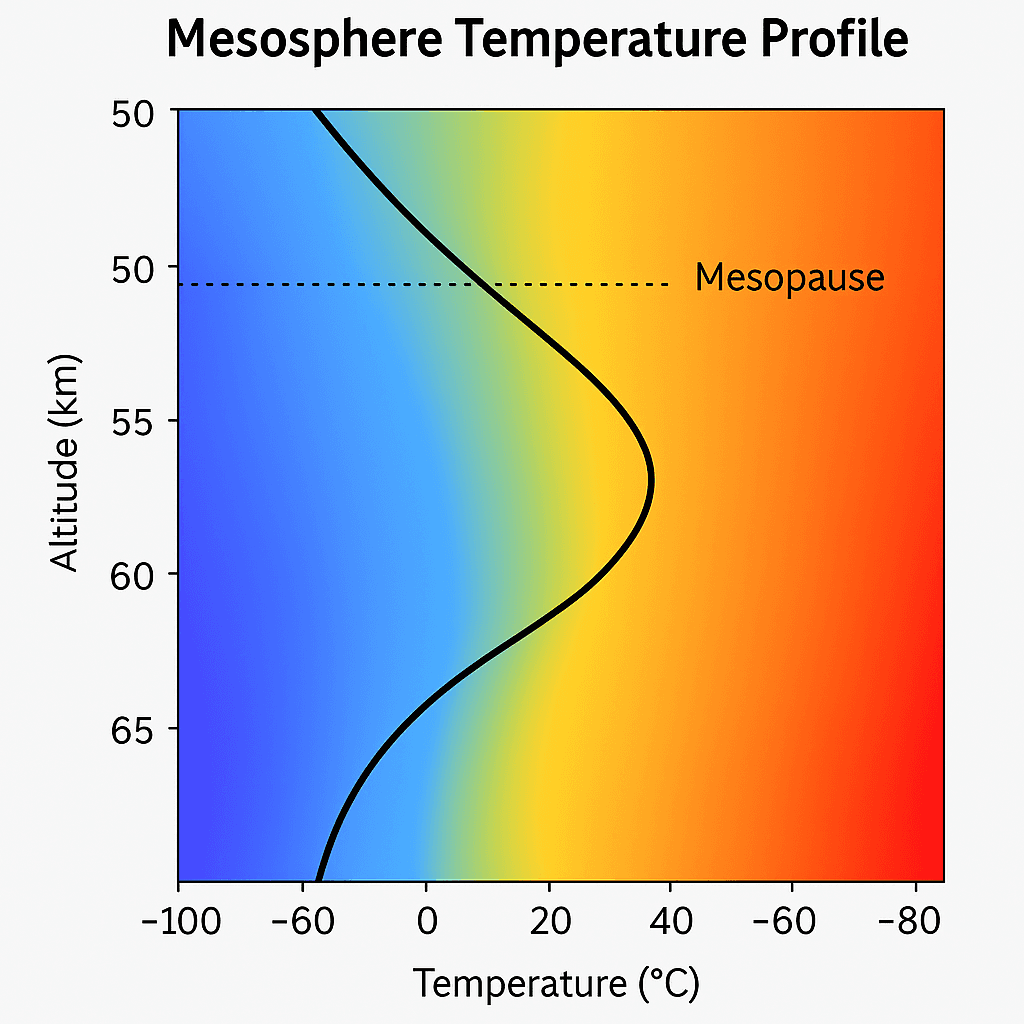
Temperature Conditions in the Mesosphere (Generated by artificial intelligence.)
Atmospheric pressure and air density in the mesosphere are significantly lower than in the lower atmospheric layers, the troposphere and stratosphere. This reduction is directly related to the mesosphere’s high altitude and the sparse distribution of air molecules.
Atmospheric pressure decreases logarithmically with altitude. At the lower boundary of the mesosphere, approximately 50 kilometers above sea level, pressure is only about 1 millibar (1 hPa), compared to the standard sea-level pressure of 1013 hPa. At the mesopause, around 85 to 100 kilometers, pressure falls below 0.01 hPa, representing a reduction of more than 100,000 times compared to sea level.
Similarly, air density decreases substantially with altitude. While air density in the troposphere is approximately 1.2 kg per cubic meter, it can drop to around 10⁻⁵ kg/m³ in the upper mesosphere. This low density increases the mean free path between gas molecules and reduces collision frequency. As a result, molecular diffusion becomes more dominant, significantly influencing the mesosphere’s dynamic and chemical properties.
This rarefied environment is of critical importance, particularly in terms of the propagation of electromagnetic waves, heat transfer, and the kinetics of chemical reactions. At the same time, the combustion of meteoroids due to friction in this layer occurs because of the long mean free path resulting from the low density.
The rarefied and low-pressure nature of the mesosphere also complicates observations within this layer. For example, conventional weather balloons cannot reach this altitude because the air density is insufficient to generate adequate buoyant force. Consequently, pressure and density measurements related to the mesosphere are typically obtained using sounding rockets or indirect lidar/radar methods.
In terms of chemical composition, the mesosphere is similar to the troposphere and stratosphere, consisting predominantly of nitrogen (%78) and oxygen (%21). However, ozone concentration is lower in this layer. Additionally, metal atoms and ions derived from the ablation of meteoroids—such as iron, magnesium, and silicon—are present. These metallic particles play a significant role in chemical reactions within the mesosphere and especially in the formation of polar mesospheric clouds (noctilucent clouds, NLCs).
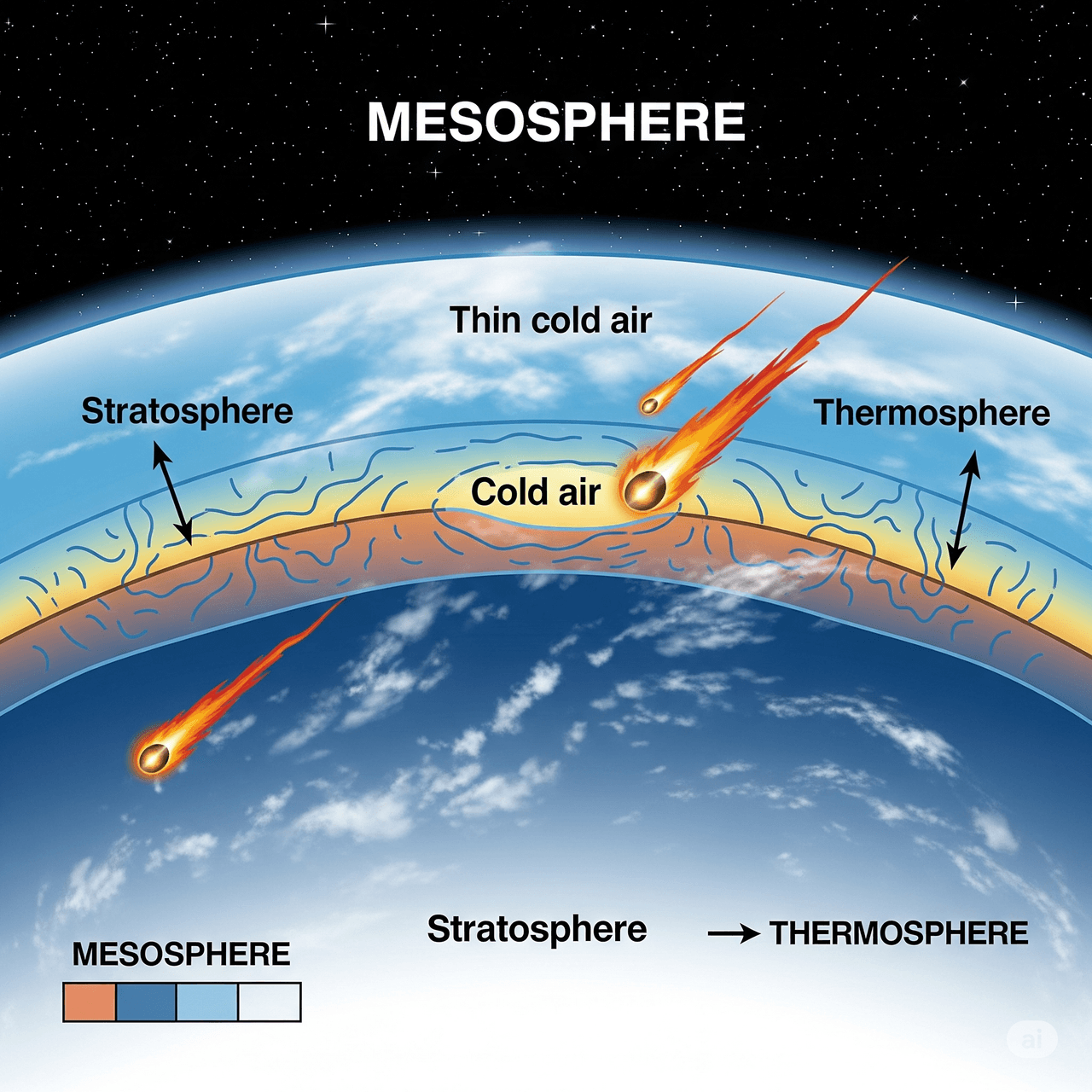
Mezosphere (generated by artificial intelligence.)
The mesosphere is a region where gravity waves and atmospheric tides (thermal tides) exert significant influence. These waves propagate upward from the lower atmosphere, where they can break, generate turbulence, and transfer momentum to wind systems. In particular, small-scale gravity waves play a critical role in determining the wind structure and temperature distribution of the mesosphere.
Dynamic structures observed in the mesosphere vary with the seasons and geographic latitude. Noctilucent clouds, visible during summer months at polar regions, result from the extremely cold and humid conditions in this layer. These clouds form at approximately 82 kilometers altitude and can only be observed when the Sun is 6°–16° below the horizon, during twilight hours. Furthermore, increased methane emissions from anthropogenic sources can oxidize into water vapor, thereby enhancing the frequency of noctilucent cloud formation.
In the mesosphere, particularly at high latitudes, vertical electric fields have been observed. These fields are directly linked to geomagnetic activity. During solar flares and proton events, the strength of these electric fields increases, along with ionospheric conductivity. These electrical processes are believed to play a key role in energy and matter transfer between the ionosphere and the mesosphere.
The mesosphere is one of the least accessible layers of the atmosphere for direct observation. This difficulty stems from technical limitations: weather balloons can ascend only up to approximately 40 kilometers and therefore cannot reach the mesosphere. On the other hand, most satellites operate above the mesosphere, typically at altitudes of 200 kilometers or higher. As a result, obtaining direct data about this layer is extremely challenging. Information on mesospheric properties is therefore largely derived from indirect observational techniques.
Sounding Rockets: Sounding rockets are vehicles that collect direct data from the mesosphere during brief atmospheric ascents. These rockets measure physical parameters such as temperature, pressure, ion density, and electric fields within the 50 to 150 kilometer altitude range. They provide transient but high-resolution data.
Lidar (Light Detection and Ranging) Systems: Lidar systems use laser beams to investigate particle density, temperature profiles, and structures such as the sodium layer in the mesosphere. Ground-based lidar observations provide high-sensitivity data, particularly in the 80–100 kilometer altitude range. Rayleigh and Na lidars are commonly employed for this purpose.
Radar Observations (Meteor Radar and MF/VHF Radars): Meteor radars track ionized trails left by meteoroids in the atmosphere to determine mesospheric wind profiles. This method is especially effective for measuring zonal (east-west) and meridional (north-south) wind components between 75 and 110 kilometers. It is also used to monitor atmospheric tides and gravity waves.
Satellite Observations: Satellites typically orbit above the mesosphere, so data about this layer are indirect. However, instruments such as the High Resolution Doppler Imager (HRDI) and the Wind Imaging Interferometer (WINDII) aboard the Upper Atmosphere Research Satellite (UARS) have been able to measure temperature and wind in the 65–105 kilometer range. These measurements are generally acquired during daytime and exhibit local time variations. Consequently, the data are evaluated using long-term averages.
Various long-term observation programs have been conducted to study seasonal variations in the mesosphere. For example, meteor radar data collected over more than a decade at the Andenes (69°N) and Juliusruh (54°N) stations in Germany have been used to derive annual patterns of atmospheric tides.
Baker-Blocker, Anita. "Mesosphere." *EBSCO Research Starters: Earth and Atmospheric Sciences*, 2024. Accessed May 26, 2025. https://www.ebsco.com/research-starters/earth-and-atmospheric-sciences/mesosphere
Duft, Denis, Mario Nachbar, and Thomas Leisner. "Unravelling the Microphysics of Polar Mesospheric Cloud Formation." *Atmospheric Chemistry and Physics* 19, no. 5 (2019): 2871–2886. Accessed May 26, 2025. https://acp.copernicus.org/articles/19/2871/2019/acp-19-2871-2019.html
Lieberman, Ruth S. "The Gradient Wind in the Mesosphere and Lower Thermosphere." *Earth, Planets and Space* 51 (1999): 751–761. Accessed May 26, 2025. https://earth-planets-space.springeropen.com/articles/10.1186/BF03353234
Pokhotelov, Dimitry, Erich Becker, Gunter Stober, and Jorge L. Chau. "Seasonal Variability of Atmospheric Tides in the Mesosphere and Lower Thermosphere: Meteor Radar Data and Simulations." *Annales Geophysicae* 36, no. 3 (2018): 825–835. Accessed May 26, 2025. https://angeo.copernicus.org/articles/36/825/2018/angeo-36-825-2018.html
Türkiye Uzay Agency. "Dünya'nın Atmosferi ve Katmanları." TUA. Accessed May 26, 2025. https://tua.gov.tr/tr/blog/dunya/dunya-nin-atmosferi-ve-katmanlari
Zadorozhny, A. M., and A. A. Tyutin. "Effects of Geomagnetic Activity on the Mesospheric Electric Fields." *Annales Geophysicae* 16, no. 12 (1998): 1544–1551. Accessed May 26, 2025. https://angeo.copernicus.org/articles/16/1544/1998/index.html

Mesosphere
Altitude Range | Approximately 50 km - 85 km | ||||||||
|---|---|---|---|---|---|---|---|---|---|
Temperature Range | -5°C (stratopause) to -125°C (mesopause) | ||||||||
Main Component(s) | Metal Atoms Water Vapor (H₂O) Ozone (O₃) Oxygen (O₂) Nitrogen (N₂) | ||||||||
Dynamic Properties | Atmospheric Tides Gravity Waves Zonal Winds | ||||||||
Significant Events | Electric Fields Noctilucent Clouds Meteor Burning | ||||||||
Climate Change Impact | Increase in Noctilucent Clouds Cooling Trend | ||||||||
Physical Characteristics and Thermal Structure
Temperature Profile
Pressure and Density
Chemical Composition
Dynamic Structures and Waves
Gravity Waves and Atmospheric Tides
Seasonal and Latitudinal Variations
Electrical Properties
Observations and Research Methods
Observational Challenges
Main Observation Methods
Seasonal and Latitudinal Observation Programs