


This article was automatically translated from the original Turkish version.
+2 More
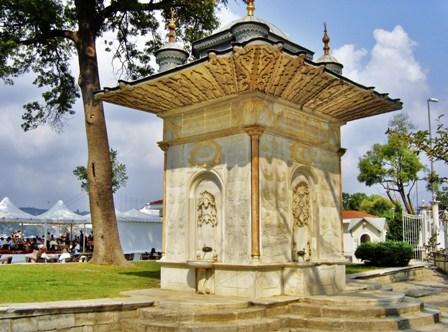
Mihrişah Sultan Fountain
Also Known as | Küçüksu Kasrı Çeşmesi | ||||||||
|---|---|---|---|---|---|---|---|---|---|
Location | Küçüksu Caddesi İstanbul Beykoz | ||||||||
Commissioned by | III. Selim | ||||||||
Commissioned for | Mihrişah Sultan (mother of III. Selim) | ||||||||
Construction Date(s) | 1806 (Hijri 1221) | ||||||||
Architectural Style(s) | Baroque–Empire transition period | ||||||||
Building Type | Meydan çeşmesi | ||||||||
Construction Material | Kesme taş | ||||||||
Mihrişah Sultan Fountain is an monumental public fountain built in 1806 by Ottoman Sultan Selim III in memory of his mother, Mihrişah Sultan, located at the entrance of the Küçüksu Pavilion on the Asian shore of the Bosphorus in Istanbul. Notable for its architecture that reflects the transition between Baroque and Empire styles, the structure is regarded as one of the most refined examples of classical public architecture along the Bosphorus. Situated on Küçüksu Street within the boundaries of Istanbul’s Beykoz district, the fountain is also known as the Küçüksu Pavilion Fountain due to its location.

Mihrişah Sultan Fountain (Türkiye Culture Portal)
During the Ottoman period, the Küçüksu area was one of the most favored recreational spots for both the sultans and the general public. Sultan Selim III, in 1792, renovated the wooden structure of the Küçüksu Pavilion in memory of his mother Mihrişah Sultan, landscaped the grassy recreational area behind it, and commissioned this fountain in 1806. The fountain’s inscription, composed by Hafızzade Mehmed Paşa, one of the leading statesmen of the era, consists of thirty-two lines. These inscriptions, placed on all four faces of the structure, serve both as historical documents and as examples of literary elegance. The tughra on the broad face of the fountain belongs to Sultan Selim III.
The architect of the Mihrişah Sultan Fountain is not definitively known. The fountain is designed as a nearly square rectangular structure (3.20 x 3.90 m), with four facades, following the traditional public fountain typology. In this respect, it continues the tradition of monumental water architecture of its time. Built on the seaside, the fountain stands on a three-step platform, although the platform visible today is not original.
The corners of the structure are emphasized by embedded columns with capitals and bases. The small turrets on each facade enhance both the structural support of the central dome and its visual harmony. The dome is surrounded by wide eaves resting on stone corbels; these eaves project outward and are adorned with rich Empire-style ornamentation.
On two opposite faces of the fountain, projecting spouts are supported by S-shaped Baroque corbels. These corbels, decorated with acanthus leaves, add a detail that reflects the decorative sensibility of the period. The keystones of the rounded, shallow niches housing the spouts feature acanthus and seashell motifs. The surfaces outside the niches are decorated with abstract branch and floral motifs executed in low relief.
The Mihrişah Sultan Fountain is one of the rare examples that unify the local Ottoman interpretation of the Baroque style with the influences of the Empire style within a single structure. In this regard, it is significant both as evidence of Western influences on Ottoman architecture and as one of the late representatives of classical fountain design.
Especially frequently depicted in 19th-century Bosphorus engravings and paintings, the fountain holds an important place in Istanbul’s urban memory, both artistically and historically. Although the structure has been affected by changes to its surroundings over time, it has largely preserved its architectural integrity and survives to the present day.
T.C. Kültür ve Turizm Bakanlığı. “Mihrişah Sultan Çeşmesi.” *Kültür Portalı*. Accessed May 20, 2025. https://www.kulturportali.gov.tr/turkiye/istanbul/gezilecekyer/mihrisah-sultan-cesmesi.
T.C.Beykoz Kaymakamlığı Governorship. “Küçüksu Mihrişah Sultan Çeşmesi.” Beykoz.gov.tr. Accessed May 20, 2025. http://www.beykoz.gov.tr/kucuksu-mihrisah-sultan-cesmesi.

Mihrişah Sultan Fountain
Also Known as | Küçüksu Kasrı Çeşmesi | ||||||||
|---|---|---|---|---|---|---|---|---|---|
Location | Küçüksu Caddesi İstanbul Beykoz | ||||||||
Commissioned by | III. Selim | ||||||||
Commissioned for | Mihrişah Sultan (mother of III. Selim) | ||||||||
Construction Date(s) | 1806 (Hijri 1221) | ||||||||
Architectural Style(s) | Baroque–Empire transition period | ||||||||
Building Type | Meydan çeşmesi | ||||||||
Construction Material | Kesme taş | ||||||||
No Discussion Added Yet
Start discussion for "Mihrişah Sultan Fountain" article
History
Architectural Features
Art Historical and Cultural Significance