

This article was automatically translated from the original Turkish version.
Classification(s) | The rhomboid minor is located between the smaller and deeper back muscles and works together with the rhomboid major. | ||||||||
|---|---|---|---|---|---|---|---|---|---|
Nerve | It is innervated by the dorsal scapular nerve from the C5 nerve root. | ||||||||
Artery | It is supplied by the dorsal scapular artery. | ||||||||
Function(s) | It retracts the scapula and stabilizes the scapula. elevates its medial border | ||||||||
Rhomboid Minor Muscle is a small muscle located in the upper medial region of the back and plays a significant role in controlling scapular movements by anchoring the scapula to the vertebral column. The muscle contributes to shoulder stability, particularly by pressing the scapula against the thoracic wall, and works in conjunction with the rhomboid major.
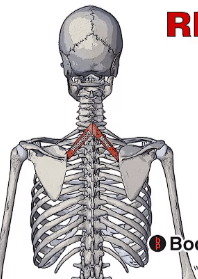
The rhomboid minor muscle originates from the inferior border of the nuchal ligament, the spinous processes of the C7 and T1 vertebrae, and the intervening supraspinous ligaments. Its muscle fibers insert onto a small area on the medial border of the scapula, particularly at the level of the scapular spine. It lies beneath the levator scapulae and above the rhomboid major, positioned deep to the trapezius muscle and superficial to the longissimus muscles.
The rhomboid minor is typically separated from the rhomboid major by a slight interval; however, in some individuals the edges of the two muscles may be continuous. By attaching to the medial border of the scapula, the rhomboid minor contributes to its medial and upward retraction and assists the levator scapulae in downward rotation of the scapula.
The rhomboid minor muscle develops from myoblasts derived from the postcranial mesoderm of somites and is classified among the intrinsic back muscles. It arises specifically from the epaxial muscle mass and serves as a bridge between the shoulder girdle and the trunk. Classified as a small, deep back muscle, the rhomboid minor, together with the rhomboid major, is situated along the medial border of the scapula and dynamically connects it to the trunk. Anatomically, it originates from the spinous processes of the C7 and T1 vertebrae and inserts into the root region of the medial scapular border. Due to this position, it is considered part of the scapulothoracic muscle group and participates in both the stabilization and controlled movement of the scapula.
The innervation of the rhomboid minor muscle is provided by the dorsal scapular nerve. This nerve primarily arises from the C5 nerve root, although in some individuals it may receive minor contributions from C4 or C6. The dorsal scapular nerve emerges from the superior trunk of the brachial plexus and passes through the levator scapulae to reach the rhomboid muscles. Although damage to this nerve is rare, it can lead to scapular winging, weakness in shoulder movements, and postural abnormalities. The arterial supply to the muscle is primarily provided by the dorsal scapular artery. This artery may originate directly from the subclavian artery or, in some individuals, from a deep branch of the transverse cervical artery. Venous drainage occurs through accompanying venous structures. Thanks to the well-developed anastomotic vascular network around the scapula, this muscle can maintain adequate blood flow even in the event of potential vascular injury.
The rhomboid minor muscle works together with the rhomboid major to retract the scapula toward the trunk and elevate its medial border. This movement occurs in coordination with the upper fibers of the trapezius and contributes to balanced motion of the shoulder girdle. Additionally, it assists the levator scapulae in downward rotation of the scapula. The primary role of the rhomboid minor is to stabilize the scapula against the thorax; without this stabilization, movements generated by the upper limb muscles cannot be effectively transmitted, resulting in functional impairments of the shoulder girdle. Clinically, weakness or loss of innervation of this muscle leads to postural disturbances and anterior and lateral displacement of the scapula (protraction). Dorsal scapular nerve injuries can cause scapular winging similar to that seen in serratus anterior lesions, although the clinical findings are typically milder. In physical therapy and rehabilitation, strengthening the rhomboid muscles is a critical component in the treatment of shoulder instability, scapulothoracic dyskinesis syndromes, and rotator cuff injuries. During surgical procedures, preservation of the dorsal scapular nerve and artery is crucial to prevent postoperative functional deficits.
Bertelli, J. A., et al. “Triple Tendon Transfer of the Levator Scapulae, Rhomboid Major, and Rhomboid Minor to Reconstruct the Paralyzed Trapezius.” ResearchGate, 2022. Accessed August 16, 2025. https://www.researchgate.net/publication/365466412_Triple_Tendon_Transfer_of_the_Levator_Scapulae_Rhomboid_Major_and_Rhomboid_Minor_to_Reconstruct_the_Paralyzed_Trapezius
Bogduk, N., and S. Mercer. “Rhomboid Muscles: Role in Postural Balance.” Clinical Biomechanics, 2000. Accessed August 16, 2025. https://europepmc.org/article/med/10704401?utm_source
Elhassan, B. T., et al. “Feasibility of Lower Trapezius and Rhomboid Minor Transfer for Irreparable Subscapularis Tears: An Anatomic Cadaveric Study.” ResearchGate, 2021. Accessed August 16, 2025. https://www.researchgate.net/publication/350245596_Feasibility_of_lower_trapezius_and_rhomboid_minor_transfer_for_irreparable_subscapularis_tears_an_anatomic_cadaveric_study
Rossi, M. J., et al. “Anatomy of Rhomboid Minor in Scapular Kinematics.” *Clinical Anatomy*, 2021. Accessed August 16, 2025. https://www.ncbi.nlm.nih.gov/pmc/articles/PMC8354549/?utm_source

Classification(s) | The rhomboid minor is located between the smaller and deeper back muscles and works together with the rhomboid major. | ||||||||
|---|---|---|---|---|---|---|---|---|---|
Nerve | It is innervated by the dorsal scapular nerve from the C5 nerve root. | ||||||||
Artery | It is supplied by the dorsal scapular artery. | ||||||||
Function(s) | It retracts the scapula and stabilizes the scapula. elevates its medial border | ||||||||
No Discussion Added Yet
Start discussion for "Minor Rhomboid Muscle" article
Anatomical Structure
Morphology and Attachment Points
Embryological Origin and Classification
Innervation and Vascular Supply
Function and Clinical Relevance