


This article was automatically translated from the original Turkish version.
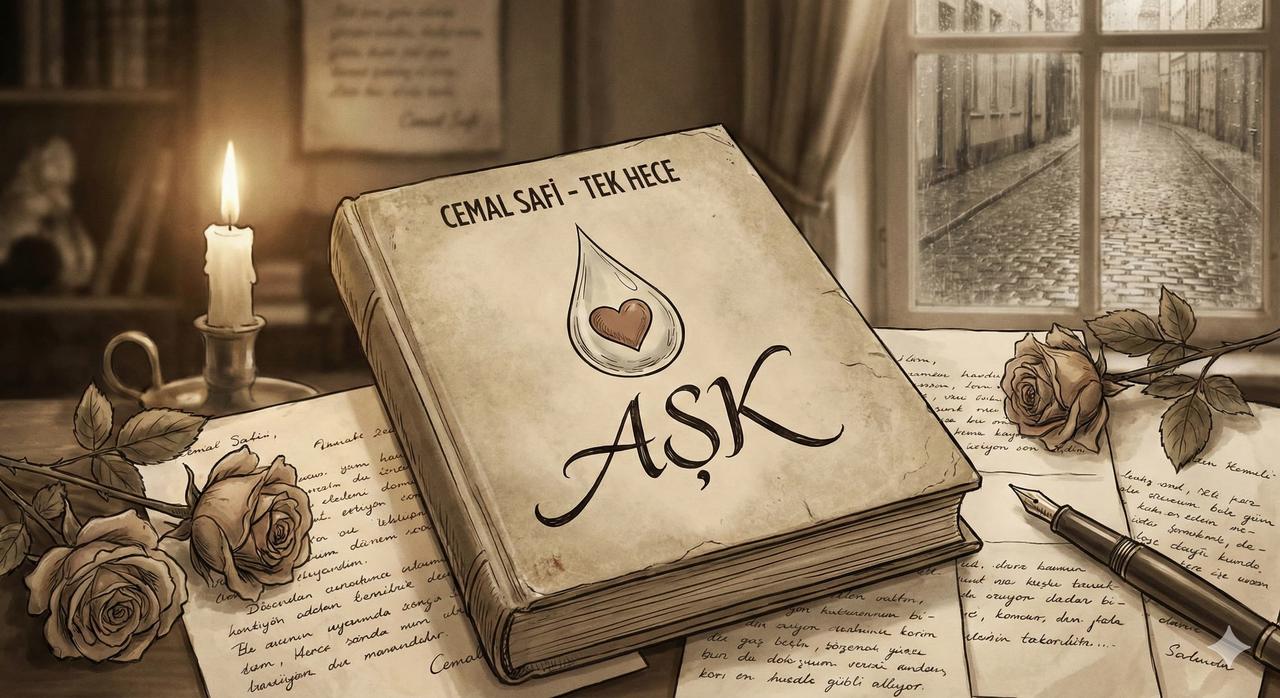
Generated by artificial intelligence.
Single Syllable
Title(s) | Monosyllable | ||||||||
|---|---|---|---|---|---|---|---|---|---|
Subject(s) | Personification of Love | ||||||||
Type(s) | Lyric Poetry | ||||||||
Meter | 11-Syllable Meter | ||||||||
Number of Quatrains | 9 | ||||||||
Poetic Unit | Quatrain | ||||||||
Poet | Cemal Sâfi | ||||||||
Cemal Sâfî’s poem “Tek Hece” is a lyrical text in which the concept of love is personified and given voice, defining its effects, power, and role in human life through various examples. The speaking subject does not name itself directly; instead, it reveals its identity indirectly through historical, religious, and literary allusions. Within this structure, love is presented not merely as an individual emotion but as a comprehensive force that transforms and guides individuals, embedded in cultural narratives.
In Cemal Sâfî’s poetic world, the theme of love occupies a central position. The poet is described as viewing emotion as the primary medium of expression, with love serving as the fundamental element nourishing poetic creation. Within this framework, “Tek Hece” is regarded as one of the texts that reveal the impact and scope of love. In the poem, love is constructed as a force capable of altering human destiny, rendering social positions irrelevant, and persisting across historical periods in diverse narratives.
The poem consists of nine quatrains written in the 11-syllable meter, resembling the traditional Turkish “koşma” verse form. Half-rhymes appear at the end of lines; sound repetitions, particularly the frequent use of the word “benim,” strongly reinforce the text’s harmonic structure.
The text is constructed in the first-person singular narrative. The speaker introduces himself through the pronoun “I” and addresses a collective audience. There is no fixed time or place in the narration; allusions to different eras and narrative universes demonstrate that the concept being described possesses a timeless and placeless quality.
The phrase “tek hece” in the title points to the central concept of the poem. The emphasis on monosyllabic words throughout the poem is striking. Expressions such as “zor benim, kar benim, kor benim, fer benim, şer benim, nur benim, yer benim” at the end of quatrains are clear examples of this sonic and semantic emphasis. These repetitions are considered structural elements that enhance the poem’s musicality.
Personification is a key narrative device in the poem. Love, an abstract concept, is endowed with human traits and positioned as the subject. In addition, allusions through telmih reference religious figures, historical characters, and classical love stories. Rhetorical devices such as hyperbole, contrast, rhetorical question, and repetition further intensify the meaning.
Is there anyone among you who knows me?
My secret is one that cannot be unraveled without living.
Even those who have never heard of my fame,
It is difficult for me to define my identity...
The nightingale sang with my language.
It set fire to its home for the sake of a rose.
A cry descended from the Taurus Mountains into its heart,
Yet my snow did not extinguish my fire...
Many were sultans, kings, and shahs,
Their fate and fortune changed with me,
I reduced crown and throne to dust,
My skills are beyond comprehension...
When he was perfect, I made the learned ignorant,
When he was wild, I made the cruel gentle,
When he was fierce, I made Selim meek,
My hidden force disrupts every game...
I created the plague upon the earth.
Lokman the healer found no cure for me.
I turned Kerem to ashes for the sake of Aslı.
The fire into which Abraham was cast is mine...
Some were the cause because of Leyla, others because of Shirin.
For my memory, lofty mountains were pierced.
My strength was known through Ferhat.
Power is mine, might is mine, fer is mine...
I turned Mevlana with my divine presence.
I calmed the wrath with my Yunus.
With my sins, I extinguished many hearths.
I am of the Master, good is mine, evil is mine...
Muhammad was created for me!
His mercy was poured into my being.
The affection in the saints’ words,
The light on the prophets’ faces is mine...
I am without kin, without enemy or rival.
I am invisible, without body or image.
I do not wound with speech; my name consists of a single syllable.
My refuge is the heart, that place called gönül...
Cemal Sâfi
Themes and Imagery
The central theme of the poem is love. In the text, love is presented as a force that is both transformative and disruptive. Some lines depict love as elevating, changing, and guiding human beings; others associate it with pain, illness, and destruction. In this way, love is structured as a multifaceted phenomenon encompassing opposing effects.
The imagery in the poem draws heavily on cultural and literary heritage. Allusions to love narratives such as the rose and the nightingale, Kerem and Aslı, Leyla and Majnun, and Ferhat and Shirin; references to religious figures such as Lokman the healer, Prophet Ibrahim, and Prophet Muhammad demonstrate that love’s influence is addressed not only on a personal level but also within historical and sacred narratives. Through these allusions, love is imaged as a comprehensive concept possessing both human and divine dimensions.
At the end of the poem, the speaker declares his invisibility and lack of physical form, notes that his name consists of a single syllable, and affirms that his place is in the heart. Thus, the qualities enumerated throughout the poem converge around a single concept, completing the text’s meaning structure.
Bayram, Abdulkadir. "Cemal Sâfî’nin Tek Hece Şiiri Üzerine Göstergebilimsel Bir Okuma Denemesi." *Atatürk Üniversitesi Türkiyat Araştırmaları Enstitüsü Dergisi*, no. 57 (September 2016): 1743–. Accessed February 11, 2026. https://dergipark.org.tr/tr/pub/ataunitaed/article/257950
Kılıç, Vildan. "Cemal Safi'nin Tek Hece Şiiri Analizi." Academia.edu. Accessed February 2, 2026. https://www.academia.edu/121014821/CEMAL_SAF%C4%B0N%C4%B0N_TEK_HECE_%C5%9E%C4%B0%C4%B0R%C4%B0_ANAL%C4%B0Z%C4%B0.

Generated by artificial intelligence.
Single Syllable
Title(s) | Monosyllable | ||||||||
|---|---|---|---|---|---|---|---|---|---|
Subject(s) | Personification of Love | ||||||||
Type(s) | Lyric Poetry | ||||||||
Meter | 11-Syllable Meter | ||||||||
Number of Quatrains | 9 | ||||||||
Poetic Unit | Quatrain | ||||||||
Poet | Cemal Sâfi | ||||||||
No Discussion Added Yet
Start discussion for "Monosyllable (Poetry)" article
The Origin of the Poem
Literary Context and Formal Features
Poem Text