


This article was automatically translated from the original Turkish version.
Morning in the Pine Forest (Painting) (Merve Sürücü)
Original Name(s) | Morning in a Pine Forest | ||||||||
|---|---|---|---|---|---|---|---|---|---|
Type(s) | Landscape animal painting | ||||||||
Dimension(s) | 139 × 213 cm | ||||||||
Collection | Tretyakov Gallery | ||||||||
Technique | Oil on canvas | ||||||||
Artist | Ivan Ivanovich Shishkin (1832–1898) | ||||||||
Morning in a Pine Forest is a landscape-animalist painting created in 1889 by Russian artist Ivan Ivanovich Shishkin. The work is situated within the national imagery repertoire of Russian visual art in the second half of the nineteenth century, which centered on representations of nature, and has enjoyed widespread circulation in art historical literature and popular culture.
The second half of the nineteenth century was a period in Russian painting when nature was no longer viewed merely as an aesthetic subject but also as a cultural and ideological reference point. Realist landscapes produced during this era gradually became iconic images embedded in collective memory and assigned pedagogical functions. Russia’s pine forest landscapes, as depicted in Morning in a Pine Forest, have been regarded as a distinctive example within this visual tradition.
The fact that the painting’s title is often overshadowed in everyday usage and that the work is commonly referred to by alternative names reflects its deep connection with popular culture.
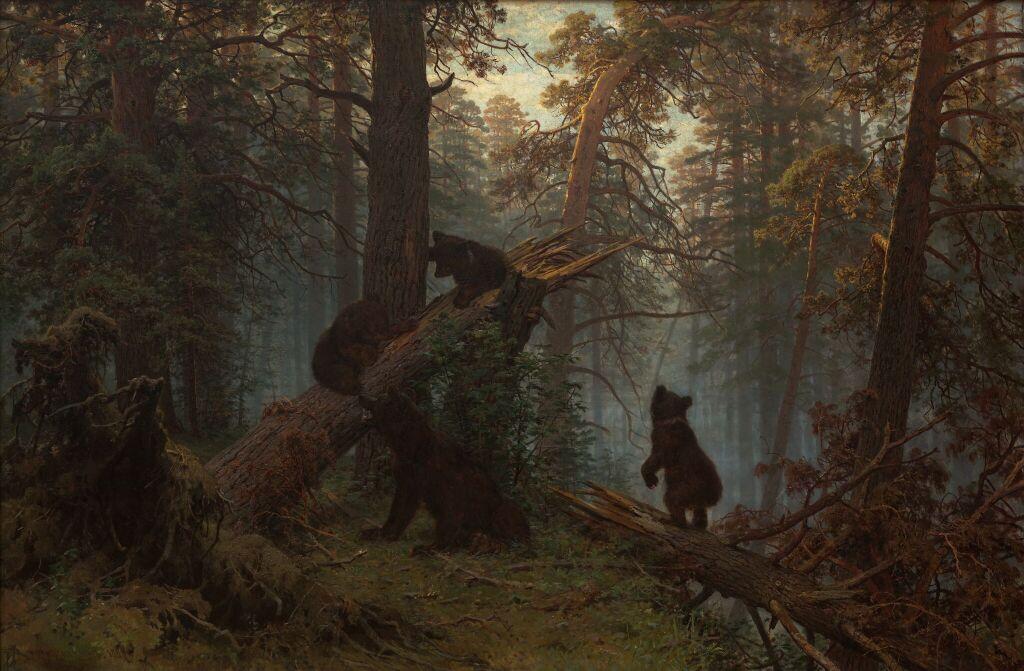
Morning in a Pine Forest, Ivan Shishkin (Tretyakov Gallery)
The creation of the painting involved collaboration between two artists. In 1889, Konstantin A. Savitsky developed the concept of a composition featuring bears, while Ivan Ivanovich Shishkin executed the overall landscape design and the majority of the painting. During this process, Shishkin produced two pencil sketches and one oil sketch; the final form of the bear figures was applied by Savitsky.
The work was exhibited under both artists’ names at the 17th Itinerant Exhibition; however, at the request of the purchaser Pavel M. Tretyakov, Savitsky’s signature was removed from the canvas. From its inception, museum catalogs and archival records have consistently attributed the work solely to Shishkin. This has led to ongoing scholarly debates regarding the painting’s authorship.
Morning in a Pine Forest was executed in oil on canvas in 1889. The painting measures 139 × 213 cm. It was purchased directly from the artist in 1889 by Pavel M. Tretyakov and incorporated into the Tretyakov Gallery collection. Its museum inventory number is Inv. 841.
The signature “I. Shishkin, 1889” appears in the lower left corner of the canvas. It is known that Savitsky’s signature was later obscured by a brushstroke. This physical trace is regarded as tangible evidence of the collaborative production process.
Morning in a Pine Forest depicts a mist-covered pine forest in the early morning hours. At the center of the composition lies a fallen pine trunk with a family of bears resting upon it. While the animal figures in the foreground capture the viewer’s attention, the primary element of the composition remains the forest landscape itself.
The contrast between the upper regions where sunlight touches the treetops and the hazy depths of the forest enhances spatial depth. The bear figures soften the dramatic impact of the fallen tree, transforming the narrative tone of the scene.
The painting was met with immediate public interest upon its first exhibition. In the twentieth century, Shishkin’s art was sometimes criticized as overly naturalistic, and the work’s broad popular appeal was occasionally evaluated within the framework of kitsch.
The painting’s popularity increased through reproductions and commercial applications. In 1913, a section of the painting featuring the bear figures was used on packaging for “Mişka Kosolapıy” brand sugar, and this image later circulated with minor modifications under the “Krasnıy Oktyabr” brand. This process significantly expanded the painting’s visibility beyond the art world.
Damadanova, S. R. “Nasledie oteçestvennogo izobrazitel’nogo iskusstva v kontekste ideyno-obraznogo soderjaniya proizvedeniy russkih hudozhnikov XIX veka.” *Nauka i Mir* 7/23 (2015): 149–152. Accessed January 18, 2026. https://www.elibrary.ru/download/elibrary_23763566_70336587.pdf
Kulyandina, L. D. ““Utro v Sosnovom Lesu” İ. İ. Şişkina: Istoriya sozdaniya i sekret populyarnosti”. Kazan: Kazanskaya Gosudarstvennaya Konservatoriya imeni N. G. Jiganova, (2023: Accessed January 18, 2026.
Muzey Brendov, İstorii i Dizayna Upakovki. "Metamorfozıy fantika "Mişka kosolapıy." Accessed January 18, 2026.
Samohin, Aleksandr V. ““Utro v Sosnovom Lesu” İ. İ. Şişkina i russkiy “bestiariy” vtoroy poloviny XIX veka.” *Academia* 2 (2023): 150–160. Accessed January 18, 2026. https://www.elibrary.ru/download/elibrary_54311916_20801980.pdf
Tretyakovskaya Galereya. “Utro v Sosnovom Lesu – Şişkin İvan (1832–1898).” Accessed January 18, 2026.

Morning in the Pine Forest (Painting) (Merve Sürücü)
Original Name(s) | Morning in a Pine Forest | ||||||||
|---|---|---|---|---|---|---|---|---|---|
Type(s) | Landscape animal painting | ||||||||
Dimension(s) | 139 × 213 cm | ||||||||
Collection | Tretyakov Gallery | ||||||||
Technique | Oil on canvas | ||||||||
Artist | Ivan Ivanovich Shishkin (1832–1898) | ||||||||
No Discussion Added Yet
Start discussion for "Morning in the Pine Forest (Painting)" article
Historical and Cultural Context
Origin and Collaborative Authorship
Technical Features
Composition and Imagery
Reception and Circulation in Popular Culture