


This article was automatically translated from the original Turkish version.
Shell inlay art is a traditional decorative art achieved by embedding shell pieces into recesses carved into wooden surfaces. The shell used in this art form is a hard, glossy, and phosphorescent material found on the inner surfaces of the shells of marine creatures such as mussels and oysters. Due to its luster and durability, shell has been valued for decorative purposes for centuries.
The craft of shell inlay is known as “sedefkârlık,” and the artisan who practices it is called a “sedefkâr.” In sedefkârlık, shell is not the only material used for ornamentation; horn, tortoiseshell, ivory, bone, filigree, and various metal wires—such as gold, silver, and brass—are also employed. These materials are typically applied alongside dark-colored, hard woods. Species such as ebony, walnut, and maun are preferred because they enhance the color and shine of the shell.
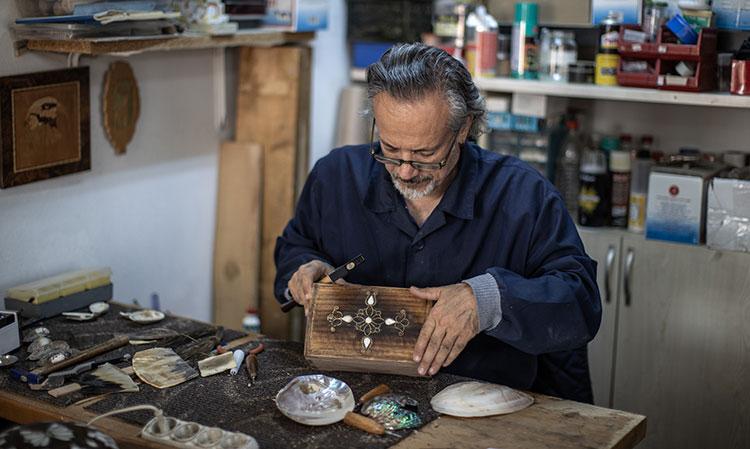
Master practicing Wood Carving and Shell Inlay Art (Anadolu Agency)
The shell inlay process consists of several stages. First, a design is drawn onto the surface to be decorated, and channels are carved along the edges of the motif using a steel-tipped chisel. Thin metal wires are then inserted into these channels and hammered into place. The interior of the motif is carved out, and shell pieces are cut to fit precisely into these recesses. Once the inlay is complete, the surface is smoothed using fine files and sandpaper, and finally polished with special varnishes to achieve a glossy finish. The most commonly used decorative motifs are geometric patterns, floral designs, and calligraphic forms characteristic of Islamic calligraphy.

Example of Shell Inlay Art (Ministry of Culture and Tourism of the Republic of Türkiye)
History and Development
Historically, shell inlay art was first used in Anatolia during the Seljuk period and reached its peak during the Ottoman era, particularly in the 17th and 18th centuries. Shell inlay is frequently found on Ottoman palace and mosque furnishings, including Quran cases, lecterns, tables, chairs, divans, desks, and seating. Examples also appear on everyday objects such as sword hilts, tobacco trays, coffee sets, nail files, and bellows.
Today, shell inlay remains a traditional craft passed down through master-apprentice relationships in various regions of Türkiye, notably in Kahramanmaraş, Gaziantep, and Adıyaman. The art is also transmitted through universities, community education centers, and workshops. Its application is highly diverse, appearing on numerous objects such as canes, combs, toothbrushes, jewelry boxes, frames, mirrors, chairs, tables, backgammon sets, and daggers, as well as on tourist souvenirs. Moreover, this art is actively employed in the restoration of historical artifacts found in museums and monuments.

Shell Inlay Art (Ministry of Culture and Tourism of the Republic of Türkiye)
Shell inlay art is not merely a craft but also an important heritage that shapes the identity and cultural memory of artisans. Preserving this art holds significant value for cultural continuity. In this context, shell inlay art was jointly nominated by Türkiye and Azerbaijan in 2023 and inscribed on UNESCO’s Representative List of the Intangible Cultural Heritage of Humanity.
Its inclusion on this list has affirmed shell inlay as a cultural value requiring protection, both locally and internationally. The traditional knowledge base of sedefkârlık is now also shared in digital environments, creating opportunities for learning and intercultural exchange through social media, blogs, and online workshops.
Anadolu Ajansı. “Ahşap Oymacılığı ve Sedef Kakma Sanatına 20 Yıldır Hayat Veriyor.” Anadolu Ajansı. Accessed July 6, 2025.
Ministry of Culture and Tourism of the Republic of Turkey. "Sedef Kakma Sanatı." Ministry of Culture and Tourism of the Republic of Turkey. Accessed July 6, 2025. https://yakegm.ktb.gov.tr/TR-359148/sedef-kakma-sanati.html.
Ministry of Culture and Tourism of the Republic of Türkiye. “Sedef Kakma Sanatı / Art of Mother-of-Pearl Inlay.” Ministry of Culture and Tourism of the Republic of Türkiye. Accessed July 6, 2025. https://yakegm.ktb.gov.tr/TR-131496/sedef-kakma-sanati--art-of-mother-pearl-inlay.html.
UNESCO. “Craftsmanship of Mother-of-Pearl Inlay.” UNESCO Intangible Cultural Heritage Lists. Accessed July 6, 2025. https://ich.unesco.org/en/RL/craftsmanship-of-mother-of-pearl-inlay-01874.

No Discussion Added Yet
Start discussion for "Mother-of-pearl Inlay Art" article
Materials Used
Production Techniques
Geographical Spread and Application Areas