


This article was automatically translated from the original Turkish version.
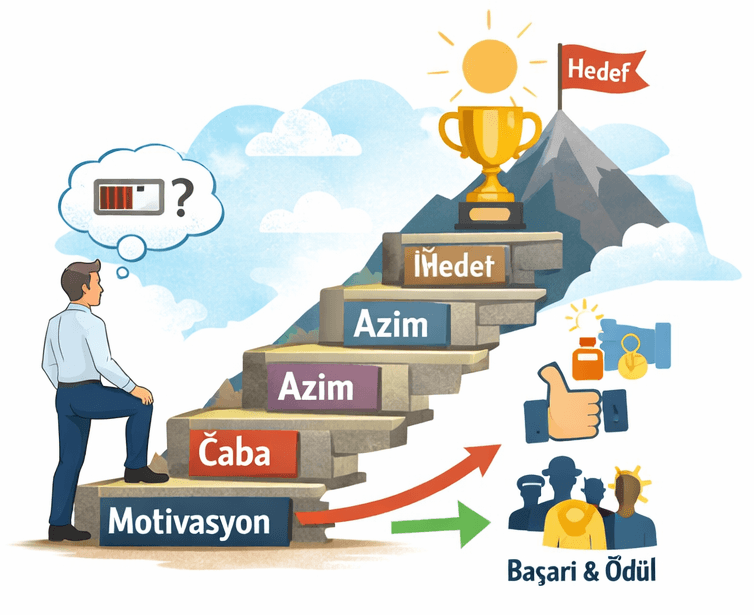
Motivasyon Süreci
(Yapay Zeka ile Oluşturulmuştur)
Motivation is an internal or external process that initiates, directs, and sustains behavior toward a specific goal. It derives from the Latin word movere, meaning "to move." As a psychological phenomenon, motivation emerges from the interaction among needs, drives, and reinforcing stimuli. The process begins when an organism perceives a deficiency (need), continues as the resulting tension transforms into action (drive or motivation), and concludes with the attainment of the goal. In academic literature, motivation is regarded not merely as a biological requirement but as a complex structure encompassing cognitive, social, and emotional components.
The fundamental distinction based on the source of motivation is between intrinsic and extrinsic motivation.

Motivation (Generated by Artificial Intelligence)
Theories explaining motivation are generally categorized into two main types: "Content" theories and "Process" theories.
Content Theories focus on what motivates individuals, that is, the nature of human needs. The most well-known approach in this category is Maslow’s Hierarchy of Needs, which organizes human needs into five basic levels ranging from physiological requirements to self-actualization. Herzberg’s Two-Factor Theory distinguishes between "hygiene factors" that prevent dissatisfaction and "motivators" that enhance motivation in the workplace. McClelland’s Theory of Need for Achievement posits that individuals are driven by needs for achievement, power, and affiliation.
Process Theories examine how motivation arises and is maintained. Vroom’s Expectancy Theory argues that motivation depends on the belief that effort will lead to performance, and performance will lead to a desired reward. Adams’ Equity Theory focuses on how an individual’s perception of fairness, derived from comparing their inputs and outcomes with those of others, influences motivation. Locke’s Goal-Setting Theory provides empirical evidence that specific, measurable, and challenging goals enhance performance.
Motivation is recognized as a fundamental determinant of performance in both educational sciences and business management. In education, motivation directly affects student engagement, resilience in the face of challenges, and the durability of knowledge acquisition. Fostering curiosity and supporting autonomy are key motivational elements that enhance academic success.
In organizational contexts, motivation is directly linked to job satisfaction, organizational commitment, and productivity. High levels of employee motivation in businesses contribute not only to improved individual performance but also to the achievement of institutional strategic objectives. Motivation is a multidimensional process that determines the direction and intensity of human behavior and constitutes the fundamental dynamic of individual and societal development.

Motivasyon Süreci
(Yapay Zeka ile Oluşturulmuştur)
Classification
Theoretical Framework
Function