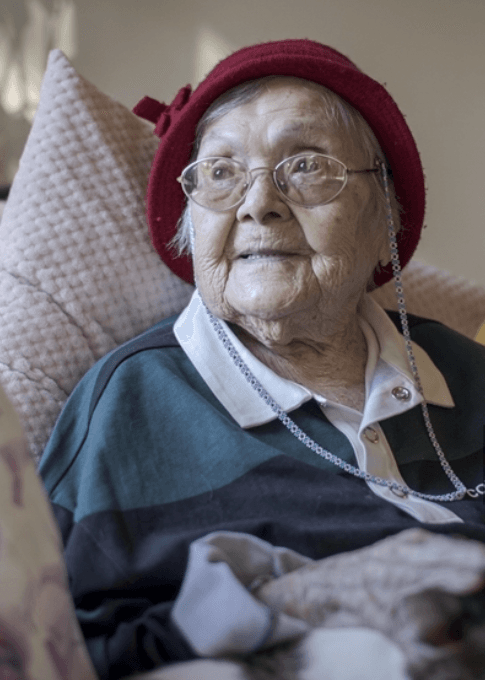



Türkiye's first female Sumerologist, Muazzez İlmiye Çığ, was born on 20 June 1914 in Bursa. Her family consisted of immigrants from Crimea. Her father had migrated from Crimea to the Merzifon district of Amasya, while her mother had moved to Bursa. When the family was living in İzmir, they relocated to Çorum after the occupation of İzmir on 15 May 1919, which they considered safer. Muazzez İlmiye Çığ began primary school in Çorum; after the family returned to Bursa, she continued her education there.
In Bursa, at the private school Bizim Mektep, she took French and violin lessons. In 1926 she entered the Bursa Girls’ Teacher Training School through an entrance examination and graduated in 1931.
Muazzez İlmiye Çığ and the Journey to Sumer Part 1 (Serkan Koç / Kam Film)
After graduation, she was assigned to Eskişehir, where her father also worked, and taught there for approximately five years. On 15 February 1936 she enrolled in the Hittitology Department of the Faculty of Language, History and Geography at Ankara University. During her studies, she took courses from prominent scientists who had fled Nazi Germany and were teaching at the university. She studied Hittite language and culture with Professor Hans Gustav Guterbock and Sumerian and Akkadian languages as well as Mesopotamian culture with Professor Benno Landsberger. She graduated from the faculty in 1940, marking the beginning of her scientific career.
Immediately after graduating in 1940, she was appointed as an expert at the Archives of Cuneiform Documents at the Istanbul Museum of Ancient Oriental Antiquities. In the same year, she married M. Kemal Çığ, Director of the Topkapı Palace Museum.
Together with her colleagues at the museum, Hatice Kızılyay and Dr. F. R. Kraus, she cleaned, classified, numbered, and cataloged tens of thousands of tablets inscribed in Sumerian, Akkadian and Hittite languages stored in the museum’s depot. As a result of these efforts, an archive of 74,000 cuneiform tablets was established; Çığ also contributed to the preparation and publication of copies of 3,000 tablets.
Her international activities include:
Even after retiring in 1972, she continued her scholarly work. She translated Professor Samuel Noah Kramer’s book History Begins at Sumer into Turkish; the book was published in 1990 under the title “Tarih Sümer’de Başlar”. Inspired by the great interest in this work, she began writing numerous books from 1993 onward aimed at both children and adults to introduce Sumerian and Hittite cultures. She produced a significant body of work comprising thirteen books.
In addition to her scientific work, Muazzez İlmiye Çığ was recognized as one of Turkey’s foremost advocates for women’s rights. Her messages regarding women’s education, freedom and role in social life had a profound impact on society.
Muazzez İlmiye Çığ was married to M. Kemal Çığ from 1940 to 1983 and was the mother of two daughters. Throughout her life, she received numerous awards, including the Professional Service Award, the Free Human Award and the Melvin Jones Friendship Award.
Çığ, one of the pioneering figures in Sumerology worldwide, passed away on 17 November 2024 at the age of 110 in a hospital in Mersin, where she had been receiving treatment, following a long and productive life.
In an interview conducted on 24 December 2021, 108-year-old Muazzez İlmiye Çığ recounted pivotal moments in her life, her perspective on Sumerology and her philosophy of work.【1】
She emphasized that choosing to work at the Istanbul Archaeology Museum instead of pursuing an academic career was the most important turning point in her life, one that shaped her professional path.

Interview with Muazzez İlmiye Çığ (AA)
While recounting how she entered the Faculty of Language, History and Geography at Ankara University, she stated that choosing Sumerology opened up a “whole new world” to her. She noted that despite difficult economic conditions, her family’s support enabled her to make the decision to attend university.
She affirmed that after university, she chose to work at a museum rather than pursue an academic career, calling it the right decision. She described how her scientific work at the museum led to international collaborations and numerous publications.
Çığ stated that even though she could no longer actively conduct research, she continued to follow publications. She emphasized that Turkey’s accumulated knowledge on Sumerology has no equivalent in the world and highlighted the central role of Sumerian culture in human history.
Çığ defined success as “working without thinking.” She urged young people to read extensively, remain steadfast in their goals and share knowledge, with these words:
“Life is work. The Sumerians said 5,000 years ago: ‘You wasted your time — what good did it do?’”【2】
Comparing the era of her education with the present day, she stated that Turkish women have made tremendous progress over the past 80 years, equivalent to the centuries-long development seen in Europe.
She emphasized that Atatürk established the Faculty of Language, History and Geography to train experts who would investigate the origins of the Turkish language, history and culture.
She said that moving to Mersin made her very happy and that she remains in constant contact with students and visitors there. She illustrated her familiarity with technology by referencing activities from her childhood and noted that she uses computers and modern devices comfortably.
Anadolu Ajansı. "108 yaşındaki Sümerolog Muazzez İlmiye Çığ, hayatının dönüm noktasını anlattı." Accessed November 15, 2025. https://www.aa.com.tr/tr/roportaj/108-yasindaki-sumerolog-muazzez-ilmiye-cig-hayatinin-donum-noktasini-anlatti/2456439
Anadolu Ajansı. "108-year-old Turkish Sumerologist say work at museum turned life around." Accessed November 15, 2025. https://www.aa.com.tr/en/culture/108-year-old-turkish-sumerologist-say-work-at-museum-turned-life-around/2457081
Bin Yaprak. "İlk Türk Kadın Sümerolog: Muazzez İlmiye Çığ." Accessed November 15, 2025. https://binyaprak.com/kesfet/ilk-tuerk-kadin-suemerolog-muazzez-ilmiye-cig
NTV Haber. "Muazzez İlmiye Çığ kimdir? Muazzez İlmiye Çığ'ın biyografisi." Accessed November 15, 2025. https://www.ntv.com.tr/turkiye/muazzez-ilmiye-cig-kimdir-muazzez-ilmiye-cigin-biyografisi,WSMsdR4SO0-Oi6m_zUYDag
Serkan Koç / Kam Film YouTube Channel. "Uygarlığın Kökeni » Muazzez İlmiye Çığ ile Sümer'e Yolculuk 1. Bölüm." Accessed November 15, 2025. https://www.youtube.com/watch?v=YRw229-5aOA
[1]
Anadolu Ajansı. "108 yaşındaki Sümerolog Muazzez İlmiye Çığ, hayatının dönüm noktasını anlattı." Son Erişim: 15.11.2025. https://www.aa.com.tr/tr/roportaj/108-yasindaki-sumerolog-muazzez-ilmiye-cig-hayatinin-donum-noktasini-anlatti/2456439
[2]
Anadolu Ajansı. "108 yaşındaki Sümerolog Muazzez İlmiye Çığ, hayatının dönüm noktasını anlattı." Son Erişim: 15.11.2025. https://www.aa.com.tr/tr/roportaj/108-yasindaki-sumerolog-muazzez-ilmiye-cig-hayatinin-donum-noktasini-anlatti/2456439

Education and Teaching Years
Scientific Career
Social Contributions
Personal Life
Death
Information Provided in the AA Interview (2021)
Beginning of Her Education
A Turning Point in Her Life
Her Perspective on Sumerology
Her Understanding of Success and Advice to Students
On the Social Status of Women
Her Views on Atatürk and the Faculty of Language, History and Geography
Her Choice to Live in Mersin and Relationship with Technology