


This article was automatically translated from the original Turkish version.
+2 More
Location | Mucur Türkiye Kırşehir | ||||||||
|---|---|---|---|---|---|---|---|---|---|
Depth(s) | 7-8 metres | ||||||||
Period(s) | Roman period Middle Byzantine period (8th-9th century CE) 3rd-4th century CE (Early Christian Period) | ||||||||
Structure(s) | 42 rooms ventilation shafts corridors secret passages places of worship stables | ||||||||
Feature(s) | Circular keystones narrow and low corridors | ||||||||
Protection | First Degree Archaeological Site Area | ||||||||
Tourism | Open to visits | ||||||||
Mucur Underground City is located beneath the town center of Mucur district within the boundaries of Kırşehir Province, Türkiye. The city was carved out of volcanic tuff rock and lies approximately 7–8 meters below the surface. Some sections extend down to as many as six levels. The underground settlement covers a wide area, and currently only two levels are open to visitors. Existing structures include rooms, corridors, stables, worship areas, secret passages, and ventilation shafts.

Mucur Underground City (Anadolu Agency)
The construction of Mucur Underground City is generally dated to the Roman period, particularly the 3rd and 4th centuries AD. During this time, Christian communities living in the region built underground cities to protect themselves from persecution, continue their worship, and seek refuge. It is also believed to have been used during the Middle Byzantine period (8th–9th centuries AD) as a defense against Arab raids.
Mucur Underground City was accidentally discovered during construction work in 1974. In 1988, the Kırşehir Municipality carried out cleaning and entrance arrangement works. The 4,795 square meter area above the underground settlement was expropriated by the Ministry of Culture in 1991. The site, under the jurisdiction of the General Directorate of Cultural Heritage and Museums of the Ministry of Culture and Tourism, is supervised by the Kırşehir Museum. It was officially registered as a first-degree archaeological site requiring protection by the Kayseri Council for the Protection of Cultural and Natural Heritage on 22.07.1989 with decision no. 457. In 2015, environmental improvements were completed and surveying work was finalized.

Mucur Underground City (Republic of Türkiye Kırşehir Governorship)
To date, 42 rooms have been identified within the underground city. These rooms contain large buried storage and water cisterns, water wells, and niches. The numerous niches found in some circular-plan rooms suggest that these areas may have been used for worship.
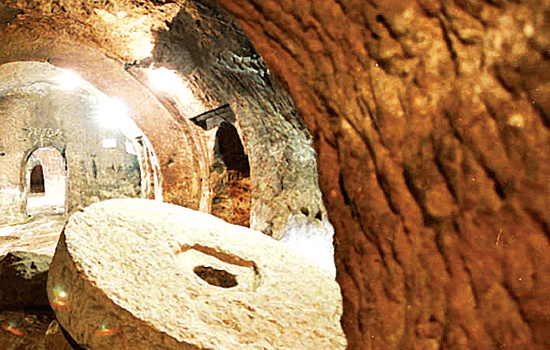
Corridors are typically 1–1.5 meters high and 0.5–1 meter wide. It is believed that these narrow and low corridors were deliberately designed for defensive purposes against potential attacks. Large circular stone blocks used to seal the entrances of main passages and special chambers are particularly notable.
The ventilation shafts of the underground city open to the surface, and five of them remain accessible today. These shafts were used to ensure air circulation within the interior spaces.

Mucur Underground City (Governorship of Kırşehir, Republic of Türkiye)
The underground city is currently open to tourism. Due to its location within the district center and its structural similarities to other underground cities in the Cappadocia region (Derinkuyu, Kaymaklı, Zelve), it is being considered for inclusion in Cappadocia tourism circuits. Only a small portion of the extensive underground structure beneath Mucur has been opened to visitors, and the full extent of the settlement has yet to be fully uncovered.
Anadolu Ajansı. “Şehrin Altında Altı Katlı Yeraltı Şehri.” Accessed June 16, 2025. https://www.aa.com.tr/tr/yasam/sehrin-altinda-alti-katli-yeralti-sehri/332085.
Kurtulay, Zeynep. “Mucur Yeraltı Şehri.” *Türkiye Turizm Ansiklopedisi*, 2019. Accessed June 16, 2025. https://turkiyeturizmansiklopedisi.com/mucur-yeralti-sehri.
Kırşehir İl Directorate of Culture and Tourism. "Mucur Yeraltı City." T.C. Ministry of Culture and Tourism. Accessed June 16, 2025. https://kirsehir.ktb.gov.tr/tr-195658/mucur-yeralti-sehri.html.
T.C. Kırşehir Valiliği. "Mucur Yeraltı Şehri." Accessed June 16, 2025. http://www.kirsehir.gov.tr/mucur-yeralti-sehri.
Turkish Museums. "Kırşehir Mucur Yeraltı Şehri." Accessed June 16, 2025. https://www.turkishmuseums.com/museum/detail/2120-kirsehir-mucur-yeralti-sehri/2120/1.

Location | Mucur Türkiye Kırşehir | ||||||||
|---|---|---|---|---|---|---|---|---|---|
Depth(s) | 7-8 metres | ||||||||
Period(s) | Roman period Middle Byzantine period (8th-9th century CE) 3rd-4th century CE (Early Christian Period) | ||||||||
Structure(s) | 42 rooms ventilation shafts corridors secret passages places of worship stables | ||||||||
Feature(s) | Circular keystones narrow and low corridors | ||||||||
Protection | First Degree Archaeological Site Area | ||||||||
Tourism | Open to visits | ||||||||
No Discussion Added Yet
Start discussion for "Mucur Underground City" article
History
Discovery and Archaeological Studies
Spatial Structure and Architectural Features
Tourism and Conservation Status