This article was automatically translated from the original Turkish version.
Type of Geographical İndication | Mahreç Sign | ||||||||
|---|---|---|---|---|---|---|---|---|---|
Application Date | 26.11.2015 | ||||||||
Registration Number | 342 | ||||||||
Registration Date | 09.04.2018 | ||||||||
Product / Product Group(s) | Textiles | ||||||||
Province(s) | Ankara | ||||||||
Applicant/Registrant(s) | Nallıhan Development Foundation | ||||||||
Nallıhan Örtmesi is a traditional handwoven textile product unique to the Nallıhan district of Ankara. As part of Nallıhan’s weaving tradition located along the historic Silk Road, the continued practice of sericulture in the region plays a significant role in the production of these coverings. On 26 November 2015 an application was submitted and on 9 April 2018 it was registered as a certification mark under Law No. 6769 on Industrial Property. The registration was carried out by the Nallıhan Development Foundation.
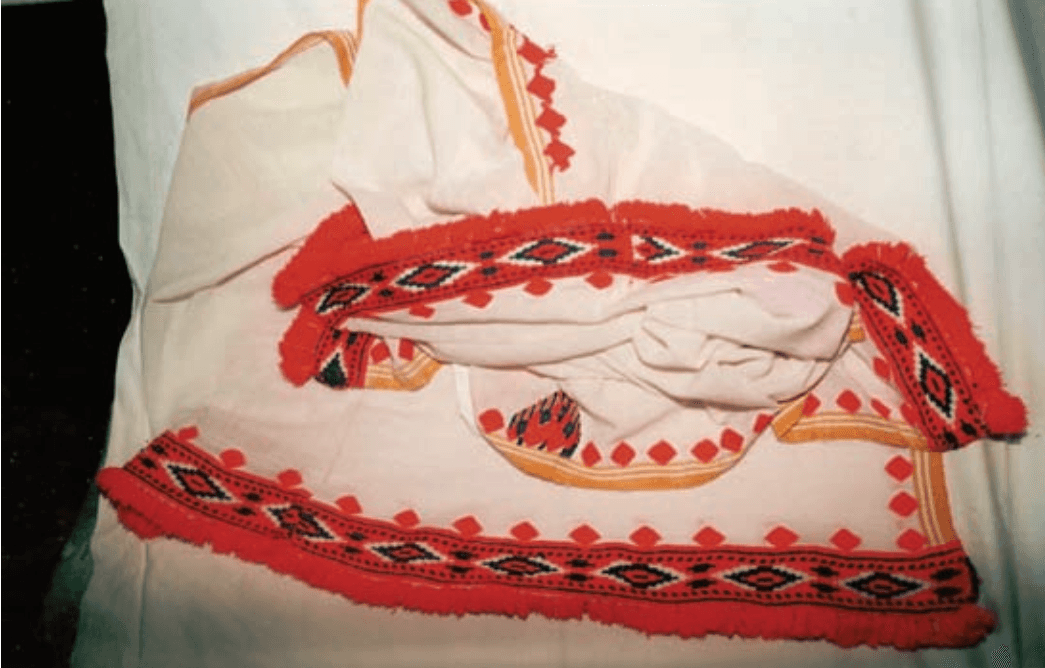
Nallıhan Örtmesi is a woven textile designed to cover the head and upper part of the body. It is produced using silk silk-cotton blends or cotton yarns. The warp yarn known as “kız kıvrağı” a twisted cotton yarn is prepared using a soap-treatment technique; this method is distinctive to Nallıhan Örtmesi.
Along both long edges of the covering are strips made from spun cocoon silk dyed in natural colors such as brown mustard or yellow. These strips are colored using natural materials such as oak galls walnut shells or mulberry cores. At the ends of these strips triangular motifs are woven using the brocade technique at the center of the long edges. These motifs are positioned to appear at the top when the covering is worn on the head and allow for two-sided use.
The short edges and the portion covering the head are decorated with multicolored motifs created using the brocade technique.
While there are no restrictions on patterns the most common motifs include “Göbekli” “Albaşlı” “Zülüf Tarağı” “Sarıgöz” “Guguk” “Bibercik” “Hambarcık” “İlikli Para” “Köy Gezen” and “Koç Boynuzu”. These designs can be created using either pre-dyed yarns or yarns dyed with natural pigments. Along the short edges there are round tassels approximately 1.5 cm in length made from thick cotton yarn. These tassels are prepared using a special tying technique.
The width of Nallıhan Örtmesi ranges from 85 to 104 cm and its length from 118 to 200 cm. The warp density is set at 10 threads per centimeter. The weaving is done using the plain weave technique; brocade is used along the long edges and kilim weaving along the short edges.
The production of Nallıhan Örtmesi is carried out on handlooms. The “kız kıvrağı” warp yarn (20/1 or 20/2 twisted cotton yarn) undergoes a soap-treatment process to enhance durability and facilitate weaving. For this process white solid soap warm water and a basin are used. The yarn is soaked while in hanks then soaped rubbed by hand to smooth it and passed tightly through a woolen cloth. It is then wound onto bobbins to prepare it for weaving.
The strips along the long edges are made from spun cocoon silk dyed with natural pigments. Dyeing is completed by immersing the yarn in colored water obtained by boiling plant materials letting it soak and then rinsing it in cold water. During weaving motifs are created using brocade and kilim techniques according to the weaver’s creativity. The tassels at the ends of the covering are made from 60 strands of yarn; the fringes are twisted with two fingers knotted and the tassel yarn is tightly threaded between these knots and cut. After weaving is complete the covering is washed in warm water to remove soap residue.
The production of Nallıhan Örtmesi is restricted to the Nallıhan district of Ankara. Although materials do not need to be sourced exclusively from the district all production stages must take place in Nallıhan to ensure the transmission of世代相传的技艺和传统方法 onto the product.
Compliance with registration requirements is monitored by a control commission coordinated by the Nallıhan Development Foundation. The commission consists of five members: one master instructor from the Nallıhan Community Education Center two representatives from the Nallıhan Tourism Volunteers Association one member from the Nal-ETİK Cooperative and one member from the Han-İpek Cooperative. Inspections are conducted at least twice a year or in response to consumer complaints and include verification of the following elements:
Inspection results are documented in a report and expert support may be obtained from public or private institutions when necessary.
Türk Patent ve Marka Kurumu. "Nallıhan Örtmesi." Accessed August 16, 2025. https://ci.turkpatent.gov.tr/Files/GeographicalSigns/342.pdf.
Türk Patent ve Marka Kurumu. “Nallıhan Örtmesi.” Coğrafi İşaretler Portalı. Accessed August 16, 2025. https://ci.turkpatent.gov.tr/cografi-isaretler/detay/38173.

Type of Geographical İndication | Mahreç Sign | ||||||||
|---|---|---|---|---|---|---|---|---|---|
Application Date | 26.11.2015 | ||||||||
Registration Number | 342 | ||||||||
Registration Date | 09.04.2018 | ||||||||
Product / Product Group(s) | Textiles | ||||||||
Province(s) | Ankara | ||||||||
Applicant/Registrant(s) | Nallıhan Development Foundation | ||||||||
Description and Distinctive Characteristics
Production Process
Geographical Boundary and Oversight