


This article was automatically translated from the original Turkish version.
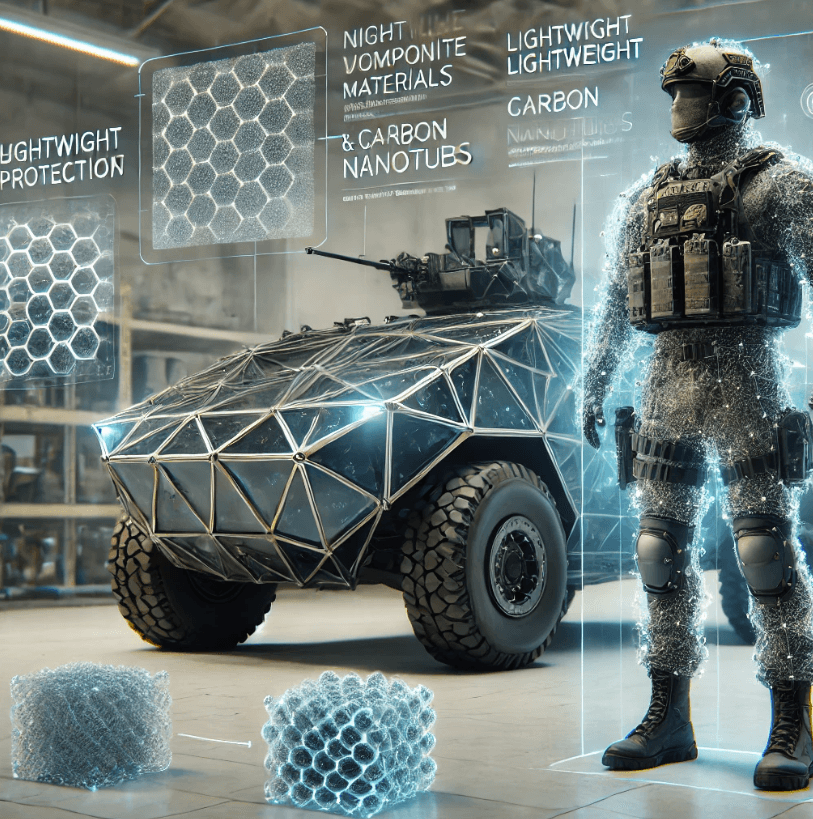
Nano Defense Applications (generated with artificial intelligence)
Definition(s) | Development of advanced materials and systems for the defense industry by controlling matter at the 1-100 nanometer scale. | ||||||||
|---|---|---|---|---|---|---|---|---|---|
Core Disciplines | Materials Science, Physics, Chemistry, Biology, Electronics | ||||||||
Main Application Area(s) | Armor sensors military textiles ammunition weapon systems stealth | ||||||||
Important Nanomaterials | Carbon Nanotubes (CNT), Graphene, Boron Carbide, Nano-aluminum, Titanium Dioxide | ||||||||
Strategic Impact | Achieve technological superiority with lighter, more durable, and functional military equipment. | ||||||||
National defense applications refer to the use of nanotechnology—manipulating matter at the atomic and molecular scale (typically between 1 and 100 nanometers)—in military and national security contexts. At this scale, materials exhibit unique and superior physical, chemical, mechanical, optical, and electrical properties not observed in their bulk forms.
The defense industry aims to leverage these novel properties to develop lighter, stronger, more durable, and multifunctional equipment, weapon systems, and platforms. As an interdisciplinary field, nanotechnology draws upon advances in materials science, physics, chemistry, biology, and electronics to hold the potential for a revolution in military technology. Some experts regard this potential as being as significant as the invention of gunpowder and capable of altering global power balances.
The primary objective of nanotechnology in military applications is to enhance the mobility, survivability, and operational effectiveness of armed forces. This is achieved through solutions that surpass the limitations of conventional materials and systems. For example, armor that is simultaneously lightweight and highly resistant to ballistic impacts, stealth coatings that are difficult to detect by radar, munitions with higher energy density, and smart uniforms capable of sensing environmental conditions are concrete outcomes of nano-defense applications. These technologies play a critical role in meeting the demands of agility, flexibility, and technological superiority required on the 21st-century battlefield.

Nano Defense Research (Generated by artificial intelligence.)
The most prominent area of nano-defense applications is materials science. Nanostructured materials fundamentally transform the performance of defense platforms by offering extraordinary strength-to-weight ratios, thermal resistance, and corrosion resistance compared to conventional materials.
Traditional armor systems typically rely on heavy steel or ceramic plates, which limit vehicle mobility and increase fuel consumption. Nanotechnology addresses this issue through nano-composite materials. Materials such as graphene and carbon nanotubes (CNTs) are many times stronger than steel yet significantly lighter. When integrated into polymer matrices, these composites produce armor plates that enhance protection for both personnel and vehicles while substantially reducing overall weight. Similarly, boron carbide and other ceramic nanomaterials provide high-strength, lightweight armor solutions for tanks and armored personnel carriers. In personal protection, nano-fiber-based bulletproof vests stand out. These vests are lighter, more flexible, and more comfortable than traditional Kevlar vests, thereby improving soldier mobility.
The barrels of firearms degrade over time due to high temperatures and friction, reducing accuracy and shortening service life. Nanomaterials offer effective solutions to this problem. Tungsten and nano-ceramic coatings applied to the inner surfaces of barrels provide exceptional resistance to wear and high temperatures. These coatings extend barrel life while reducing maintenance requirements. Additionally, next-generation materials such as nano-steel alloys enable the production of lighter and more durable weapon barrels. These advancements enhance the overall reliability and performance of weapon systems.

Nano Defense Research (Generated by artificial intelligence.)
Marine vessels are continuously exposed to threats of corrosion and microbiological fouling due to saltwater and atmospheric conditions. This increases maintenance costs and reduces vessel lifespan. Nanotechnology provides advanced coating solutions to combat these issues. Coatings containing metal oxide nanoparticles such as aluminum oxide, titanium dioxide, and nanostructured zirconia are applied to surfaces in contact with seawater. These coatings offer superior corrosion resistance while increasing surface smoothness to inhibit biofilm formation (microbiological fouling). As a result, vessel durability improves, time spent at sea extends, and fuel efficiency increases.
Nanotechnology is revolutionizing the miniaturization and enhanced functionality of military electronic systems. Smaller, faster, and lower-power sensors, computers, and communication systems enable modern armed forces to achieve information superiority. The ability to operate undetected on the modern battlefield is a critical advantage.
Bürgi, Birgit R., and T. Pradeep. “Societal Implications of Nanoscience and Nanotechnology in Developing Countries.” *Current Science* 90, no. 5 (2006): 645–58. http://www.jstor.org/stable/24089112
McINTYRE, ROBIN A. “Common Nano-Materials and Their Use in Real World Applications.” Science Progress (1933–) 95, no. 1 (2012): 1–22.
Raska, Michael. “Strategic Competition for Emerging Military Technologies: Comparative Paths and Patterns.” *PRISM* 8, no. 3 (2019): 64–81. https://www.jstor.org/stable/26864277
Tüylek, Zülfü. “Küçük Şeylerin Hikayesi: Nanomalzeme.” Nevşehir Bilim Ve Teknoloji Dergisi 5, no. 2 (December 2016): 130–41. https://doi.org/10.17100/nevbiltek.284737
Özer, Yusuf. "NANOTEKNOLOJİ’NİN ASKERÎ UYGULAMALARI ÜZERİNE BİR DEĞERLENDİRME." *Güvenlik Bilimleri Dergisi*, IDEF Özel Sayı (2019): 33-52. https://doi.org/10.28956/gbd.551739
Şahin, Emre, Orhan Dağdeviren, and Mustafa Akkaş. "Nano-Nesnelerin İnterneti’nin Gelecekteki Uygulamalarına Yönelik Bir Yol Haritası." *Avrupa Bilim ve Teknoloji Dergisi*, no. 26 (2021): 174-79. https://doi.org/10.31590/ejosat.951879

Nano Defense Applications (generated with artificial intelligence)
Definition(s) | Development of advanced materials and systems for the defense industry by controlling matter at the 1-100 nanometer scale. | ||||||||
|---|---|---|---|---|---|---|---|---|---|
Core Disciplines | Materials Science, Physics, Chemistry, Biology, Electronics | ||||||||
Main Application Area(s) | Armor sensors military textiles ammunition weapon systems stealth | ||||||||
Important Nanomaterials | Carbon Nanotubes (CNT), Graphene, Boron Carbide, Nano-aluminum, Titanium Dioxide | ||||||||
Strategic Impact | Achieve technological superiority with lighter, more durable, and functional military equipment. | ||||||||
No Discussion Added Yet
Start discussion for "Nano Defense Applications" article
Advances in Materials Science
Armored Vehicles and Ballistic Protection
Weapon Systems and Durability
Corrosion-Resistant Coatings for Marine Platforms
Electronics and Sensor Technologies