

This article was automatically translated from the original Turkish version.
Azerbaijani Name | Azərbaycan Marşı | ||||||||
|---|---|---|---|---|---|---|---|---|---|
Type(s) | Official state anthem | ||||||||
Lyricist | Ahmet Cevat | ||||||||
Composer | Üzeyir Hacıbeyli | ||||||||
Written/Composed | 1919 | ||||||||
Adoption | During the independence period (1918–1920) | ||||||||
Reofficialization | 1991 | ||||||||
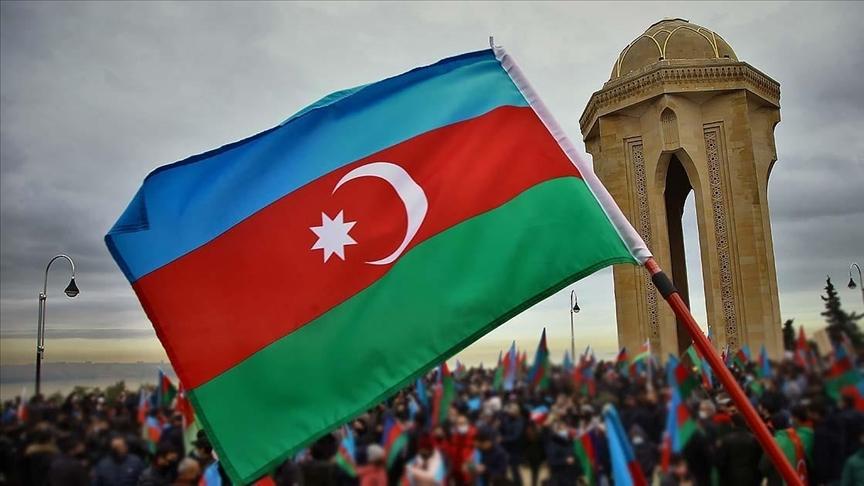
The National Anthem of Azerbaijan (Azərbaycan Marşı) is the official state anthem, composed in march form, that elevates national identity, love of homeland, and the ideal of independence. The lyrics are attributed to Ahmet Cevat and the music to Üzeyir Hacıbeyli; the text was written in 1919 and set to music in the same year. It was used as the national anthem during the republic’s period of independence and regained its official status after the dissolution of the Soviet Union.
Thematically, it progresses around the axes of “homeland,” “flag,” and “heroic children”; musically, it is a spirited and march-like composition reflecting Hacıbeyli’s style, which harmonizes Western harmony with the melodic world of Azerbaijan.
The National Anthem of Azerbaijan (Üzeyir)
The Azerbaijani version of the lyrics is as follows:
Ey qәhrәman övladın şanlı Vәtәni!
Sәndәn ötrü can vermәyә cümlә hazırız!
Sәndәn ötrü qan tökmәyә cümlә qadiriz!
Üç rәngli bayrağınla mәsud yaşa!
Minlәrlә can qurban oldu,
Sinәn hәrbә meydan oldu!
Hüququndan keçәn әsgәr,
Hәrә bir qәhrәman oldu!
Sәn olasan gülüstan,
Sәnә hәr an can qurban!
Sәnә min bir mәhәbbәt
Sinәmdә tutmuş mәkan!
Namusunu hifz etmәyә,
Bayrağını yüksәltmәyә,
Cümlә gәnclәr müştaqdır!
Şanlı Vәtәn, şanlı Vәtәn!
Azәrbaycan, Azәrbaycan!【1】
The Turkish version of the lyrics is as follows:
Ey kahraman evladın şanlı vatanı!
Senin için can vermeye hepimiz hazırız!
Senin için kan dökmeye hepimiz kadiriz!
Üç renkli bayrağınla mesut yaşa!
Binlerce can kurban oldu!
Sinen harbe meydan oldu!
Kendini feda eden askerlerin,
Her biri kahraman oldu!
Sen olasın gülistan!
Sana her an can kurban!
Sana bin bir muhabbet!
Sinemde tutmuş mekân!
Namusunu korumaya,
Bayrağını yükseltmeye,
Bütün gençler müştaktır!
Şanlı vatan, şanlı vatan!
Azerbaycan, Azerbaycan!【2】
The text positions the expressive world of the National Anthem of Azerbaijan along two main axes:
1—War, sacrifice, and defense of the homeland;
2—Heroism and honor-based glorification.
Expressions such as “to give one’s life,” “to shed blood,” “war,” and “to sacrifice oneself” demonstrate that the anthem’s foundational semantic field is centered on struggle and sacrifice. Accompanying evaluative terms such as “heroic,” “glorious,” and “rose garden” are not merely aesthetic descriptions of beauty but values that elevate the notions of collective pride and dignity.
The historical basis for these linguistic choices lies in the prolonged experience of conflict and threat faced by the Azerbaijani Turks in a multiethnic region, and their frequent necessity to defend their homeland.
The memory of traumatic events such as March 31, Kuba, Hocalı, and January 20 (Black January)—periods in which even the right to defend oneself was denied—has been embedded in the anthem’s content. Thus, the glorifying elements in the text point not to a depiction of natural beauty but to a regime of honor built upon the protection of “dignity,” “flag,” and “homeland.”
In alignment with the collective memory shaped by historical experience, the anthem re-creates national identity around the axes of sacrifice, loyalty, and honor, and functions as a political and social pedagogical text that mobilizes younger generations within this normative framework.
Anadolu Ajansı. "Azerbaycan bağımsızlığını yeniden kazanmanın 33. yılını kutluyor." Accessed September 30, 2025. https://www.aa.com.tr/tr/dunya/azerbaycan-bagimsizligini-yeniden-kazanmanin-33-yilini-kutluyor/3366120
Serkan Yüksel, “Bağımsız Türk Devletlerinin Millî Marşlarının Muhtevası Üzerine,” *International Journal of Humanities and Education* 10, no. 23 (2024). Accessed September 30, 2025. https://dergipark.org.tr/en/pub/ijhe/issue/88967/1494135
Üzeyir Youtube Kanalı. "National anthem of Azerbaijan/ Azerbaycan Himni (high quality)." Accessed September 30, 2025. https://www.youtube.com/watch?v=FVHRZcPtVHw&list=RDFVHRZcPtVHw&start_radio=1
[1]
Serkan Yüksel, “Bağımsız Türk Devletlerinin Millî Marşlarının Muhtevası Üzerine,” International Journal of Humanities and Education 10, no. 23 (2024): 406. https://dergipark.org.tr/en/pub/ijhe/issue/88967/1494135
[2]
Yüksel, “Bağımsız Türk Devletlerinin Millî Marşlarının Muhtevası Üzerine, s. 406. https://dergipark.org.tr/en/pub/ijhe/issue/88967/1494135

Azerbaijani Name | Azərbaycan Marşı | ||||||||
|---|---|---|---|---|---|---|---|---|---|
Type(s) | Official state anthem | ||||||||
Lyricist | Ahmet Cevat | ||||||||
Composer | Üzeyir Hacıbeyli | ||||||||
Written/Composed | 1919 | ||||||||
Adoption | During the independence period (1918–1920) | ||||||||
Reofficialization | 1991 | ||||||||
No Discussion Added Yet
Start discussion for "National Anthem of Azerbaijan" article
Lyrics