
This article was automatically translated from the original Turkish version.
+1 More
Type(s) | Comet | ||||||||
|---|---|---|---|---|---|---|---|---|---|
Observation Area | Northern Hemisphere | ||||||||
Class | Long-period | ||||||||
Physical Characteristics | Consists of a nucleus, dust, and gas | ||||||||
Official Designation | C/2020 F3 (NEOWISE) | ||||||||
Comet NEOWISE, a comet observable with the naked eye, was observed in 2020. It derives its name from the NEOWISE mission, which played a key role in its discovery and the acquisition of observational data. It was observed from Earth in July 2020 and reported by various observatories and media outlets.
Comet NEOWISE was detected during observations conducted as part of the NEOWISE space mission. The discovery was made through systematic surveys carried out in infrared wavelengths. The acquired data underwent observational analysis, confirming the object as a comet.
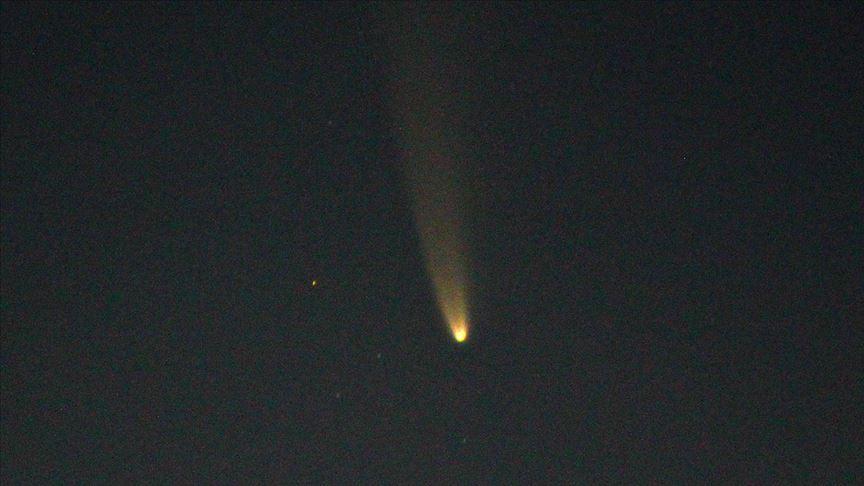
Comet NEOWISE was observable from the Northern Hemisphere in July 2020, appearing near the horizon during early morning and evening hours. On certain dates, it reached brightness levels visible to the naked eye.【1】

Comet NEOWISE (AA)
NEOWISE is a space observation program designed for wide-field infrared surveys. The data collected under this mission are used to detect and characterize small Solar System bodies.
Observations in infrared wavelengths provide a critical data source for determining the physical properties of asteroids near Earth. Measurements obtained in this context enable analysis of object brightness and comparison of observational results across different wavelengths.
NEOWISE data undergo systematic processing, with corrections applied to enhance measurement accuracy. These methods aim to ensure more reliable evaluation of observational results.
Data collected under the NEOWISE mission are based on infrared wavelength observations. These data are used primarily to determine the physical properties of asteroids near Earth. During data processing, photometric measurements are performed and color corrections are applied. These corrections make brightness values obtained at different wavelengths comparable.
The data processing procedure aims to eliminate systematic effects in measurements and improve observational accuracy. These methods enable more reliable assessments of the surface properties and reflectance characteristics of small Solar System bodies.
Comet NEOWISE attracted attention in both scientific circles and the general public during the summer of 2020. Photo galleries and observational announcements published by media outlets demonstrated that the comet was widely followed by a broad audience.
Anadolu Ajansı. “NEOWISE Kuyruklu Yıldızı Samsun Semalarında Gözlendi.” Anadolu Ajansı Foto galeri. Accessed February 4, 2026. https://www.aa.com.tr/tr/pg/foto-galeri/neowise-kuyruklu-yildiz-samsun-semalarinda-gozlendi
Anadolu Ajansı. “NEOWISE Kuyruklu Yıldızı İdlib Semalarında Gözlendi.” Anadolu Ajansı Foto galeri. Accessed February 4, 2026. https://www.aa.com.tr/tr/pg/foto-galeri/neowise-kuyruklu-yildiz-idlib-semalarinda-gozlendi/146
Anadolu Ajansı. “Neowise Kuyruklu Yıldızı Ankara Üniversitesi Gözlemevi'nde Görüntülendi.” Accessed February 4, 2026. https://www.aa.com.tr/tr/bilim-teknoloji/neowise-kuyruklu-yildizi-ankara-universitesi-gozlemevinde-goruntulendi/1919789
Boğaziçi Üniversitesi Kandilli Rasathanesi ve Deprem Araştırma Enstitüsü. “NEOWISE (C/2020 F3) Kuyruklu Yıldızı.” *bogazici.edu.tr.* Accessed February 4, 2026. https://astronomi.bogazici.edu.tr/neowise-c2020-f3-kuyruklu-yildizi
Meyer, Rachel. *Preprocessing of Astronomical Images from the NEOWISE Survey for Near-Earth Asteroid Detection*. Pence Boyce. Olivet Nazarene University, 2021-05-05. Olivet Scholarship. ONU Digital Collections. https://jstor.org/stable/community.37867884
Myers, Samuel A., Ellen S. Howell, Yanga R. Fernández, Sean E. Marshall, Christopher Magri, Ronald J. Vervack Jr., and Mary L. Hinkle. “NEOWISE Data Processing and Color Corrections for Near-Earth Asteroid Observations.” *The Planetary Science Journal* 6, no. 80 (2025): 1–12. Accessed February 4, 2026. https://www.researchgate.net/publication/390393377_NEOWISE_Data_Processing_and_Color_Corrections_for_Near-Earth_Asteroid_Observations
[1]
Boğaziçi Üniversitesi Kandilli Rasathanesi ve Deprem Araştırma Enstitüsü, “NEOWISE (C/2020 F3) Kuyruklu Yıldızı,” bogazici.edu.tr, Access date: 4 February 2026, https://astronomi.bogazici.edu.tr/neowise-c2020-f3-kuyruklu-yildizi

Type(s) | Comet | ||||||||
|---|---|---|---|---|---|---|---|---|---|
Observation Area | Northern Hemisphere | ||||||||
Class | Long-period | ||||||||
Physical Characteristics | Consists of a nucleus, dust, and gas | ||||||||
Official Designation | C/2020 F3 (NEOWISE) | ||||||||
Discovery
Observational Characteristics
The NEOWISE Mission and Infrared Observation Infrastructure
Data Processing Procedures
Observational and Public Impact