


This article was automatically translated from the original Turkish version.
The Nizami Ganjavi National Azerbaijan Literature Museum, located in the capital of Baku within the framework of the Azerbaijan National Academy of Sciences (ANAS), is a museum that most comprehensively represents activity and classical Azerbaijani literature. With its rich collections and aesthetic architecture, it is regarded as one of culture’s most significant cultural spaces.

Exterior of the Museum (Photo: Duygu Şahinler)
In 1939, for the first time, it was decided to establish a museum in honor of the 800th anniversary of the great poet Nizami Ganjavi, and restoration work on the current building began. However, due to the Second World War, the opening was delayed and the museum was finally opened to the public on 14 May 1945 with a collection focused on Nizami-era Azerbaijani literature. In 1947, the museum’s scope was expanded and in 1967 it was reorganized to encompass all of Azerbaijani literature.
The museum building possesses notable architectural characteristics. Originally constructed in 1850 as a single-story caravanserai, the building underwent various renovations and in 1915 the second floor was redesigned by A. Nikitin. During its conversion into a museum in 1939, two additional floors were added according to the designs of Sadiq Dadashov and Mikayil Huseynov, bringing the structure to four stories state.
The exterior façade is adorned with tiles, busts, and statues of six major literary figures (Fuzûlî, Molla Penah Vagif, Mirza F. Akhundov, Natevan, Jalil Mammadguluzadeh, Cəfər Cabbarlı). The museum is situated on Çeşme Square, facing the Inner City Gate close.

(Photo: Duygu Şahinler)
Between 2004 and 2009, the museum underwent restoration and modernization and was reopened on 14 March 2009 with a message from Azerbaijani President Ilham Aliyev. This renovation introduced contemporary museum concepts: audiovisual digital information systems replaced guided tours, the number of exhibition halls was increased, and technological infrastructure capabilities were enhanced. Today the museum now displays over 100,000 items across 35 main and 15 auxiliary halls.
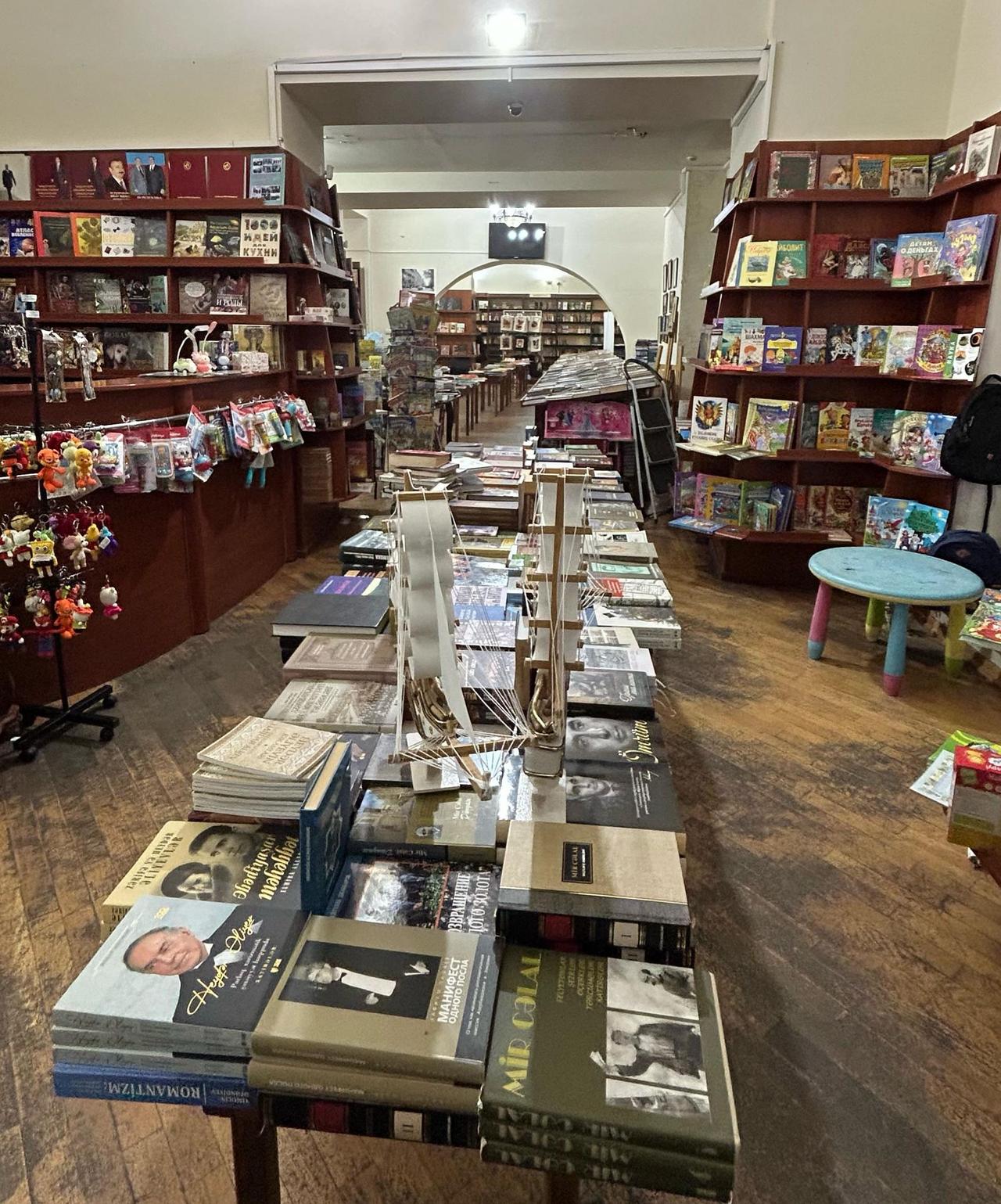
Bookshop located beneath the Literature Museum (Photo: Duygu Şahinler)
The museum features the lives, works, and personal belongings of approximately 4,000 poets and writers from the origins of Azerbaijani literature to the present day. Rare manuscripts, stone printed books, paintings, miniatures, sculptures, and busts enrich the collection exhibits, offering both visual and contextual depth. One of the museum’s most striking features is a dedicated section honoring nationalist and freedom-seeking poets who were persecuted during the Soviet era for their ideas.
The museum also functions as a beautiful arts museum. Works related to literature were created by renowned Azerbaijani painters (Sadiq Sherifzade, Rüstem Mustafayev, Tahir Salahov, etc.), sculptors (Fuad Abdurrahmanov, Omar Eldarov, etc.), miniaturists, and carpet masters (Latif Kerimov, etc.). These works exemplify the fusion of literature with visual aesthetics.
The ANAS Nizami Ganjavi National Literature Museum also operates as a science and publishing center. Each year, scientific publications are produced under five headings:
Risale (Scholarly Studies)
Qaynaq (Sources)
Şerq (Translations)
Hezine (Catalogues)
Meclis (Ceremonies)
The museum has several branches outside Baku. Notable among them are the Aran Region Center in Kürdəmir, the Sergey Yesenin Azerbaijani-Russia Literary Relations Center in Mərdəkan, and the Karabakh Department. The Hurşidbanu Natevan section, originally located in Shusha, was relocated to Baku following the Armenian occupation.
The museum has taken on the mission of teaching Azerbaijani literature, especially to younger generations. Students, accompanied by their teachers, visit the museum to gain comprehensive knowledge of literary and cultural history. Additionally, through work screens on Fevvarələr Square, continuous audiovisual information dissemination is carried out.
The Nizami Ganjavi National Azerbaijani Literature Museum is a word that narrates the thousand-year history of Azerbaijani literature. Today, visitors tour the museum with guides, and photography by visitors is not permitted.

No Discussion Added Yet
Start discussion for "Nizami Ganjavi National Azerbaijani Literature Museum" article
History
Architectural Features of the Museum Building
Renovation and Contemporary Museum Practices
Exhibited Collections and Content
Publishing and Research Activities
Branches and Expansion
Social and Educational Role