

This article was automatically translated from the original Turkish version.
+1 More
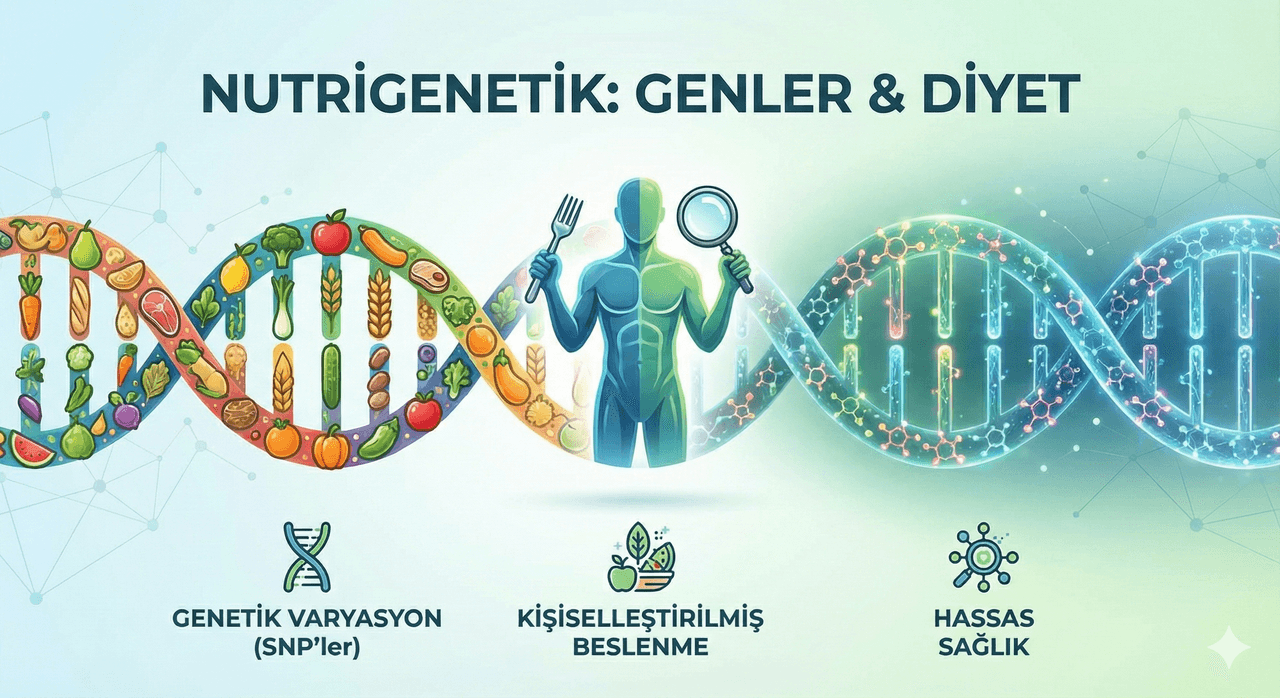
(Yapay Zeka ile Oluşturulmuştur)
Nutrigenetics is an applied scientific discipline that studies how genetic variations in individuals—particularly Single Nucleotide Polymorphisms - SNPs—influence nutritional requirements, food metabolism, and physiological responses to diet. This discipline, which emerges from the integration of genetics, nutrition science, and omics technologies, forms the foundation for Personalized Nutrition and Precision Health approaches, replacing population-wide “one-size-fits-all” dietary recommendations with individualized strategies based on a person’s genotype.
Research into the genetic basis of nutritional requirements began in the mid-20th century with classical genetics. The term “nutrigenetics” was first used in the literature in 1975 by Richard Brennan to describe the role of genetic factors in the treatment of hypoglycemia. With the completion of the Human Genome Project in 2003 and the advancement of high-throughput genotyping technologies, the field has evolved into modern clinical and commercial applications.
Nutrigenetics examines genetic variations in enzymes, transporters, and receptors that determine the fate of nutrients and bioactive compounds in the body—absorption, distribution, metabolism, and excretion. These variations alter the efficiency of metabolic pathways, thereby shaping individual nutritional needs and disease risks.
This cycle, essential for DNA synthesis, repair, and epigenetic control of gene expression (methylation), depends on B vitamins (folate, B12, B6, B2) and is highly sensitive to genetic variations.
Vitamin K metabolism is one of the best-understood biochemical pathways illustrating gene-nutrient-drug interactions.
The processing of dietary fats and cholesterol homeostasis are controlled by a complex genetic network.
The body’s capacity to eliminate xenobiotics (drugs, toxins) and dietary components (caffeine, polyphenols) is genetically determined.
Vitamin D exerts its effects through the Vitamin D Receptor (VDR) in the cell nucleus. Polymorphisms in the VDR gene (FokI, BsmI, TaqI) affect an individual’s ability to utilize vitamin D, calcium absorption, and bone density. Individuals with these variants may require higher vitamin D doses than standard recommendations to manage osteoporosis risk.
Obesity and diabetes are underpinned by low-grade inflammation that is genetically modulated. Variants in the interleukin-6 (IL-6) and tumor necrosis factor-alpha (TNF-α) genes alter an individual’s anti-inflammatory response to dietary omega-3 fatty acids. Individuals with high-risk genotypes have an increased need for omega-3 to reduce inflammation.
Nutrigenetics influences not only metabolism but also what individuals choose to eat. Variants in the TAS1R2 (sweet taste) and TAS2R38 (bitter taste) genes determine individual susceptibility to sugary foods or bitter-tasting vegetables like broccoli. This genetic taste profile directly affects vegetable consumption habits and overall diet quality.
Nutrigenetic tests are tools that translate theoretical molecular knowledge into practical dietary recommendations.
Method: DNA, typically collected via non-invasive methods (buccal swab or saliva), is analyzed for specific SNPs validated by Genome-Wide Association Studies (GWAS) to be associated with nutritional responses.
Test Categories:
Reporting: Results are presented as personalized recommendations such as “caffeine sensitivity,” “lactose intolerance risk,” or “vitamin requirements.”
The commercialization and clinical translation of nutrigenetics have raised several ethical concerns:
The integration of nutrigenetics into routine healthcare depends on developing standardized clinical protocols. In this context, international authorities have proposed the “Nutrigenomics Care Map,” which consists of four key stages: training healthcare professionals, assessing patient suitability, planning personalized interventions, and monitoring outcomes. However, the current lack of education among healthcare providers in interpreting complex genetic data remains the greatest barrier to widespread adoption of this model.
The future vision is shifting away from single-gene analyses toward a “Systems Biology” approach that views the organism as an integrated whole. This new model aims to combine genomic data with proteomic (protein), metabolomic (metabolite), and gut microbiome (gutome) analyses. Powered by artificial intelligence, this multi-omics approach will deliver far more precise nutritional strategies designed not only to prevent disease but to optimize overall health and wellness.
To strengthen the scientific credibility of the field, higher levels of evidence are essential. Beyond existing observational data, large-scale Randomized Controlled Trials (RCTs) are needed to definitively establish causality in gene-diet interactions. Obtaining such robust clinical evidence will elevate nutrigenetics from the realm of “probability” to “certainty,” enabling its inclusion in insurance reimbursement systems and its adoption as a standard component of clinical medicine.
Disclaimer: The content in this article is provided solely for general encyclopedic informational purposes. The information presented here should not be used for diagnosis, treatment, or medical advice. Always consult a physician or qualified healthcare professional before making decisions related to health. Neither the author nor the KÜRE Encyclopedia accepts any liability for consequences arising from the use of this information for diagnostic or therapeutic purposes.
Ceriani, Florencia, Martha Montalvan, Beatriz Quintero, Rosario Suárez, Estefanía Bautista-Valarezo, and Evelyn Frias-Toral. "Ethics of the Clinical Practice of Nutrigenetics and Nutrigenomics." *Clinical Nutrition Open Science* 49 (2023): 58–66. Accessed January 9, 2026. https://doi.org/10.1016/j.nutos.2023.04.006.
De Caterina, Raffaele, J. Alfredo Martinez, and Martin Kohlmeier, eds. *Principles of Nutrigenetics and Nutrigenomics: Fundamentals for Individualized Nutrition*. London: Academic Press, 2020. Accessed January 9, 2026. https://www.sciencedirect.com/book/edited-volume/9780128045725/principles-of-nutrigenetics-and-nutrigenomics
Lam, Hong Nhung, Shih-Ping Lin, Dang Hien Ngan Nguyen, Chiao-Ming Chen, Chien-Tien Su, Te-Chao Fang, and Sing-Chung Li. "Integrative Roles of Functional Foods, Microbiotics, Nutrigenetics, and Nutrigenomics in Managing Type 2 Diabetes and Obesity." *Nutrients* 17, no. 4 (2025): 608. Accessed January 9, 2026. https://doi.org/10.3390/nu17040608.
Marcum, James A. "Nutrigenetics/Nutrigenomics, Personalized Nutrition, and Precision Healthcare." *Current Nutrition Reports* 9 (2020): 338–345. Accessed January 9, 2026. https://doi.org/10.1007/s13668-020-00327-z.
O'Donovan, Clare B., Marianne C. Walsh, Michael J. Gibney, Lorraine Brennan, and Eileen R. Gibney. "Knowing Your Genes: Does This Impact Behaviour Change?" *Proceedings of the Nutrition Society* 76, no. 3 (2017): 182–191. Accessed January 9, 2026. https://doi.org/10.1017/S0029665116002949.
Rahman, N. A., and N. Muhammad. "Precision Nutrition: The Future of Health Management." In *Proceeding of the International Seminar on Islamic Studies 2023 (SEAPIS 2023)*, edited by Amer Hudhaifah Hamzah, Nur Shadwa Shazana Shamrin, and Nur Jannah Mohd Nur, Kota Kinabalu: Fakulti Pengajian Islam, Universiti Malaysia Sabah, 2023. Accessed January 9, 2026. https://doi.org/10.13140/RG.2.2.25074.89281.
Saukko, Paula M., Kate Reed, N. Britten, and L. Hogarth. "Negotiating the Boundary Between Medicine and Consumer Culture: Online Marketing of Nutrigenetic Tests." *Social Science & Medicine* 70, no. 5 (2010): 744–753. Accessed January 9, 2026. https://doi.org/10.1016/j.socscimed.2009.10.066.

(Yapay Zeka ile Oluşturulmuştur)
History
Molecular Foundations and Metabolic Pathways
One-Carbon Metabolism and Methylation
Vitamin K Cycle
Lipid Metabolism and Nuclear Receptors
Detoxification Phases and Bioactive Compounds
Vitamin D and Bone Health
Inflammation and Cytokines
Taste Perception and Food Preference
Energy Homeostasis and Appetite Control
Nutrigenetic Testing and Application Methods
Ethical, Legal, and Social Issues
Clinical Application and Future