

This article was automatically translated from the original Turkish version.
+2 More
Old Malatya (Battalgazi) City Walls are a historical defensive structure located within the boundaries of Meydanbaşı Neighborhood in the Malatya district of Battalgazi, present-day Malatya Province. These walls were constructed following the city’s relocation from its earliest settlement site at Arslantepe, approximately 10 kilometers away, to the area now known as Old Malatya. The structure served over centuries to ensure the military and strategic security of the city during the Roman, Byzantine, Sasanian, Arab, Seljuk and Ottoman periods.
The construction of the walls began as Malatya (then known as Melitene) gained strategic importance as a military center.
The city’s development commenced with the relocation of the headquarters of the 12th Legion (Fulminata) to an area located 4 kilometers north of Arslantepe, the region’s earliest settlement. The foundational elements of the walls were laid between 79 and 81 AD during the reign of Roman Emperor Titus, coinciding with the construction of the legionary headquarters. The Romans selected this location due to its position at a major crossroads, its role as a crossing point along the Euphrates River, and its abundance of water sources and food reserves.【1】 Construction activities were expanded under Emperor Trajan (98–117 AD), who transformed Melitene into a vital frontier garrison along the routes used against the Parthians. With the city’s growth during the reign of Emperor Diocletian (284–305 AD), the walls’ strategic significance increased further, and construction accelerated under Constans I (363 AD). The walls, originally built in fragmented and disconnected sections, were unified, repaired and completed around 532 AD during the reign of Emperor Justinian, coinciding with the city’s emergence as a strategic frontier town during the Sasanian-Byzantine conflicts.
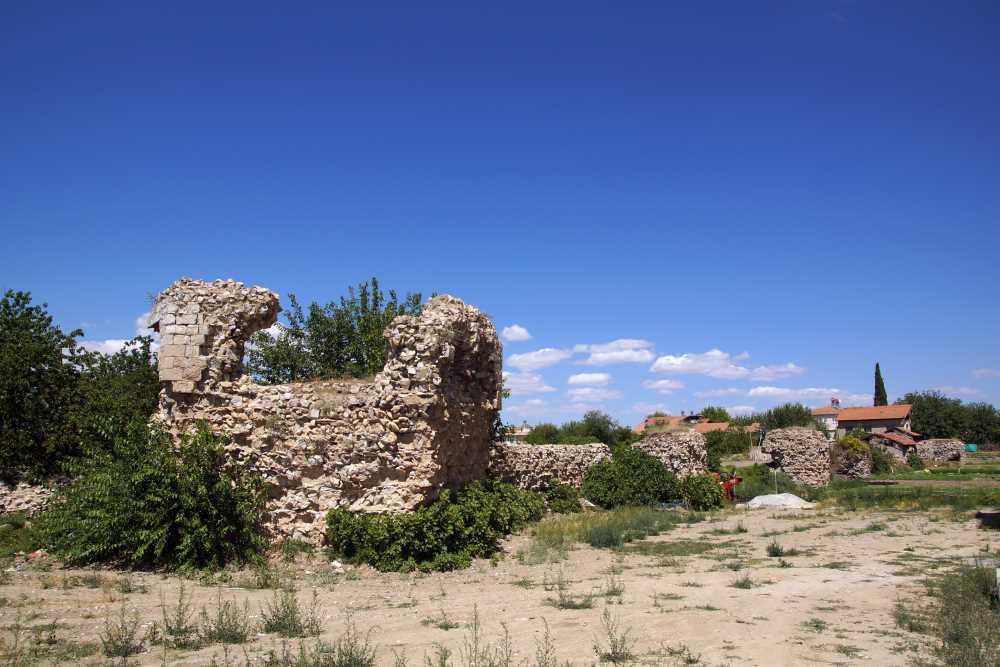
After the city was captured by Muslim forces, the walls suffered repeated damage and underwent multiple repairs during prolonged conflicts. The Abbasid Caliph Harun al-Rashid invested substantial funds to reconstruct them. Historical records note that during the campaign of Great Seljuk Sultan Tughrul Bey in 1057, the walls were in a severely weakened state and the city appeared virtually without fortifications.【2】 The moat surrounding the walls was widened in 1060, and in 1102, after capturing the city, Danişmentli Gümüştekin Ahmet Gazi ordered its restoration. As the structure gradually lost its military defensive function under the Ottoman State, particularly during the 19th century, it suffered extensive destruction and reached the present day in a ruined state.【3】 A portion of the walls was restored and placed under protection by the Battalgazi Municipality between 2010 and 2015.
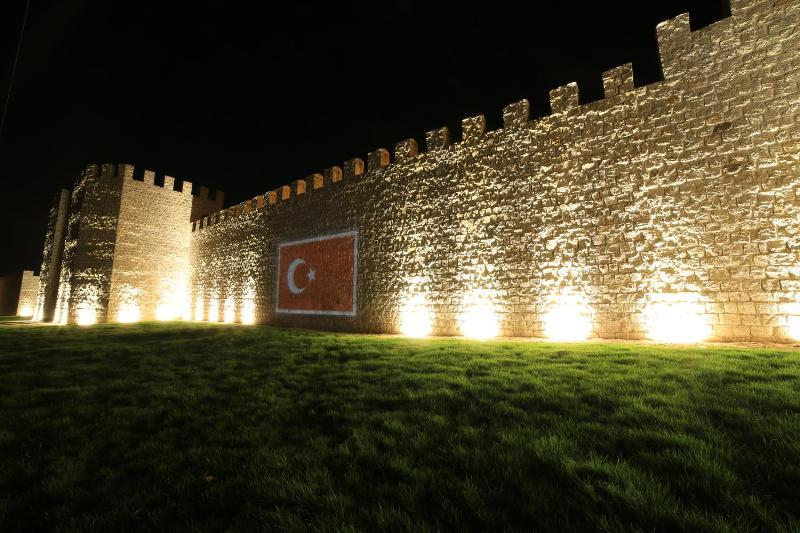
Battalgazi Surları (Battalgazi Belediyesi)
The Battalgazi Walls exhibit a unique and unparalleled example of military architecture in the region.【4】
The walls follow a trapezoidal plan resembling a pentagon and rectangle. According to precise measurements, the eastern facade measures 850 meters, the northern facade 500 meters, the western facade 800 meters, and the southern facade 750 meters.【5】
The defensive system is based on a two-tiered wall design. An inner wall approximately 20 meters high encloses a second, lower outer wall constructed at intervals of about 15 meters. Both the inner and outer surfaces of the walls are faced with precisely cut, large, five-sided stone blocks, while the interior space between them is filled with rubble stones and mortar. The outer wall is surrounded by a moat 30 to 40 meters wide, filled with water to prevent enemy access. It is believed that access to the fortress across the moat was provided via movable bridges, and remnants of these moats are still observable today.【6】
The number of towers in the structure varies across historical records, with figures of 71,【7】 75【8】 or 95【9】 reported. The towers are designed in a triangular form, while the structures at the main gateways feature an octagonal geometry. A total of 11 gates provided access to the city: five on the east, one on the north, one on the west, and four on the south. Except for the main gates, the other entrances are narrow. The recorded names of the gates are: Alacakapı, Meşakkapı (Müşakkapı), Pazarkapısı, Süsürkemkapı, Börüdiyye, Yediboy (Sepidroz / Sıptırızkapı), Bağdat Kapısı and Gizli Kapı.【10】
The 17th-century traveler Evliya Çelebi mentions the Battalgazi walls in his famous work, the Seyahatname. He notes that there were 24 towers and bastions along the eastern and southern facades and 23 along the northern and western facades, estimating the total length of the walls at 5100 steps.【11】 In the Seyahatname, the fortress is referred to as “Rakabe” (or Rekabe), and a legend is recorded attributing its construction to a Byzantine emperor who, after converting the people of Mosul to Islam under Prophet Yunus, was so impressed by the climate and water of Malatya that he built his castle there.【12】
[1]
Battalgazi Belediyesi, “Eski Malatya Surları ve Kalesi,” 11 Aralık 2023, erişim tarihi: 8 Mart 2026, https://www.battalgazi.bel.tr/2023/12/11/eski-malatya-surlari-ve-kalesi/
[2]
T.C. Battalgazi Kaymakamlığı, “Battalgazi Surları,” erişim tarihi: 8 Mart 2026, https://www.battalgazi.gov.tr/battalgazi-surlari
[3]
Türkiye Kültür Portalı, “Eski Malatya Şehir Surları-Malatya,” T.C. Kültür ve Turizm Bakanlığı, Erişim tarihi: 8 Mart 2026, https://www.kulturportali.gov.tr/turkiye/malatya/gezilecekyer/eski-malatya-sehir-surlari
[4]
T.C. Battalgazi Kaymakamlığı, “Battalgazi Surları,” erişim tarihi: 8 Mart 2026, https://www.battalgazi.gov.tr/battalgazi-surlari
[5]
T.C. Battalgazi Kaymakamlığı, “Battalgazi Surları,” erişim tarihi: 8 Mart 2026, https://www.battalgazi.gov.tr/battalgazi-surlari
[6]
Battalgazi Belediyesi, “Eski Malatya Surları ve Kalesi,” 11 Aralık 2023, erişim tarihi: 8 Mart 2026, https://www.battalgazi.bel.tr/2023/12/11/eski-malatya-surlari-ve-kalesi/
[7]
T.C. Battalgazi Kaymakamlığı, “Battalgazi Surları,” erişim tarihi: 8 Mart 2026, https://www.battalgazi.gov.tr/battalgazi-surlari
[8]
Battalgazi Belediyesi, “Eski Malatya Surları ve Kalesi,” 11 Aralık 2023, erişim tarihi: 8 Mart 2026, https://www.battalgazi.bel.tr/2023/12/11/eski-malatya-surlari-ve-kalesi/
[9]
Türkiye Kültür Portalı, “Eski Malatya Şehir Surları-Malatya,” T.C. Kültür ve Turizm Bakanlığı, Erişim tarihi: 8 Mart 2026, https://www.kulturportali.gov.tr/turkiye/malatya/gezilecekyer/eski-malatya-sehir-surlari
[10]
T.C. Battalgazi Kaymakamlığı, “Battalgazi Surları,” erişim tarihi: 8 Mart 2026, https://www.battalgazi.gov.tr/battalgazi-surlari
[11]
T.C. Malatya Valiliği, “Eski Malatya Şehir Surları,” erişim tarihi: 8 Mart 2026, https://www.malatya.gov.tr/eski-malatya-sehir-surlari
[12]
Battalgazi Belediyesi, “Eski Malatya Surları ve Kalesi,” 11 Aralık 2023, erişim tarihi: 8 Mart 2026, https://www.battalgazi.bel.tr/2023/12/11/eski-malatya-surlari-ve-kalesi/

No Discussion Added Yet
Start discussion for "Old Malatya (Battalgazi) Walls" article
Historical Development and Construction Process
Roman and Byzantine Period
Islamic Invasions, Seljuk and Ottoman Periods
Architectural Features and Structural Design
Plan and Dimensions
Wall and Moat System
Towers and Gates
Walls in Historical Sources