

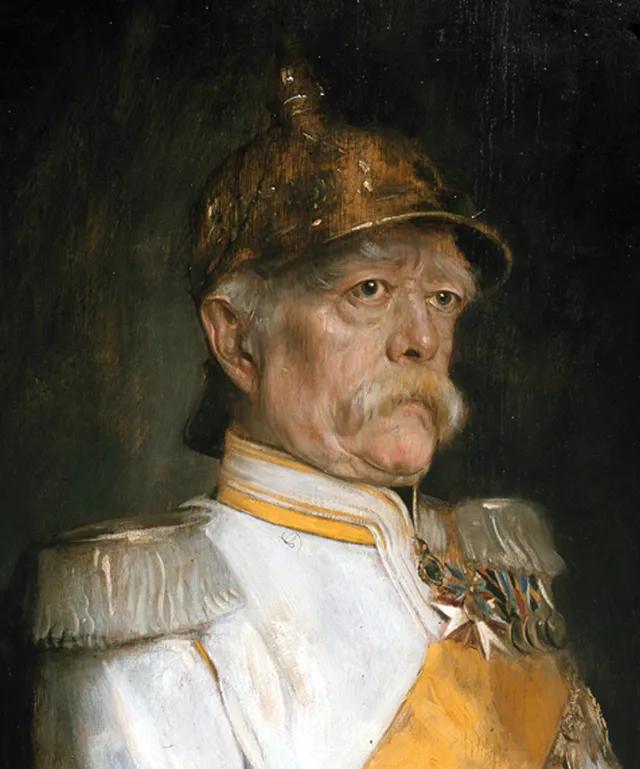

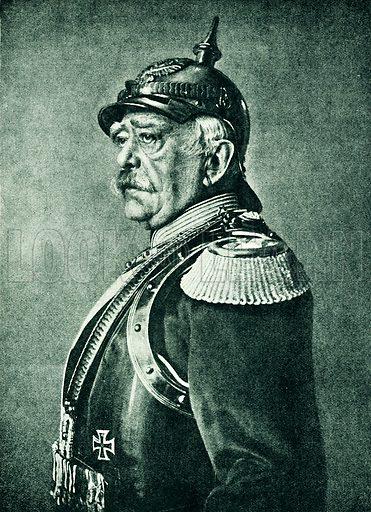
Otto von Bismarck
Babası | Ferdinand von Bismarck-Schönhausen | ||||||||
|---|---|---|---|---|---|---|---|---|---|
Eş | Johanna von Puttkamer | ||||||||
Annesi | Wilhelmine Mencken | ||||||||
Ölüm tarihi | 1898-07-30 | ||||||||
Doğum tarihi | 1815-04-01 | ||||||||
Çocuk | Wilhelm Herbert Marie | ||||||||
Duties | Chancellor of Germany (1871–1890) Minister of Foreign Affairs of Prussia (1862–1890) Minister President of Prussia (1873–1890) Minister President of Prussia (1862–1873) | ||||||||
Title(s) | Iron Chancellor | ||||||||
Otto Eduard Leopold von Bismarck (1 April 1815 – 30 July 1898) was a Prussian statesman who served as Prime Minister of Prussia and the first Chancellor of the German Empire. Bismarck, who engineered German unification under Prussian leadership, played a pivotal role in 19th century European history through his domestic and foreign policies between 1862 and 1890.
Otto von Bismarck was born on 1 April 1815 in Schönhausen, in the Prussian Kingdom’s Brandenburg province. Bismarck came from a Junker family; his father Ferdinand von Bismarck was a landowner while his mother Wilhelmine Mencken was educated and of bourgeois origin. The family lived in a household with six children and Otto was the third. Raised at the Schönhausen estate, Bismarck was shaped by the traditions of Prussia’s rural aristocracy.
In childhood, Bismarck received a basic education. His mother encouraged his intellectual development and fostered an early interest in history literature and languages. However, he showed little interest in academic discipline and was an average student. His family planned for him to enter public service; this expectation influenced his path.
In 1821 at the age of six he was sent to the Plamann Institute in Berlin. This institution was known for its innovative yet disciplined approach to education. In 1827 he transferred to the Friedrich-Wilhelm Gymnasium where he received a classical education. He excelled in Latin Greek and history but showed little interest in mathematics and the natural sciences. In 1832 he began studying law at the University of Göttingen. At Göttingen he participated in social activities alongside his academic work and became known for duels.
In 1833 he moved to the University of Berlin to complete his legal studies. In 1835 he passed the state examinations and entered civil service. During his studies he learned French English and Russian; these languages played a crucial role in his diplomatic career. The university years developed Bismarck’s intellectual capacity but his lack of interest in bureaucracy was evident early in his career.
In 1836 he began working as a civil servant in Aachen but found administrative duties unappealing. In 1837 he moved to Potsdam and later resigned from public service. In 1838 he served in the Prussian army; this experience strengthened his understanding of military affairs. In 1839 he returned to Schönhausen due to his family’s financial difficulties and took charge of the family estate. During this period he became involved in agriculture and local governance.
In 1847 he married Johanna von Puttkamer. The couple had three children: Marie Herbert and Wilhelm. The marriage brought personal stability to Bismarck and supported his political career. In the 1840s he participated in local political debates and defended the interests of the Junker class.
Bismarck was elected to the Prussian United Diet in 1847. In the Diet he displayed a conservative stance defending the monarchical structure and Junker privileges. During the 1848 Revolutions he opposed liberal demands and supported the preservation of the monarchy. After the suppression of the revolutions his conservative stance was praised by the Prussian ruling class.
In 1849 he was elected to the Prussian Chamber of Deputies. There he expressed views on fiscal policy and constitutional reforms. His political speeches revealed his oratorical skill and combative approach. During this period his belief in Prussia’s leadership potential in Germany strengthened.
In 1851 Bismarck was appointed as Prussia’s representative to the German Confederation in Frankfurt. His task was to defend Prussian interests and limit Austria’s influence within the Confederation. The Frankfurt years honed his diplomatic skills. In 1859 he was sent as Prussian ambassador to St. Petersburg. There he established relations with Tsar Alexander II and gained insight into Russian foreign policy.
In 1862 he briefly served as ambassador to France. These postings increased Bismarck’s experience in international relations and deepened his understanding of European power balances. The diplomatic years reinforced his pragmatic approach of placing state interests above ideals.
In 1862 a constitutional crisis erupted between King Wilhelm I of Prussia and the liberal parliament over military reforms. Bismarck was appointed Prime Minister and Minister of Foreign Affairs during this crisis. He implemented reforms without parliamentary approval and strengthened the king’s authority. In a speech on 30 September 1862 he declared that German unification would be achieved not by speeches and majority decisions but by blood and iron.
Bismarck worked to modernize the army. Troop numbers were increased new technologies were integrated and logistical systems were developed. These reforms enhanced Prussia’s military strength and proved decisive in subsequent wars.
In 1864 Prussia and Austria united against Denmark over the Schleswig-Holstein question. The Second Schleswig War ended in victory for the Prussian-Austrian alliance. Under the Treaty of Gads (1864) Schleswig was ceded to Prussia and Holstein to Austria. Bismarck used this war to strengthen Prussian leadership and temporarily stabilize relations with Austria.
In 1866 Bismarck deepened disagreements with Austria over the administration of Schleswig-Holstein. Prussia formed an alliance with Italy and launched the Seven Weeks War against Austria. Prussia’s victory at the Battle of Königgrätz on 3 July 1866 sealed Austria’s defeat. Under the Treaty of Prague (1866) Austria was excluded from the German Confederation and the North German Confederation was established under Prussian leadership.
This outcome solidified Prussia’s dominance in Germany. Bismarck avoided harsh penalties against Austria leaving the door open for future alliances.
In 1870 the Hohenzollern candidacy for the Spanish throne created tension between France and Prussia. Bismarck edited the Ems Dispatch to provoke France into declaring war. The Franco-Prussian War progressed with Prussia’s superior military organization. At the Battle of Sedan on 1 September 1870 France was defeated and Emperor Napoleon III was captured.
At the end of the war on 18 January 1871 the German Empire was proclaimed in the Hall of Mirrors at the Palace of Versailles. Wilhelm I became Emperor and Bismarck was appointed Chancellor. Under the Treaty of Frankfurt (1871) Alsace-Lorraine was annexed by Germany. This territorial gain strengthened Germany but created lasting tensions with France.
The 1871 constitution of the German Empire was prepared under Bismarck’s leadership. It established a federal structure that preserved Prussian supremacy while granting autonomy to southern states (Bavaria Württemberg and Baden). A balance was created between the Reichstag (parliament) and the Bundesrat (council of state representatives). As Chancellor Bismarck was the decisive authority in both domestic and foreign policy.
The Empire achieved economic unity through a single currency unit (the Mark) a standardized legal system and a national railway network. These infrastructure projects accelerated Germany’s industrialization and supported national integration.
Between 1871 and 1887 Bismarck enacted a series of laws to limit the political influence of the Catholic Church. These policies were known as the Kulturkampf. Laws required clergy to be subject to state control closed Catholic schools and mandated civil marriage. The Kulturkampf faced resistance especially in Catholic regions such as Bavaria and the Rhineland.
The Catholic Centre Party organized opposition to these policies. In the 1880s Bismarck softened the Kulturkampf but relations with Catholics remained strained for years. This conflict complicated social cohesion and deepened political divisions.
To counter the growth of socialist movements Bismarck introduced social security laws. The Health Insurance Law was passed in 1883 the Accident Insurance Law in 1884 and the Pension and Disability Insurance Law in 1889. These laws provided workers with healthcare accident compensation and pension rights. The reforms laid the foundation of the modern social security system.
During the same period Bismarck enforced the Socialist Laws (1878-1890) to restrict socialist activities. These laws banned socialist meetings and publications but failed to halt the growth of the Social Democratic Party (SPD).
In 1879 Bismarck introduced protective tariffs. These policies supported German industry particularly iron steel and chemical sectors and protected agricultural products. By the 1880s Germany surpassed Britain in steel production. The railway network expanded the banking system was modernized and foreign trade increased. This economic growth enabled Germany to become a global power.
Bismarck’s foreign policy aimed to keep Germany out of war and maintain a balance of power in Europe. In 1873 the Three Emperors League was formed between Germany Austria-Hungary and Russia. However rivalry between Russia and Austria-Hungary in the Balkans weakened this alliance.
In 1879 the Dual Alliance was signed between Germany and Austria-Hungary. In 1882 Italy joined to form the Triple Alliance. In 1887 Bismarck signed a secret Reinsurance Treaty with Russia. These treaties aimed to isolate France and protect Germany.
In 1878 Bismarck hosted the Berlin Congress. The Congress regulated the territorial losses of the Ottoman Empire in the Balkans and curtailed Russian influence in the region. Bismarck emphasized that Germany had no direct interests in the Balkans and assumed a neutral mediator role.
Until the 1880s Bismarck was indifferent to colonial expansion. However economic interests and public pressure led Germany to establish colonies in Africa and the Pacific between 1884 and 1885. German Southwest Africa (Namibia) Togo Cameroon and German East Africa were acquired during this period. Colonial policies enhanced Germany’s international prestige but the priority of maintaining European balances remained unchanged.
Wilhelm II’s accession to the throne in 1888 weakened Bismarck’s position. Wilhelm sought a more active role in foreign policy and blocked Bismarck’s efforts to renew the Reinsurance Treaty with Russia. Differences over social policy and governance style further increased tensions.
On 20 March 1890 Bismarck resigned. His resignation generated widespread public reaction and sparked debates among political circles. Bismarck was 75 years old when he left office.
After his resignation Bismarck withdrew to his estate in Friedrichsruh. Between 1891 and 1898 he wrote his memoirs; his work Thoughts and Memories was published in 1898. The book provided a detailed account of his political career and views. Bismarck criticized Wilhelm II’s policies through newspaper articles but his political influence remained limited.
His health deteriorated from the mid-1890s. He died on 30 July 1898 at Friedrichsruh. His funeral was conducted as a simple ceremony according to his wishes.
Bismarck achieved German unification under Prussian leadership and founded the German Empire in 1871. Its constitutional structure preserved Prussian dominance while establishing a federal balance. His social reforms laid the foundation of the modern social security system and improved conditions for the working class. However the Kulturkampf and the Socialist Laws intensified social tensions.
His economic policies transformed Germany into a leading industrial and commercial power. Between 1871 and 1890 Germany made significant progress in economic growth and infrastructure development.
Bismarck’s foreign policy preserved peace in Europe between 1871 and 1890. The alliance system isolated France and prevented large-scale wars. However the annexation of Alsace-Lorraine created lasting hostility with France. After Bismarck the alliance system collapsed and contributed to the path toward the First World War.
His colonial policies turned Germany into a global actor but provoked competition with Britain and France. Initiatives such as the Berlin Congress demonstrated his diplomatic influence.
Bismarck’s policies have been subject to varied historical assessments. His success in achieving German unification demonstrated his political acumen. However his authoritarian methods and policies targeting Catholics and socialists were criticized. The Kulturkampf hindered social cohesion while the social reforms were seen as progressive. In foreign policy his balance strategy was effective but the collapse of his system under Wilhelm II raised questions about the long-term sustainability of his policies.
Altıntaş, Yusuf Ziya. “Otto von Bismarck ve Osmanlı Diplomasisi.” Master's thesis, İstanbul Üniversitesi, Sosyal Bilimler Enstitüsü, Tarih Anabilim Dalı, 2012. https://nek.istanbul.edu.tr/ekos/TEZ/49408.pdf. Accessed April 15, 2025.
BBC. “Otto von Bismarck.” *BBC History*. Accessed April 13, 2025. https://www.bbc.co.uk/history/historic_figures/bismarck_otto_von.shtml.
Bismarck, Otto von. *Pensées et souvenirs: mémoires authentiques du Prince de Bismarck*. Vol. 2. Paris: Plon-Nourrit et Cie, 1898. Accessed April 15, 2025. https://books.google.com.tr/books?hl=tr&lr=&id=KrwzGwO8um0C&oi=fnd&pg=PA1&dq=otto+von+bismarck&ots=Jf67TAmwEi&sig=skKy_cEMU1YIYEIPvoBdo6rIU_4&redir_esc=y#v=onepage&q=otto%20von%20bismarck&f=false​:contentReference[oaicite:3]{index=3}
Biyografiler.com. “Otto von Bismarck Kimdir?” Accessed April 13, 2025. https://www.biyografiler.com/kimdir/otto-von-bismarck.
Gall, Lothar. “Otto von Bismarck und Wilhelm II.: Repräsentanten eines Epochenwechsels?” In *Friedrichsruher Beiträge*, Bd. 4, 1999, 70–79. Leiden: Brill, 1999. https://brill.com/display/book/edcoll/9783657786978/BP000007.xml. Accessed April 15, 2025.
Gerlach, Leopold von, and Otto von Bismarck. *Briefwechsel des Generals Leopold von Gerlach mit dem Bundestags-Gesandten Otto von Bismarck*. Berlin: G. Reimer, 1879. Accessed April 15, 2025. https://books.google.com.tr/books?hl=tr&lr=&id=8pxFnWg22mUC
HistoryExtra. “Otto von Bismarck: Biography of the Man Who Unified Germany.” HistoryExtra, Accessed April 13, 2025. https://www.historyextra.com/period/victorian/otto-von-bismarck-unification-germany-unify-biography-facts-how-prussian-politician/.
Lumen Learning. “Otto von Bismarck and the Franco-Prussian War.” *World History II*. Accessed April 13, 2025. https://courses.lumenlearning.com/suny-hccc-worldhistory2/chapter/otto-von-bismarck-and-the-franco-prussian-war/.
O-Staj. “Almanya’da Yeni Düzen ve Diplomasi: Otto von Bismarck Dönemi (1871–1890).” O-Staj Blog. Accessed April 13, 2025. https://o-staj.com/blog-oku/almanya%E2%80%99da-yeni-duzen-ve-diplomasi:-otto-von-bismarck-donemi-1871-1890-16.
Tawfeeq, Sulaiman Shafiq. “Otto von Bismarck and German Politics (1862–1898).” Master's thesis, Near East University, Graduate School of Educational Sciences, History Education, 2020. https://docs.neu.edu.tr/library/6843294706.pdf. Accessed April 15, 2025.
Von Bismarck, Otto. *Bismarck, the Man and the Statesman*. Sayfalar Cosimo, Inc., 2007. https://books.google.com.tr/books?hl=tr&lr=&id=v5Sj6vxkitUC&oi=fnd&pg=PA8&dq=otto+von+bismarck&ots=HKrQZlz4H4&sig=fTP88S83GHeegnKNaBWSSTB1f78&redir_esc=y#v=onepage&q=otto%20von%20bismarck&f=false. Accessed April 15, 2025.


Otto von Bismarck
Babası | Ferdinand von Bismarck-Schönhausen | ||||||||
|---|---|---|---|---|---|---|---|---|---|
Eş | Johanna von Puttkamer | ||||||||
Annesi | Wilhelmine Mencken | ||||||||
Ölüm tarihi | 1898-07-30 | ||||||||
Doğum tarihi | 1815-04-01 | ||||||||
Çocuk | Wilhelm Herbert Marie | ||||||||
Duties | Chancellor of Germany (1871–1890) Minister of Foreign Affairs of Prussia (1862–1890) Minister President of Prussia (1873–1890) Minister President of Prussia (1862–1873) | ||||||||
Title(s) | Iron Chancellor | ||||||||
Early Life
Family and Childhood
Education
Youth and Early Experiences
Beginning of Political Career
Prussian Diet and the 1848 Revolutions
Diplomatic Appointments
Prussian Premiership and German Unification
Appointment in 1862
Danish War (1864)
Austro-Prussian War (1866)
Franco-Prussian War (1870-1871)
Chancellorship of the German Empire
Constitutional and Administrative Structure
Kulturkampf
Social Reforms
Economic Policies
Foreign Policy
Alliance System
Berlin Congress and the Balkans
Colonial Policies
Resignation and Retirement
Disputes with Wilhelm II
Retirement
Historical Impact and Assessment
Impact on Germany
Impact on Europe and the World
Historical Debates