
This article was automatically translated from the original Turkish version.
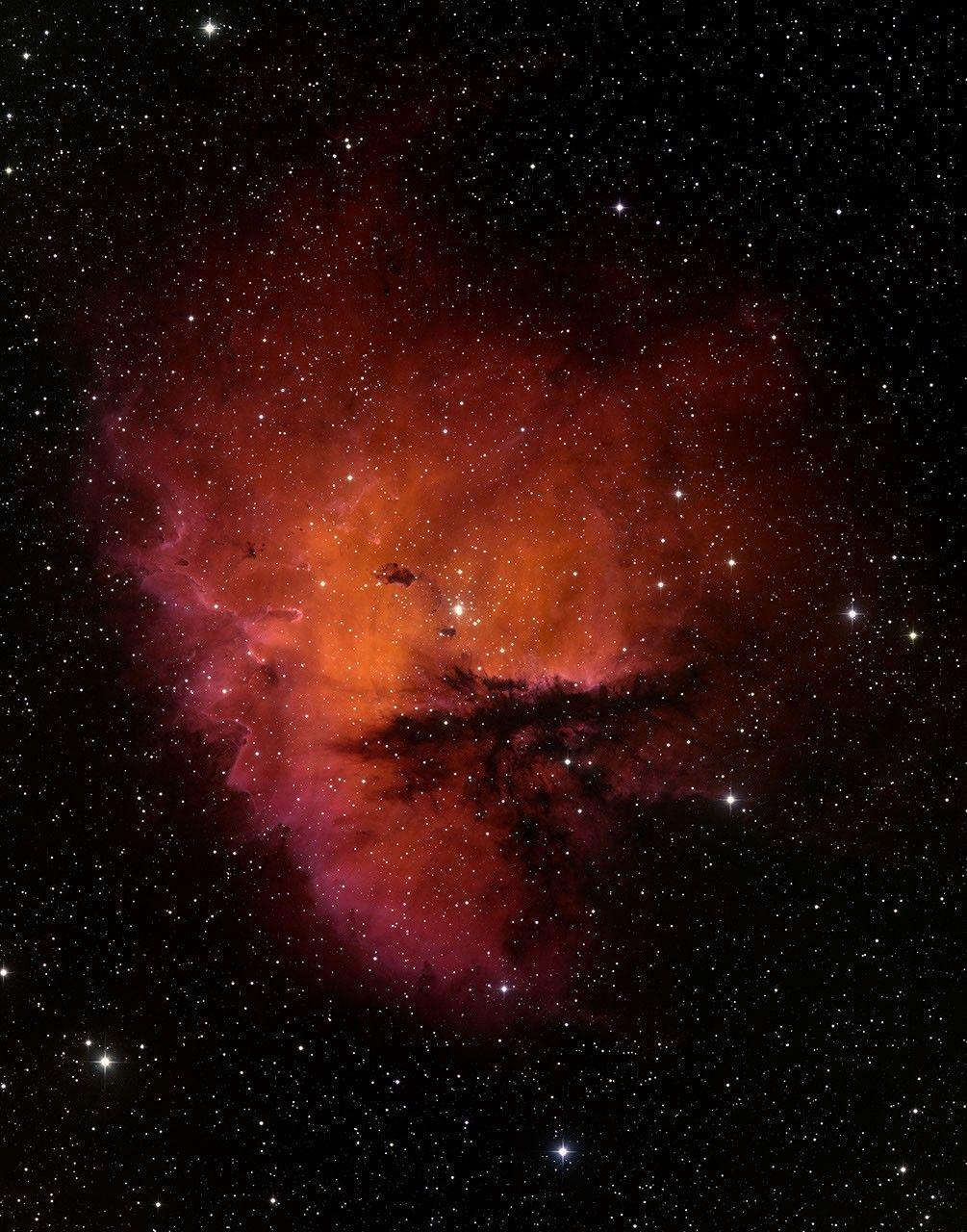
NGC 281 is an emission nebula located in the direction of the Cassiopeia constellation and classified as an H II region. Commonly known in astronomy as the "Pacman Nebula" due to its visual resemblance to the classic video game character, this nebula is regarded both as a star-forming region and as an OB association containing young stars. It was first discovered in 1883 by American astronomer Edward Emerson Barnard.
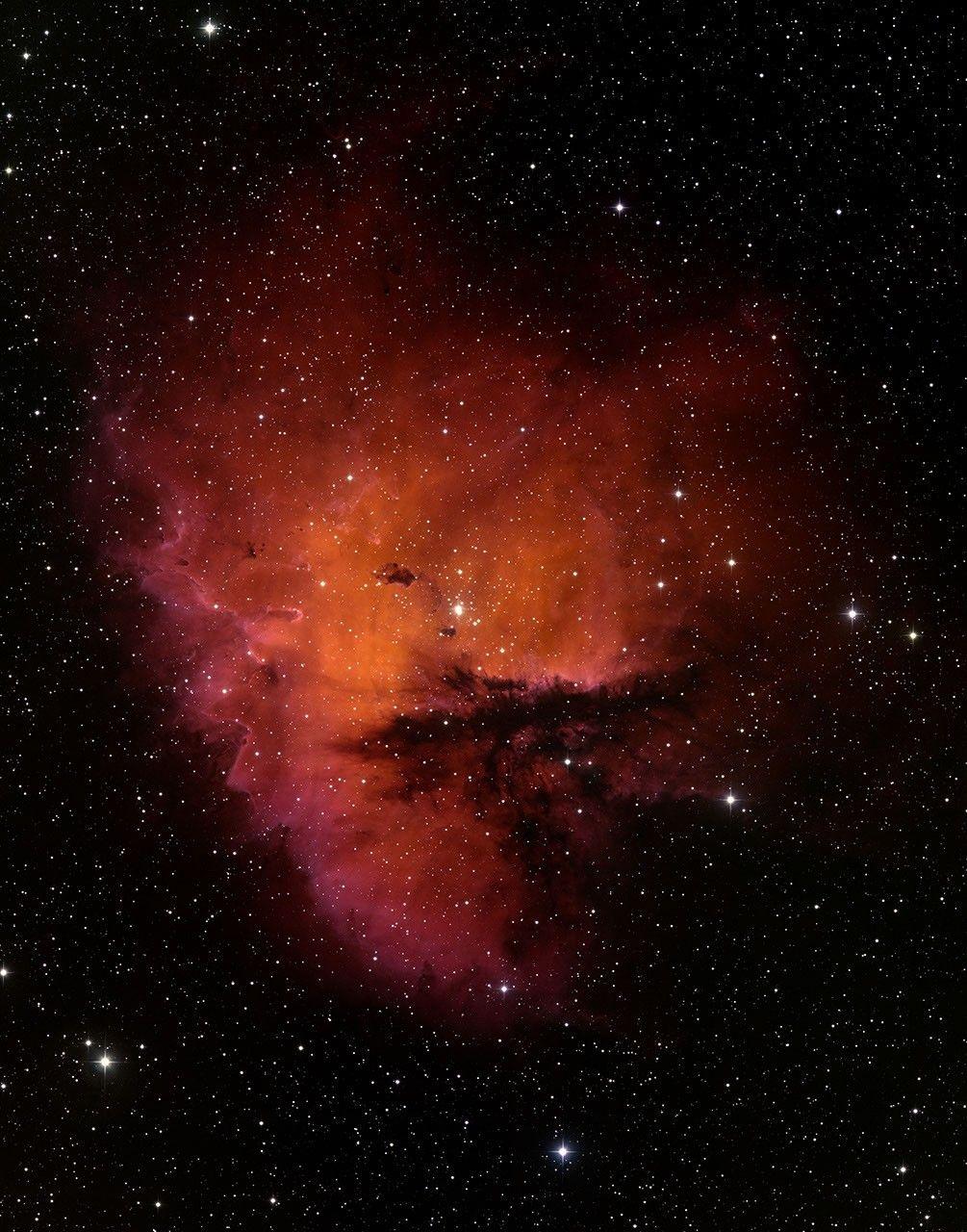
Pacman Nebula. (NASA)
NGC 281 lies within the Cassiopeia constellation and is approximately 9,200 light years (about 2,800 parsecs) from Earth. However, distances reported in various sources range between 6,500 and 9,500 light years. It is known to be situated along the Perseus Arm of the Milky Way Galaxy.
Celestial coordinates:
The angular size of NGC 281 is reported in some sources as approximately 18 arcminutes, corresponding to a width of about 48 light years. However, other literature cites values between 30 and 35 arcminutes. The nebula contains numerous star-forming regions and dense gas structures.
NGC 281 is classified as an H II region, meaning it contains ionized hydrogen gas excited by ultraviolet radiation from nearby young, hot stars. These ionized gases emit a characteristic red glow that makes them visible in astronomical observations.
Several Bok globules are found within the nebula. These dark, dense structures composed of gas and dust are recognized as sites of ongoing star formation. Their presence has made NGC 281 an important target for studies of stellar birth.
The open star cluster IC 1590, located within NGC 281, consists of the stars responsible for shaping and ionizing the nebula. The cluster particularly contains O-type stars, whose intense ultraviolet radiation ionizes the surrounding hydrogen gas, producing the nebula’s luminous emission.
NGC 281 is a typical H II region exhibiting strong emission in the H-alpha line (656.3 nm), which corresponds to the characteristic radiation of ionized hydrogen atoms and is used to define the nebula’s structural boundaries. Some studies mention the detectability of lines such as [O III] and [S II], though these features are only sparsely documented in the general literature.
NGC 281 is a bright object observable by amateur astronomers. Narrowband imaging using H-alpha filters reveals the detailed gas structure of the nebula. Observations conducted with optical and infrared telescopes have provided further insights into its star-forming regions. The Spitzer Space Telescope has contributed to the study of NGC 281’s internal structure through thermal infrared bands.

No Discussion Added Yet
Start discussion for "Pacman Nebula (NGC 281)" article
Physical and Observational Properties
Position and Distance
Angular and Physical Size
Structural Features and Components
H II Region
Bok Globules
IC 1590 Open Cluster
Spectral Properties and Emission
Technical Specifications
Observational Status and Investigation Techniques