This article was automatically translated from the original Turkish version.
+1 More
Type(s) | Architectural structure / Monument / Exhibition building | ||||||||
|---|---|---|---|---|---|---|---|---|---|
Architectural Style(s) | Fascist architecture / Rationalism | ||||||||
Location | EUR district Italy Rome | ||||||||
Construction Years | 1938–1943 (construction), 1940 (opening), 2003–2008 (restoration) | ||||||||
Material(s) | Reinforced concrete structure travertine cladding | ||||||||
Palazzo della Civiltà Italiana (Palace of Italian Civilization), also known as Palazzo della Civiltà del Lavoro, is one of the symbolic buildings of the EUR (Esposizione Universale di Roma) district in Rome, the capital of Italy. The structure is a prominent example of fascist architecture developed in the mid-20th century, notable for its simplicity, monumentality, and symmetry.
These characteristics have made it not only an emblem of the EUR district but also one of the most distinctive icons of modern Roman architecture. It is commonly referred to by the public as "Colosseo Quadrato", or the "Square Colosseum".
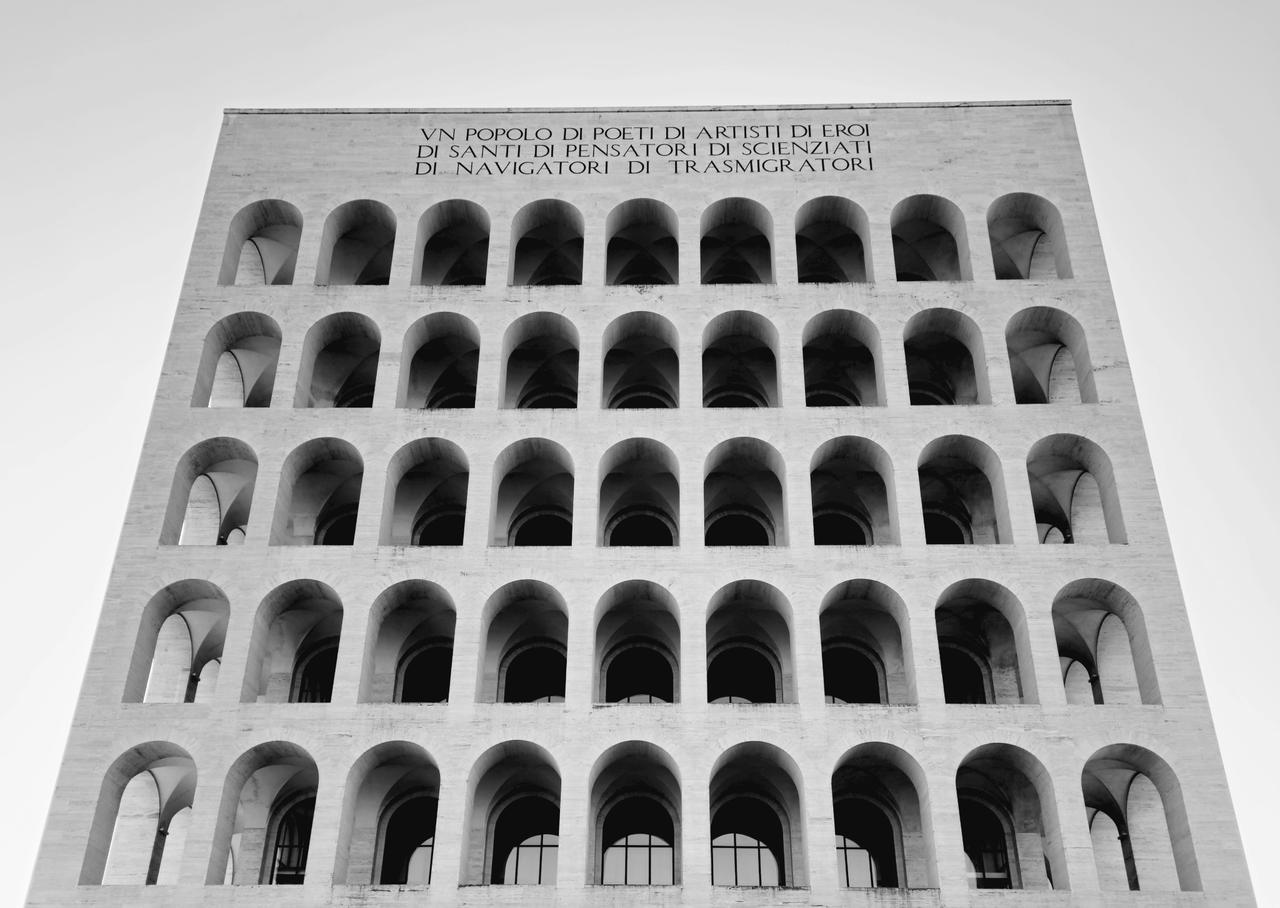
Palazzo della Civiltà Italiana (Pexels)
The building’s architects were Giovanni Guerrini, Ernesto Bruno La Padula, and Mario Romano. The team won the project in a national competition launched in 1937. The design was created for the Rome Universal Exhibition (E42), planned by Benito Mussolini to be held in 1942. However, the exhibition never took place; construction was halted in 1943 due to the Second World War, and the building was only completed after the war ended.
The structure is a parallelepiped block measuring 68 meters in height and 51 meters in width. It was constructed with a reinforced concrete framework clad in travertine slabs. The façade features a rhythmic repetition of nine arches per level, with six levels on each side, resulting in a total of 216 arches. This repetition references classical Roman architecture while interpreting it through a rationalist and metaphysical lens. Each façade is symmetrically arranged, with the number of arches—6 by 9—matching the number of letters in the name “BENITO MUSSOLINI.” The façades were planned both technically and ideologically to evoke the grandeur of the Roman Empire.
At the top of the building is an inscription that glorifies Italian national identity:
"Un popolo di poeti di artisti di eroi di santi di pensatori di scienziati di navigatori di trasmigratori"
(Translation: “A people of poets, artists, heroes, saints, thinkers, scientists, navigators, and migrants”). This phrase is regarded as a reflection of the ideological message common to many structures built during the fascist era.
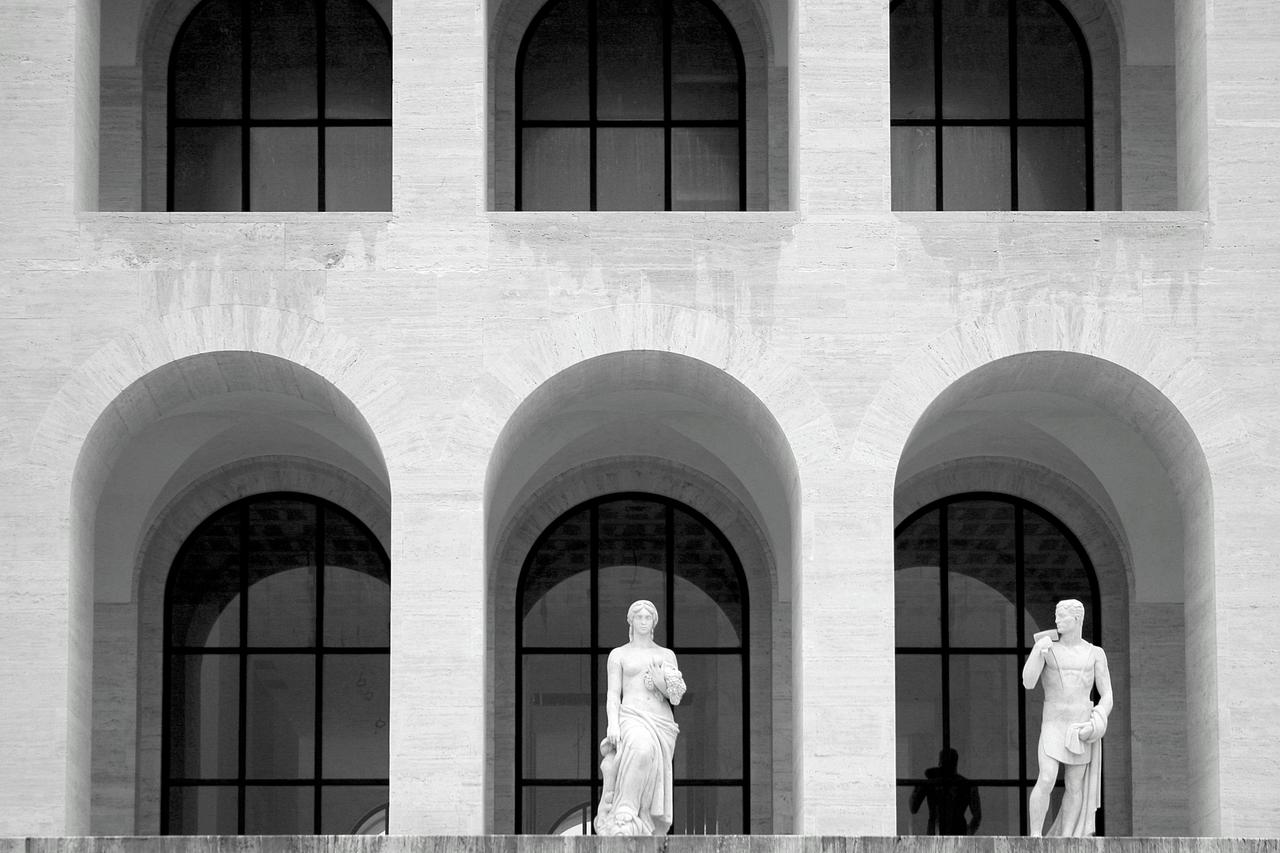
Palazzo della Civiltà Italiana (Pexels)
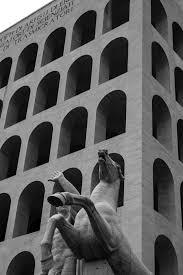
The sculptural program on the building’s exterior is as striking as its architecture. On either side of the entrance, two monumental travertine sculptural groups by Morbiducci and Felci depict the Dioscuri (Castor and Pollux). These figures aim to link Roman mythology with contemporary ideology. Additionally, on each façade, a total of 28 marble statues are placed beneath the arches, representing allegories of various human activities symbolizing art, science, and labor. Each statue, approximately 3.40 meters in height, alludes to the historical achievements and cultural values of Italian civilization.
Construction began in 1938, was interrupted in 1943 due to the war, and was completed after the conflict. During the war, the EUR district became a major center under Nazi occupation; the Palazzo della Civiltà Italiana was temporarily used for military purposes. The building remained unused for many years until it underwent restoration between 2003 and 2008 by the Ministry of Cultural Heritage and Activities and EUR SpA. This restoration included structural interventions to preserve both the exterior façade and the interior functionality.
Since 2015, the building has served as the global headquarters of the luxury fashion brand Fendi. After acquiring a 15-year lease, Fendi allocated the ground floor for exhibitions and cultural events, contributing to the continued cultural relevance of the structure.
The Palazzo della Civiltà Italiana stands not only as an architectural structure but also as a cultural icon. Its rationalist and metaphysical design has inspired numerous films. The building has appeared as a visual backdrop in movies such as Roberto Rossellini’s Roma, Città Aperta, Michelangelo Antonioni’s L’Eclisse (The Eclipse), Federico Fellini’s 8½, and Peter Greenaway’s The Belly of an Architect.
The Palazzo della Civiltà Italiana is a unique structure that embodies the ideological, cultural, and aesthetic dimensions of 20th-century Italian architecture. It draws attention through its relationship with both the symbolic language of the fascist era and the classical heritage of Rome. Its planning process, materials, sculptural program, and contemporary function transform it into more than a historical monument—it has become a living cultural entity.
Architectuul. "Palazzo della Civiltà Italiana." Accessed August 6, 2025. https://architectuul.com/architecture/palazzo-della-civilta-italiana.
EUR SpA. “Palazzo della Civiltà Italiana.” Accessed August 6, 2025. https://www.eurspa.it/en/the-city-within-the-city/estate/historical-buildings/palazzo-civilta-italiana.
Pexels. “Facade of the Palazzo della Civiltà Italiana in Rome, Italy.” Photograph. Accessed August 6, 2025. https://www.pexels.com/photo/facade-of-the-palazzo-della-civilta-italiana-in-rome-italy-19368962/.
Pexels. “Palazzo della Civiltà Italiana – Statues under Arched Window.” Photograph. Accessed August 6, 2025. https://www.pexels.com/photo/statues-under-arched-window-7017635/.
Turismo Roma. "Palace of Italian Civilization." Accessed August 6, 2025. https://www.turismoroma.it/en/places/palace-italian-civilization.


Type(s) | Architectural structure / Monument / Exhibition building | ||||||||
|---|---|---|---|---|---|---|---|---|---|
Architectural Style(s) | Fascist architecture / Rationalism | ||||||||
Location | EUR district Italy Rome | ||||||||
Construction Years | 1938–1943 (construction), 1940 (opening), 2003–2008 (restoration) | ||||||||
Material(s) | Reinforced concrete structure travertine cladding | ||||||||
No Discussion Added Yet
Start discussion for "Palazzo della Civiltà Italiana" article
Design and Architectural Features
Sculptural Program and Artistic Details
Historical Development and Use
Cultural Reflections and Impact