


This article was automatically translated from the original Turkish version.
+2 More
Parentification is a disrupted family interaction pattern in which a child assumes roles and responsibilities inappropriate for their developmental level and age in an attempt to meet the physical or emotional needs of their parents.
In psychological and family systems literature, this concept, also known as role reversal, dissolution of intergenerational boundaries, or overburdened child, was first defined by Minuchin and colleagues under the term parent-child. 【1】 Later, representatives of contextual family therapy, Boszormenyi-Nagy and Spark introduced the concept of parentification into the literature. 【2】 A parentified child, while transitioning from being the recipient of care to becoming the provider of care, is forced to sacrifice their own needs for attention, affection, and guidance.
Different types of parentification exist depending on the nature of the responsibilities assumed by the child and the family dynamics. The responsibilities undertaken by the child can be categorized into two main types: instrumental and emotional parentification.

Ebeveynleştirilmiş Çocuk Görseli (Yapay Zeka ile Oluşturulmuştur)
Based on the family system’s approach to the child, parentification can be classified as destructive or adaptive.
The main theories attempting to explain this role reversal in childhood are as follows:
Family Systems Theory: According to this approach, parentification arises when the family hierarchy collapses and the parent abandons their own responsibilities, transferring the burden to the child. The blurring of boundaries between family members and the formation of parent-child alliances are the primary disruptive forces within the system.【3】
Attachment Theory: This theory explains the process as a consequence of the breakdown of the trust bond between parent and child. Faced with a parent who fails to respond to their emotional or physical needs, the child chooses compulsively to provide care as the only way to maintain attachment and avoid abandonment.【4】
Psychodynamic Theories: These theories interpret parentification as the parent’s inability to fulfill their functions of validation and empathy, leading them to project their own unmet expectations onto the child. As a result, the child distances themselves from their authentic desires under pressure to realize the parent’s ideals and constructs a false self.【5】
Many factors that plunge families into crisis and impair parental functioning create conditions for child parentification. When a mother or father suffers from chronic physical illness or mental disorders such as depression or schizophrenia, children are rapidly thrust into the caregiver role. In families affected by alcohol or substance addiction, the inconsistent and neglectful environment compels the child to assume parental roles in order to maintain family stability and regain a sense of control. In homes marked by intense marital conflict, divorce proceedings, or domestic violence, boundaries are completely violated, and children are used by parents as allies or advisors against the other partner.

Ebeveynleştirilmiş Çocuk Görseli (Yapay Zeka ile Oluşturulmuştur)
External stressors such as low socioeconomic status, poverty, and migration experiences also trigger parentification. Economic hardship leads children to work to support the household or care for siblings while their mother is employed; in immigrant families, children who adapt more quickly to the new culture often assume the role of linguistic or cultural interpreters for their parents, effectively occupying the top of the family hierarchy. Additionally, in collectivist cultures such as Turkish society, where the family is prioritized, expectations that girls assist with household tasks and sibling care and that boys be more outwardly oriented contribute to shaping parentification dynamics.【6】
Experiences of parentification profoundly affect children’s cognitive, academic, and emotional development. Children who spend time meant for their own growth solving family problems show reduced academic achievement, difficulties in peer relationships, and increased levels of externalizing or internalizing problems.【7】 In later life, these individuals exhibit significantly higher risks of depression, chronic anxiety disorders, eating disorders, somatization, and substance use.
The heavy burden assumed and the belief that every task must be performed flawlessly, particularly in females who experienced parent-focused parentification, lead to the development of obsessive belief patterns such as perfectionism, exaggerated threat perception, and thought control. In males forced to care for siblings, later life is marked by increased outward expressions of anger and persistently high anger levels, while their anger regulation mechanisms are severely impaired.【8】
In the context of interpersonal relationships and personality development, parentified children develop an identity centered on self-sacrifice. Because they focused exclusively on meeting others’ needs during childhood, they repeatedly engage in harmful relationship patterns in adulthood known as partner dependency. These individuals, who strive to solve their partner’s problems at the cost of their own identity, exhibit excessive dependency and a strong tendency to control relationships.
On the other hand, a child expected to behave like an adult from an early age and resolve family problems may develop an inflated self-esteem and an internal locus of control, believing themselves superior and more capable than their peers. By internalizing the ideals demanded by their parent and drawing sustenance from their own false achievements, these individuals become vulnerable to developing narcissistic traits characterized by exploiting others for personal gain in later life.【9】
How parentification behaviors manifest in a child’s life is closely related to their individual characteristics, particularly their self-construction and level of self-differentiation. Children’s self-constructions—their ways of defining themselves—directly influence the type of parentification they exhibit. Girls with a relational self-construction, who define themselves through emotional bonds with others, provide emotional parentification at significantly higher rates to family members. Girls with an independent self-construction, who define themselves entirely through personal goals and autonomy, tend to reject instrumental parentification behaviors and protect themselves from this cycle.【10】
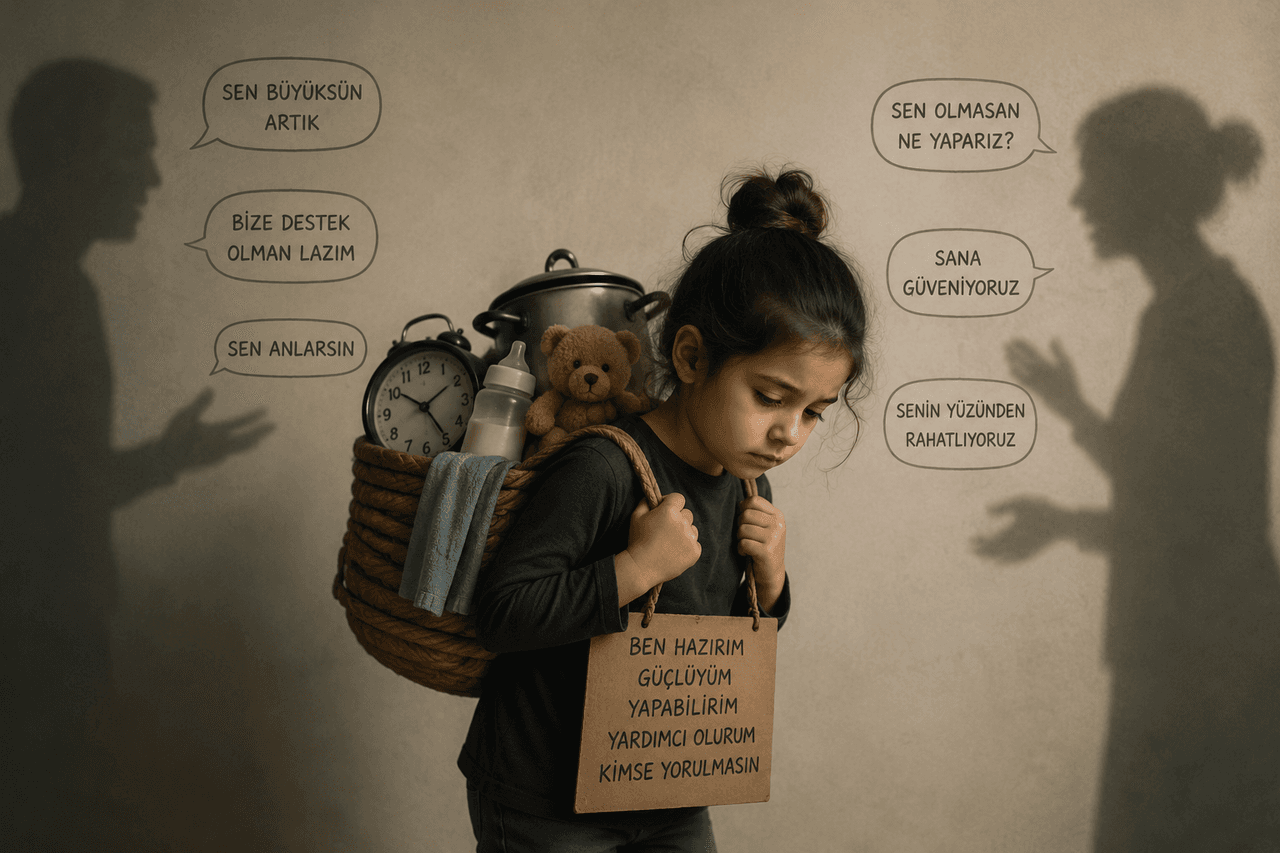
Ebeveynleştirilmiş Çocuk Görseli (Yapay Zeka ile Oluşturulmuştur)
Differentiation of self, a cornerstone of family systems theory, is the ability to make autonomous decisions without severing family ties or remaining emotionally dependent on them. Parentification is typically transmitted intergenerationally as a result of failure to differentiate. Individuals who, in childhood, could not detach from family boundaries and continuously assumed caregiving roles for their parents remain unable to separate from their families in adulthood. This lack of differentiation predisposes individuals to exhibit partner-dependent behaviors, emotional reactivity, and loss of personal identity in their adult romantic relationships.
The challenges brought by parentification do not inevitably lead to destructive psychological problems in every individual. When children perceive the responsibilities assigned to them not as unjust exploitation but as a necessary and reciprocal form of family solidarity, the negative effects are significantly mitigated. Individuals who successfully navigate this process may develop positive competencies such as post-traumatic growth, calmness during crises, increased independence, enhanced empathy, and psychological resilience. The perceived benefits and adaptive skills gained from the experience serve as a protective shield against future episodes of depression, anxiety, and anger, thereby supporting psychological well-being.【11】
The primary goal of mental health professionals working with parentified children and adults is not to abruptly remove all responsibilities from the individual but to restore the family hierarchy and reestablish age-appropriate boundaries. During therapy, validating the individual’s contributions within the family and exploring past feelings of injustice and shame are of great importance.【12】
Akün, Ebru. "Çocukluktaki Ebeveynleşme Yaşantılarının Özellikleri ve Birey Üzerindeki Etkileri." *Nesne Psikoloji Dergisi* 5, no. 10 (2017): 219–246. Accessed July 4, 2026.https://www.nesnedergisi.com/makale/pdf/1506519571.pdf
Emre, Oğuz. "Ebeveynleştirmenin Çocukların Gelişim Sürecine Etkisi." *İnönü Üniversitesi Sağlık Bilimleri Dergisi* 5, no. 2 (2016): 29–34. Accessed July 4, 2026.https://dergipark.org.tr/tr/download/article-file/2017127
Köyden, Duygu. "Ebeveynleşme Olgusunun Depresyon, Kaygı, Öfke ve Obsesif İnanış Biçimleriyle İlişkisinin İncelenmesi." Master's thesis, Hacettepe Üniversitesi, 2015. Accessed July 4, 2026.https://scales.arabpsychology.com/wp-content/uploads/2022/07/ebeveynlesme-envanteri-toad.pdf
Say, Gülen, and İhsan Dağ. "Narsisizmde Ebeveynleşmenin Rolü: Benlik Saygısı ve Kontrol Odağının Aracı Etkisi." *AYNA Klinik Psikoloji Dergisi* 10, no. 3 (2023): 542–561. Accessed July 4, 2026.https://dergipark.org.tr/en/download/article-file/3133088
Özbiler, Şerife. "Annelerin Ebeveynleşme Geçmişi ile Kız Çocuklarının Ebeveynleşmesi: Benliğin Ayrımlaşmasının Moderatör Rolü." In *Anneler ve Kızlar*, edited by Elif Engin and Gülden Beyzan-Çeliker, pp. 209–226. İzmir: Ege Üniversitesi Kadın Sorunları Uygulama ve Araştırma Merkezi (EKAM) Yayınları, 2022. Accessed July 4, 2026.
Ünver, Buket, İpek Esen, and İpek Ülkümen. "Ebeveynleşme ve Eş Bağımlılık Arasındaki İlişkide Benlik Ayrımlaşmasının Aracı Rolü." *Bilişsel Davranışçı Psikoterapi ve Araştırmalar Dergisi* 13, no. 3 (2024): 310–323. Accessed July 4, 2026.https://jcbpr.org/storage/upload/pdfs/1732884776-tr.pdf
İplikçi, Ayşe Büşra, and Başak Şahin-Acar. "Kim Ebeveyn? 12-Yaş Çocuklarının Ebeveynleşme Davranışlarını Yordayan Etkenler." *Türk Psikoloji Dergisi* 34, no. 84 (2019): 1–15. Accessed July 4, 2026.https://www.researchgate.net/profile/Ayse-Iplikci/publication/338901092
[1]
Ebru Akün, "Çocukluktaki Ebeveynleşme Yaşantılarının Özellikleri ve Birey Üzerindeki Etkileri," Nesne Psikoloji Dergisi 5, no. 10 (2017): 224, erişim tarihi 4 Temmuz 2026, https://www.nesnedergisi.com/makale/pdf/1506519571.pdf
[2]
Akün, "Çocukluktaki Ebeveynleşme Yaşantıları,"223-224.
[3]
Akün, "Çocukluktaki Ebeveynleşme Yaşantıları,"223.
[4]
Akün, "Çocukluktaki Ebeveynleşme Yaşantıları," 224.
[5]
Akün, "Çocukluktaki Ebeveynleşme Yaşantıları," 225.
[6]
Şerife Özbiler, "Annelerin Ebeveynleşme Geçmişi ile Kız Çocuklarının Ebeveynleşmesi: Benliğin Ayrımlaşmasının Moderatör Rolü." İçinde Anneler ve Kızlar, editör Elif Engin ve Gülden Beyzan-Çeliker, 212. İzmir: Ege Üniversitesi Kadın Sorunları Uygulama ve Araştırma Merkezi (EKAM) Yayınları, 2022. Erişim tarihi 4 Temmuz 2026. https://www.researchgate.net/profile/Serife-Ozbiler/publication/360476383
[7]
Akün, "Çocukluktaki Ebeveynleşme Yaşantıları," 229.
[8]
Duygu Köyden, "Ebeveynleşme Olgusunun Depresyon, Kaygı, Öfke ve Obsesif İnanış Biçimleriyle İlişkisinin İncelenmesi" (yüksek lisans tezi, Hacettepe Üniversitesi, 2015), 81, erişim tarihi 4 Temmuz 2026, https://scales.arabpsychology.com/wp-content/uploads/2022/07/ebeveynlesme-envanteri-toad.pdf.
[9]
Gülen Say ve İhsan Dağ, "Narsisizmde Ebeveynleşmenin Rolü: Benlik Saygısı ve Kontrol Odağının Aracı Etkisi," AYNA Klinik Psikoloji Dergisi 10, no. 3 (2023): 552, erişim tarihi 4 Temmuz 2026, https://dergipark.org.tr/en/download/article-file/3133088
[10]
Ayşe Büşra İplikçi ve Başak Şahin-Acar, "Kim Ebeveyn? 12-Yaş Çocuklarının Ebeveynleşme Davranışlarını Yordayan Etkenler," Türk Psikoloji Dergisi 34, no. 84 (2019): 5, erişim tarihi 4 Temmuz 2026, https://www.researchgate.net/profile/Ayse-Iplikci/publication/338901092
[11]
Köyden, "Ebeveynleşme Olgusunun Depresyon," 79.
[12]
Akün, "Çocukluktaki Ebeveynleşme Yaşantıları," 235.


Primary Types of Parentification
Theoretical Approaches Explaining Parentification
Risk Factors and Social Dynamics
Psychological and Developmental Effects of Parentification
Self-Construction and Differentiation of Self
Protective Factors and Clinical Interventions