This article was automatically translated from the original Turkish version.
+2 More
Location | Türkiye Tunceli Pertek | ||||||||
|---|---|---|---|---|---|---|---|---|---|
Date(s) | Construction date unknown repaired during the Ottoman period | ||||||||
Structure(s) | Two nested walls blue tiles red brick carved stone | ||||||||
Geography | Appears as an island in the Keban Dam Lake | ||||||||
Transportation(s) | 10–15 minutes by ferry and boats | ||||||||
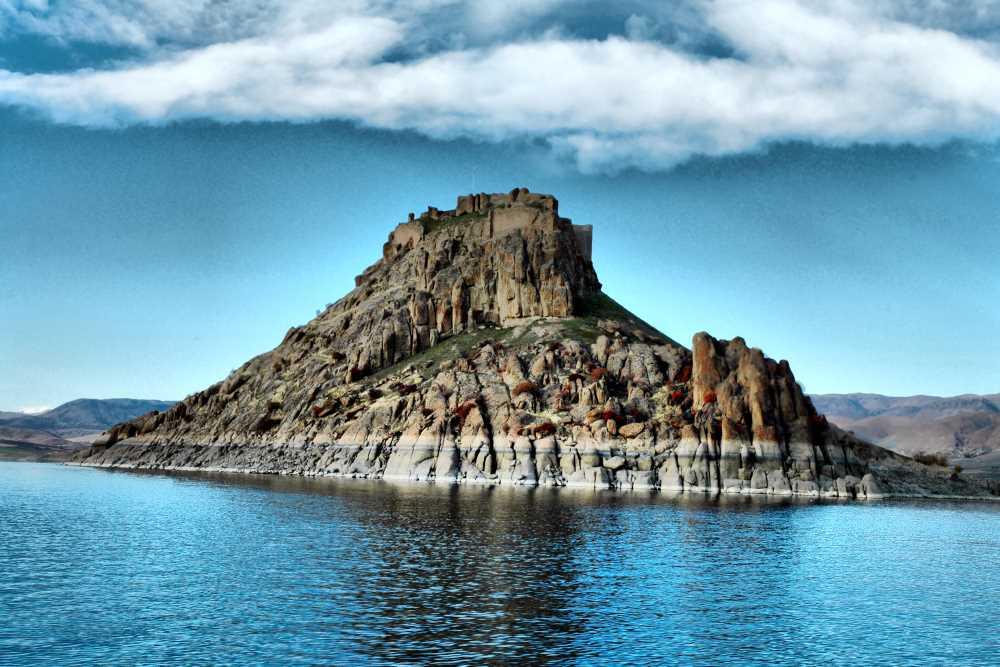
Located along the banks of the Murat River within the boundaries of Pertek district in Tunceli province, Pertek Castle has historically served as a settlement for various civilizations and is today one of the region’s most significant cultural heritage sites. Although its exact construction date remains unknown, the castle underwent repairs during the Ottoman period and, due to submersion beneath the waters of the Keban Dam Lake, has now taken on the appearance of an island. Its integration with the natural landscape makes it both historically and touristically compelling.

Pertek Castle (Türkiye Culture Portal)
Pertek Castle was constructed on a hilltop in the southern part of the district, along the banks of the Murat River. With the construction of the Keban Dam in the 20th century, the surrounding area was submerged under water, causing the castle to begin occupying the summit of an island. Its location along the ferry route connecting Elazığ and Pertek facilitates visitor access. In addition to the ferry, the castle can also be reached in approximately 10 to 15 minutes by fishing boats.
Pertek Castle consists of a defensive structure formed by two concentric walls. Between the wall sections, various structural remains are visible. Particularly striking are the red hard bricks placed between carved stones on the southern facade, along with scattered blue ceramic tiles. Within the castle grounds, there is also a cistern and remnants of other structures.

Pertek Castle (Türkiye Culture Portal)
Although the exact date of the castle’s construction is not definitively known, it is documented that it was repaired during the Ottoman period. According to historical sources, it was also restored at one point under Khalid ibn al-Walid, during which the Karakuş statue (Mongolian: Portok) located within the castle was removed and replaced with an Arabic inscription. The area where the castle stands is also recognized as the site of the ancient Pertek town.
Today, Pertek Castle is regarded as one of the defining symbols of Tunceli province and particularly of Pertek district. Its location at the center of the Keban Dam Lake has endowed it with the character of a natural attraction. Designated walking paths for visitors and the surrounding natural landscape elements—such as floral cover and bird species—enhance its tourism potential. The local population and visitors alike consider it an integral part of the town’s historical identity.
Anadolu Ajansı. “Tarihi Pertek Kalesi Mavi Suların Ortasında Ziyaretçilerini Bekliyor.” Accessed June 24, 2025. https://www.aa.com.tr/tr/turkiye/tarihi-pertek-kalesi-mavi-sularin-ortasinda-ziyaretcilerini-bekliyor/2258605.
Ministry of Culture and Tourism of the Republic of Türkiye. "Pertek Kalesi." *Kültür Portalı*. Accessed June 24, 2025. https://www.kulturportali.gov.tr/turkiye/tunceli/gezilecekyer/pertek-kalesi.
T.C.Pertek Kaymakamlığı Governorship. "Pertek Kalesi." pertek.gov.tr. Accessed June 24, 2025. http://www.pertek.gov.tr/pertek-kalesi.

Location | Türkiye Tunceli Pertek | ||||||||
|---|---|---|---|---|---|---|---|---|---|
Date(s) | Construction date unknown repaired during the Ottoman period | ||||||||
Structure(s) | Two nested walls blue tiles red brick carved stone | ||||||||
Geography | Appears as an island in the Keban Dam Lake | ||||||||
Transportation(s) | 10–15 minutes by ferry and boats | ||||||||
Location and Physical Characteristics
Architectural Structure and Features
Historical Development and Restorations
Social and Cultural Significance