This article was automatically translated from the original Turkish version.
Type(s) | Regional dough dish / type of mantı | ||||||||
|---|---|---|---|---|---|---|---|---|---|
Local Uses | Piruhî, peruhî | ||||||||
Geographical Origin | Karabük Province, Safranbolu District | ||||||||
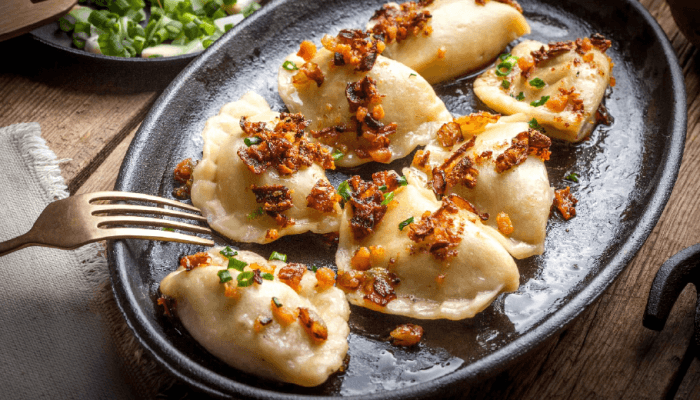
Piruhî is a regional dish based on dough preparation, traditionally associated with the district of Safranbolu in Karabük province. Classified among dumpling varieties, piruhî distinguishes itself from similar dough dishes by the absence of meat in its filling and its serving with yogurt and butter. Within Safranbolu’s culinary culture, piruhî holds a traditional place and is directly linked to the region’s local dietary practices.
The dish’s name appears in both spoken and written usage as piruhî and peruhî. This variation stems from regional dialectal features found in Safranbolu and its surroundings. The inconsistent transcription of orally transmitted dish names into written texts is one of the primary reasons for this diversity.
Both forms remain valid in the local culinary context, and no standardized spelling exists. While peruhî is more commonly used in local discourse and studies centered on Safranbolu, piruhî is more frequently preferred in tourist and promotional settings. No definitive etymological explanation for the dish’s name has been established.
Piruhî is known and prepared primarily in the district center of Safranbolu and its immediate surroundings in Karabük province. Its preparation and consumption are largely confined to Safranbolu’s local culinary tradition. Its spread beyond the region has occurred mainly through migration, tourism, and the promotion of regional cuisine.
Piruhî is regarded as an example of how Ottoman-era dough-based dishes underwent local transformation within regional cuisines. Safranbolu’s historical position along trade routes and its multi-ethnic settlement structure contributed to the diversification of its culinary culture. In this context, piruhî developed as a dish rooted in the Ottoman culinary heritage but shaped by local production conditions and regional taste preferences.
The fact that the recipe was not widely documented in written sources for a long time indicates that its transmission occurred predominantly through home kitchens and oral tradition. This process was sustained especially through familial practices.
The production of piruhî involves three main components: dough, filling, and sauce. The dough is made from flour and water, rolled out thinly, and cut into specific shapes. The cut dough pieces are then filled with the preparation.
Traditionally, lor cheese or çökelek is used for the filling. The filled dough pieces are boiled in water and served with garlic-infused yogurt and melted butter. The absence of standardized measurements reflects the flexible, practice-based nature of its preparation.

Piruhî preparation (Turk Tarim ve Orman Dergisi)
The preparation of piruhî proceeds in several stages:
Dough Preparation: Flour, salt, egg, and water are combined to form a dough with the consistency of an earlobe.
Rolling the Dough: The dough is rolled to medium thickness and cut into squares.
Filling Placement: A filling of strained yogurt and dried mint is placed inside each dough square.
Sealing: The dough squares are folded into triangular pouch shapes.
Cooking: The triangular dumplings are boiled in hot water until cooked.
Serving: Melted butter and dried mint are drizzled over the cooked piruhî.
In Safranbolu’s culinary culture, piruhî is not merely regarded as a food item but also as a practice that supports social interaction. Its preparation is typically a collective activity involving multiple family members, reinforcing its character as a shared and communal culinary tradition.
Traditionally, piruhî is prepared for hosting guests and on special occasions, serving not only as part of daily consumption but also as part of ceremonial contexts.
Variations in piruhî preparation exist depending on the family or preparer, particularly in the shape of the dough cuts, the type of cheese used in the filling, and the thickness of the sauce. While these differences do not alter the dish’s essential character, they reflect the diversity of practices preserved within the local culinary memory.
Today, piruhî is recognized as one of the signature dishes representing Safranbolu’s local culinary identity. It is prepared both in home kitchens and offered by businesses specializing in regional cuisine. Preserving the traditional method of production is essential for maintaining piruhî’s cultural uniqueness and ensuring its transmission to future generations.
Hürriyet Lezizz. “Piruhi Nedir? Bir Osmanlı Yemeği Olan Piruhi Nasıl Yapılır?” Accessed February 1, 2026. https://www.hurriyet.com.tr/lezizz/piruhi-nedir-bir-osmanli-yemegi-olan-piruhi-nasil-yapilir-41079009
Trakya Gezi. "Piruhi (Pir-i Ruhi)." Accessed February 1, 2026. https://www.trakyagezi.com/piruhi-pir-i-ruhi/
Türk Tarım ve Orman Dergisi. "Safranbolu’nun Yöresel Mantısı: Piruhi." Accessed February 1, 2026. https://www.turktarim.gov.tr/Haber/1014/safranbolunun-yoresel-mantisi-piruhi
Yurt, İrfan, and Beril Bayraklı. “Safranbolu’da Yöresel Bir Lezzet: Peruhi.” *Safran Kültür ve Turizm Araştırmaları Dergisi* 5, no. 2 (2022): 270–287. Accessed February 1, 2026. https://dergipark.org.tr/en/download/article-file/2535797

Type(s) | Regional dough dish / type of mantı | ||||||||
|---|---|---|---|---|---|---|---|---|---|
Local Uses | Piruhî, peruhî | ||||||||
Geographical Origin | Karabük Province, Safranbolu District | ||||||||
Name and Local Usage
Geographical Distribution
Historical Background and Transmission
Production and Application Method
Preparation and Cooking Techniques
Social and Cultural Function
Variations and Local Adaptations
Current Status and Sustainability