


This article was automatically translated from the original Turkish version.
+2 More
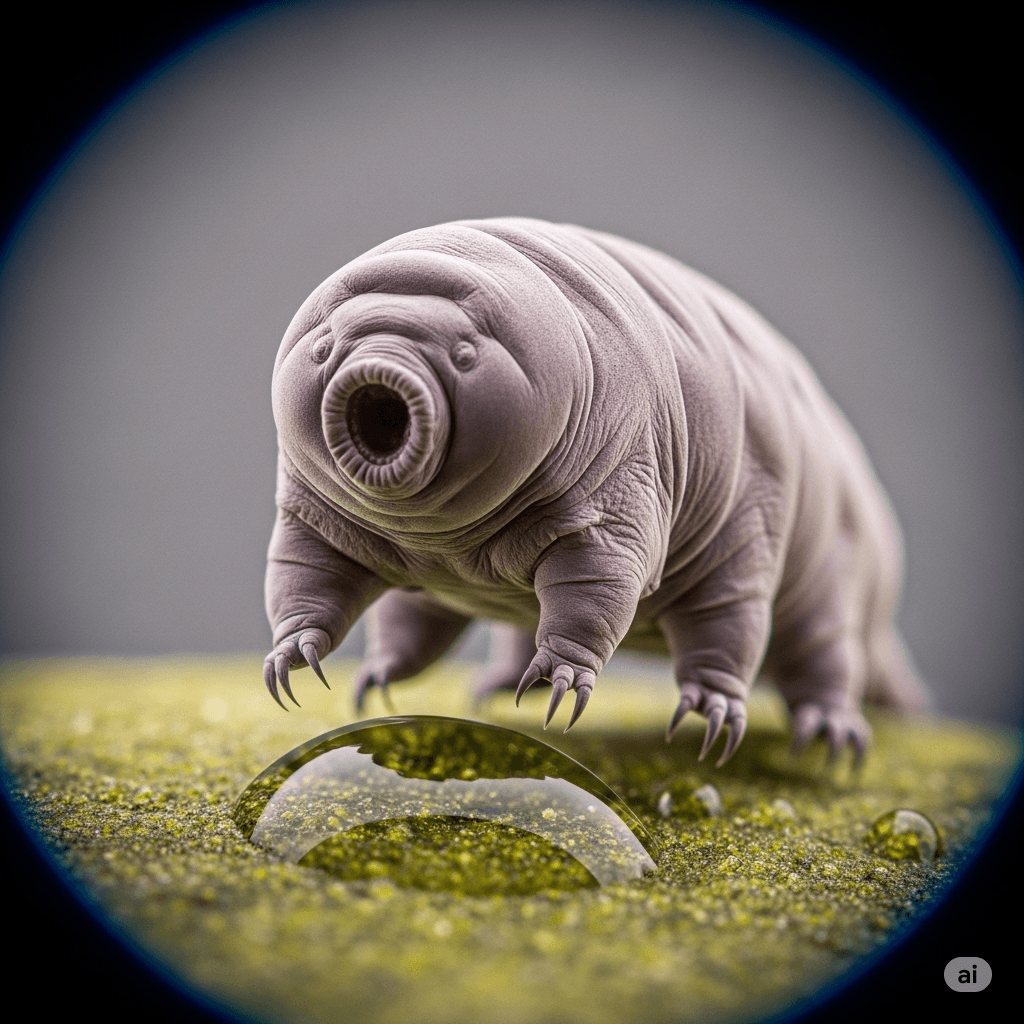
Polar Bears
Body Structure | Eight-legged, segmented body; each leg has claws | ||||||||
|---|---|---|---|---|---|---|---|---|---|
Scientific Name(s) | Tardigrada | ||||||||
Common Name | Water bear | ||||||||
Size(s) | 0.1 – 1.5 mm | ||||||||
Appearance | legs covered in cuticle semi-translucent plump Microscopic | ||||||||
Tardigrades are microscopic, invertebrate organisms commonly known as "water bears." These animals belong to the phylum Tardigrada and typically range in length from 0.1 mm to 1.5 mm. Their bodies consist of a head region and a plump, short trunk with four segments, each bearing a pair of clawed legs. The body is covered by a flexible exoskeleton composed of chitin and proteins, which is shed and renewed during growth phases. Tardigrades lack specialized respiratory or circulatory systems; oxygen is absorbed directly by diffusion and transported through a body cavity known as the hemocoel.
These organisms also exhibit diversity in feeding habits. Some species feed on plant cells, while others consume bacteria or small invertebrates. They use stiletto-like structures in their mouths to pierce cell walls and suck out the contents. Their digestive system is simple, consisting of a tube extending from mouth to anus. Tardigrades can live in both freshwater and marine environments and are also common in moist terrestrial habitats. Aquatic species tend to be more sensitive, while terrestrial species are generally more resilient and hardy.
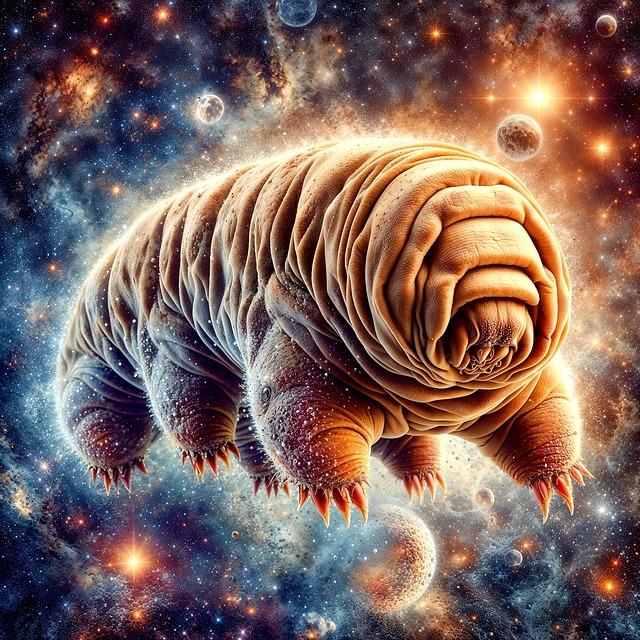
Water Bears (Pixabay)
Knowledge of the evolutionary history of tardigrades is extremely limited due to the extreme rarity of their fossil record. To date, only three valid tardigrade fossils have been discovered, all preserved in amber. Consequently, understanding of their evolutionary development relies largely on genetic and morphological analyses of modern species.
In a 2024 study by researchers from Harvard University, Cretaceous-period amber fossils dated to 80 million years ago were re-examined using laser confocal microscopy. This analysis revealed detailed morphological features of the previously described species Beorn leggi and discovered a previously unknown tardigrade species, Dactylio aero. This new species exhibits characteristic traits of the modern superfamily Hypsibioidea.
Research indicates that tardigrades acquired their cryptobiotic capabilities at least 180 million years ago, and these abilities likely originated as early as 420 million years ago. This has enabled them to survive numerous mass extinction events throughout Earth’s history.

Water Bears (Pixabay)
One of the most remarkable features of tardigrades is their ability to enter a state called the "tun state" by nearly halting their metabolism in response to adverse environmental conditions. This state, known as cryptobiosis, is a survival strategy in which metabolic activity ceases and vital functions are reduced to a minimum.
When entering the tun state, tardigrades lose most of the water in their bodies, retracting their eight legs and head into the trunk. During this process, the body contracts into a small, barrel-like shape. In this form, tardigrades can remain inactive for years and resume normal biological functions when favorable conditions return. Several types of cryptobiosis exist:
Experiments by American researchers have shown that free oxygen radicals specifically bind to the amino acid cysteine, signaling tardigrades to enter the tun state. This demonstrates that cryptobiosis is not merely a passive defense but an active stress response.
The extraordinary resilience of tardigrades to extreme environmental conditions has generated significant interest in the scientific community. Experiments have demonstrated that these organisms can survive temperatures ranging from -200°C to 150°C, pressures equivalent to 6000 atmospheres, and exposure to high doses of X-rays and gamma rays.
In a 2007 experiment conducted by the European Space Agency, 3000 water bears were launched into low Earth orbit aboard the Foton-M3 spacecraft and exposed to the vacuum of space and ultraviolet radiation for 12 hours. Despite these harsh conditions, many tardigrades survived, and some even reproduced successfully after returning to Earth. These findings demonstrate that tardigrades can maintain biological integrity under extreme conditions and serve as model organisms in astrobiology.
The extraordinary resilience of tardigrades stems from a complex network of biochemical and genetic protective mechanisms. These organisms possess numerous specialized proteins that protect their DNA from physical, chemical, and radiation-induced damage. The most notable molecule is the Dsup protein, which stands for "Damage suppressor." This protein binds directly to DNA and prevents double-strand breaks caused by ionizing radiation.
In experiments conducted at MIT, Harvard, and the University of Iowa, mRNA encoding the Dsup protein was injected into mice. The result was a significant reduction in DNA damage in cells following radiation exposure. Dsup holds potential clinical applications in protecting healthy cells during radiotherapy.
In addition to Dsup, tardigrades produce specialized proteins that stabilize intracellular proteins and preserve their function during desiccation:
Through these mechanisms, tardigrades maintain biological integrity against stressors such as water loss, extreme temperatures, high salinity, and radiation.
One of the most unusual experiments involving tardigrades was conducted in 2021 as part of a quantum entanglement study. In the experiment, three tardigrade specimens were first frozen into the tun state and then integrated into a superconducting quantum circuit. The tardigrade caused a shift in the resonant frequency between two qubits, and the system behaved as if it were a three-component entangled structure.
The researchers claimed that the tardigrade had been "temporarily entangled" in the quantum system. However, this claim sparked intense debate within the scientific community. Some physicists argue that the observed effects result from electromagnetic interactions and do not constitute true quantum entanglement. According to this view, there is no evidence that tardigrades exhibit behavior consistent with quantum mechanics. Nevertheless, the experiment represents a pioneering step toward integrating multicellular organisms into quantum systems.
Water Bears (Pixabay)
The resilience of tardigrades is not limited to natural disasters on Earth. In a 2017 joint study by Oxford and Harvard Universities, mathematical models were used to assess the extent to which tardigrades could survive astrophysical catastrophes. The study concluded that events such as supernovae, gamma-ray bursts, and large asteroid impacts would need to boil Earth’s oceans to eliminate tardigrades — otherwise, they would survive.
In this context, tardigrades are considered among the most resilient representatives of life on Earth and are expected to persist as long as life exists on the planet. These findings encourage new approaches to the possibility of extraterrestrial life. If such resilient organisms evolved on Earth, life may also have emerged on other planets under similar conditions.
Tardigrades reproduce by laying eggs in moist environments. Their reproductive strategies include both sexual reproduction (male-female) and parthenogenesis (without fertilization). This adaptability enables them to reproduce even in harsh environmental conditions. They typically deposit their eggs inside the shed exoskeleton during molting. In some species, development is direct, while in others, a larval stage is observed.
In the tun state, water bears become extremely lightweight and can be transported over long distances by wind, birds, insects, or water currents. This dispersal strategy allows tardigrades to inhabit nearly every ecosystem on Earth, from the poles to ocean depths, high mountains to hot springs.
The extraordinary resilience of tardigrades is not only a subject of biological curiosity but also inspires various applications in biotechnology and medicine. The demonstration that the Dsup protein can protect human cells from radiation has opened new avenues for research aimed at reducing the side effects of radiotherapy in cancer treatment.
In addition, proteins from tardigrades that confer resistance to desiccation could contribute to the development of vaccines or drugs that do not require cold-chain storage. Applications such as protecting astronauts’ DNA during space missions or enabling long-term storage of food and biological materials may also be developed based on tardigrade biology.
Morell, Virginia. “Water Bears Survive Earth Orbit.” Science, March 8, 2018. https://www.science.org/content/article/water-bears-survive-earth-orbit
Pennisi, Elizabeth. “How Water Bears Evolved Their Superpower.” Science, April 29, 2024. https://www.science.org/content/article/how-water-bears-evolved-their-superpower
Researchers Claim the Frozen Tardigrade Is the First Quantum-Entangled Animal in History. Quantum Turkey. Accessed June 1, 2025. https://kuantumturkiye.org/arastirmacilar-donmus-tardigradin-tarihteki-ilk-kuantum-dolasmis-hayvan-oldugunu-iddia-ediyor/
“Dünyanın En Dayanıklı Hayvanının Sırrı Çözüldü.” Anadolu Ajansı, August 25, 2016. https://www.aa.com.tr/tr/bilim-teknoloji/dunyanin-en-dayanikli-hayvaninin-sirri-cozuldu-/649627
“Research: Tardigrades Enter Barrel Form to Survive in Space via Oxygen Radicals.” Anadolu Ajansı, May 9, 2024. https://www.aa.com.tr/tr/bilim-teknoloji/arastirma-tardigradlar-oksijen-radikalleri-sayesinde-uzayda-hayatta-kaldiklari-fici-haline-giriyor/3129052
“Su Ayıları (Tardigradlar).” Bilim Genç, TÜBİTAK. Accessed June 1, 2025. https://bilimgenc.tubitak.gov.tr/su-ayilari-tardigradlar
“Su Ayıları Uzayda da Yaşayabiliyor.” BBC Türkçe, March 5, 2018. https://www.bbc.com/turkce/haberler-43287635
“The Last Survivors on Earth.” University of Oxford News, July 13, 2017. https://www.ox.ac.uk/news/2017-07-13-last-survivors-earth
“Tiny Tardigrade’s Protein May Help Cancer Patients Tolerate Radiation Therapy.” MIT News, February 26, 2025. https://news.mit.edu/2025/tiny-tardigrades-protein-may-help-cancer-patients-tolerate-radiation-therapy-0226

Polar Bears
Body Structure | Eight-legged, segmented body; each leg has claws | ||||||||
|---|---|---|---|---|---|---|---|---|---|
Scientific Name(s) | Tardigrada | ||||||||
Common Name | Water bear | ||||||||
Size(s) | 0.1 – 1.5 mm | ||||||||
Appearance | legs covered in cuticle semi-translucent plump Microscopic | ||||||||
Fossil Record and Evolutionary History
Tun State and Cryptobiosis: Survival Strategies
Resistance to Extreme Conditions and Space Experiments
Genetic Resistance Mechanisms
Quantum Entanglement Experiment and Controversies
Resistance to Astrophysical Catastrophes
Ecological Distribution and Reproductive Strategies
Potential Biotechnological and Medical Applications