


This article was automatically translated from the original Turkish version.
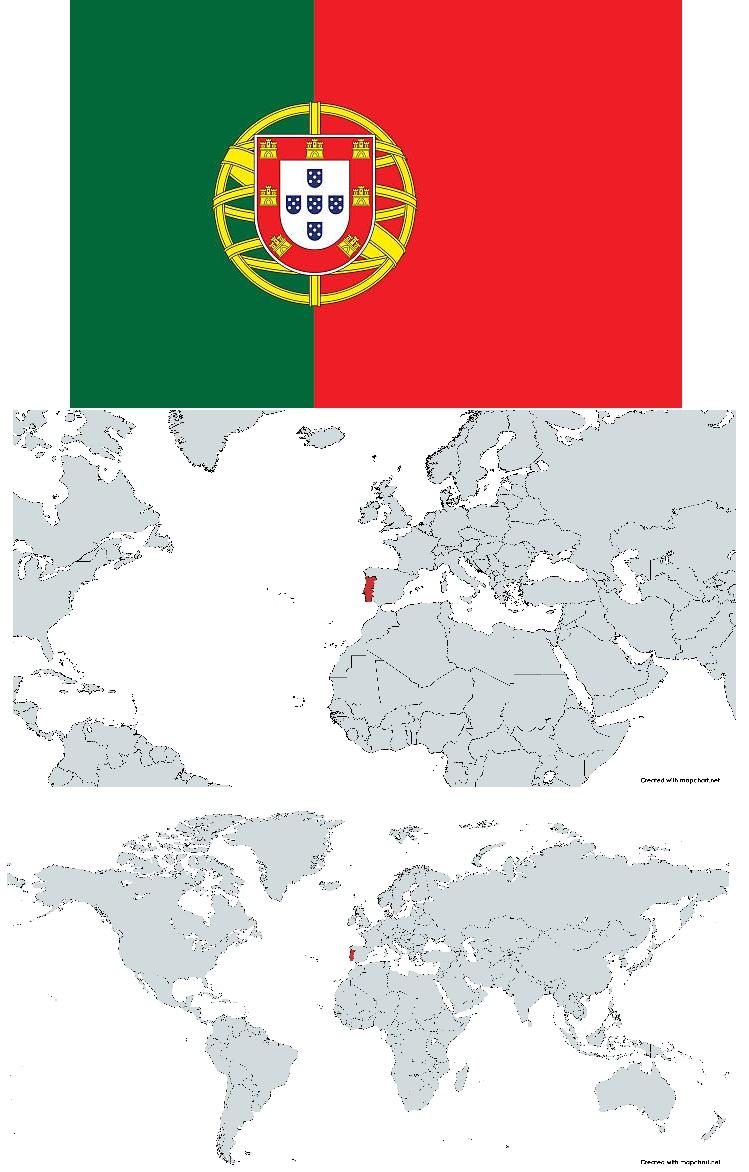
Portuguese Republic (República Portuguesa)
GDP per Capita | 27.275 USD | ||||||||
|---|---|---|---|---|---|---|---|---|---|
GDP | 287.08 billion USD (2023) | ||||||||
Ethnic Structure | Portuguese (%95), Other ethnic groups (%5) | ||||||||
Climate | Mediterranean climate summers are hot and dry rainy and windy winters are mild | ||||||||
Internet Domain | .pt | ||||||||
Telephone Code | +351 | ||||||||
Time Zone | UTC+2 (Winter Time), UTC+3 (Summer Time) | ||||||||
Currency | Euro (EUR) | ||||||||
Population | 10.525.347 | ||||||||
Area (km²) | 92.226 | ||||||||
Independence | 1143 | ||||||||
Prime Minister | Luís Montenegro | ||||||||
President | Marcelo Rebelo de Sousa | ||||||||
System of Government | Parliamentary Republic | ||||||||
Official Language | Portuguese | ||||||||
Capital | Lisbon | ||||||||
Portugal is a country located in Western Europe that has played an important role throughout history through its maritime exploration, culture, and art. Having gained its independence in 1143, Portugal has a long historical legacy. Within its current borders, it has a population of 10.5 million and a GDP of $287.08 billion, attracting attention with its rich natural resources, warm climate, and hospitable people. Geographically, Portugal is situated along the Atlantic Ocean and includes the Madeira and Azores archipelagos. In terms of time zones, Portugal has a two-hour difference with Türkiye during summer time and a three-hour difference during winter time.

Flag and Coat of Arms of Portugal
Portugal’s history was shaped by the great maritime explorations that began in the 15th century, as the country opened significant sea routes that established a global influence. This cultural heritage is felt widely across the country, from villages to cities. Its capital, Lisbon, offers a captivating contrast of historic architecture and modern lifestyle, while Porto is renowned for its scenic beauty and wines. Portuguese cuisine is particularly known for its seafood, olive oil, and wine. The country has a structure that blends a modern economy with traditional values and has shown significant growth in tourism in recent years.
Name: A Portuguesa – "The Song of the Portuguese"
Composer and Lyricist: Henrique Lopes de Mendonça (1856–1931) / Alfredo Keil (1850–1907)
Adopted: 5 October 1910
Official Status: National anthem of the Portuguese Republic
Original Composition Year: 1890
"A Portuguesa", Portugal’s national anthem, was written in 1890 in response to an ultimatum issued by Britain regarding its territorial claims in Africa. The ultimatum sparked widespread anger among the Portuguese population toward the monarchy, and "A Portuguesa" became a symbol of these protests. The lyrics, particularly the chorus, serve as a call to arms, while the third line uses terms such as "insults" and "shame," reflecting the Portuguese people’s reaction to the British ultimatum. The first chorus line reads, "Contra os bretões marchar, marchar" ("March against the Britons, march!"). After the Republican revolution of 1910 overthrew the monarchy and established a democratic government, "A Portuguesa" was quickly adopted as the national anthem. Today, typically only the first verse and chorus are sung as the national anthem.
In 1956, various variations emerged in the melody and instrumentation of "A Portuguesa." Recognizing this, the government established a commission to determine the official version. The commission submitted a recommendation approved by the Council of Ministers on 16 July 1957, and this version remains in force to this day.
Portugal’s history is the result of an evolution spanning thousands of years, during which the country has exerted significant global influence in maritime exploration, culture, economy, and politics. Despite its location in western Europe, Portugal has played a major role in world history through its overseas discoveries and colonial empires. This article aims to examine Portugal’s history in depth.
The territory of Portugal was first settled by the Iberians and Phoenicians in the 3rd millennium BCE. The Phoenicians established various trading colonies to control sea routes in the western Mediterranean. However, the greatest power to dominate the region was the Roman Empire. Rome conquered the region of Hispania in the 2nd century BCE and began administering the territory of modern-day Portugal as Hispania Ulterior. Under Roman rule, the region underwent profound cultural transformation. Rome left deep impacts on agriculture, trade, infrastructure, and culture, building cities and introducing the local population to Roman customs. Modern Portuguese cities such as Porto and Lisbon were founded during the Roman period. After the fall of the Roman Empire, the region was conquered by the Visigoths in the 5th century.
One of the most pivotal moments in Portugal’s medieval history was the Arab conquest of the Iberian Peninsula in 711. The Arabs took control of most of Portugal’s territory, but Christian kingdoms in the north, particularly the Kingdom of Asturias, resisted. By the 12th century, Christian kingdoms began gradually pushing back the Arabs. In 1139, Afonso Henriques declared himself the first King of Portugal, marking the first step toward Portuguese independence. This period was part of the broader "Reconquista," the process of reclaiming territories from the Arabs. The Kingdom of Portugal rapidly expanded its borders, experiencing a period of territorial gains from the 12th to the 13th century.
Portugal became one of the world’s most powerful maritime powers in the 15th and 16th centuries. This era was marked by Portugal’s ambitious campaigns of exploration and opening of sea routes across the globe. Under the leadership of Prince Henry the Navigator, Portuguese sailors explored the African coast and in 1487 Bartolomeu Dias discovered the Cape of Good Hope, opening the sea route to Asia. One of the most significant discoveries was Vasco da Gama’s arrival in India in 1498. This achievement established Portugal as a leading power in global trade.
Portugal’s overseas conquests included the capture of Goa and other territories along the western coast of India. In the 16th century, Portugal established a vast colonial empire, including Brazil, and acquired territories across Asia, Africa, and South America. At its greatest extent, the Portuguese Empire exerted major influence in maritime trade and commerce. However, Portugal’s Age of Discoveries was shaped not only by military successes but also by cultural, scientific, and economic developments. Yet, from the 17th century onward, the empire’s administration and military strength began to weaken.
Portugal’s decline in the late 17th and early 18th centuries was largely due to its union with Spain. In 1580, the Kingdom of Portugal was incorporated into the Kingdom of Spain and remained under Spanish rule for approximately 60 years. During this period, Portugal struggled against rivals such as England and the Netherlands for control of sea routes and suffered economic weakening. In 1640, Portugal regained its independence with the ascension of João IV, becoming once again an independent kingdom.
In the 18th century, Portugal experienced some economic recovery through gold and diamonds extracted from Brazil, but this wealth was not sustained over the long term. The French Revolution and Napoleon’s influence in Europe further weakened Portugal economically and militarily. In 1807, Napoleon’s invasion of Portugal caused major internal disruption and led to the relocation of the government to Brazil.
In the early 19th century, Portugal faced serious political and economic instability. A revolution in 1820 established a constitutional monarchy. In 1822, Brazil declared its independence from Portugal, a major loss for the country. In 1910, a revolution overthrew the monarchy and established the Portuguese Republic. However, this new republican period was marked by numerous government changes and internal conflicts.
After the establishment of the Portuguese Republic in 1910, the country faced political instability. A military coup in 1926 led to a dictatorship and the rise of Salazar’s regime. António de Oliveira Salazar established a fascist regime in 1933, creating a totalitarian government system known as the "Estado Novo" (New State). Salazar’s rule lasted until the 1974 Carnation Revolution, which ended the dictatorship and ushered Portugal into democracy.
Portugal joined the European Economic Community in 1986, accelerating its economic development. However, after the 2008 global financial crisis, Portugal faced severe economic difficulties, rising unemployment, and increasing debt. Financial assistance from the European Union in 2011 helped Portugal overcome the crisis, but significant structural reforms were needed. In recent years, Portugal has achieved economic growth and increased its contributions to the European Union.
Portugal’s history is a narrative shaped not only by its internal boundaries but also by its global maritime explorations and empires. The Age of Discoveries made Portugal one of the most important actors in world history, while internal wars, political turmoil, and economic crises have also been inseparable parts of its historical journey. Modern Portugal is moving in a different direction from its past influence, guided by its membership in the European Union and its democratic structure.
Portugal is a country located in southern Europe on the western part of the Iberian Peninsula. Bordered by the Atlantic Ocean to the west and south, and by Spain to the east and north, Portugal’s strategic location has played a major role in its maritime history and explorations. Portugal’s geography is diverse, combining mountains, plateaus, plains, and coastal strips, with each region possessing distinct climates and natural features. This article will examine the geography of Portugal in detail.
Portugal covers an area of approximately 92,226 square kilometers and is located at the westernmost point of Europe. As the westernmost country on the Iberian Peninsula, Portugal extends along the western coast of Western Europe. Geographically, the country stretches 561 kilometers from east to west and about 218 kilometers from north to south. Its coastline is approximately 1,793 kilometers long, giving it a deeply maritime character. Additionally, Portugal’s access to the Atlantic Ocean places it in a strategically important position for maritime activities.
Portugal’s terrain is mountainous and rugged. The western and northern regions feature high mountains, while the south has flatter areas and extensive plains.
Serra da Estrela
Portugal’s highest mountain is Serra da Estrela, standing at 1,993 meters. Located in the center of the country, the Serra da Estrela mountain range forms one of the region’s most important natural areas. Serra da Estrela is notable for its rock formations, forests, and high-altitude meadows. This region is one of Portugal’s most important centers for mountaineering and winter sports. The mountains also serve as habitats for various flora and fauna species.
Península de Setúbal and Algarve
The Algarve region in southern Portugal is characterized by gentle, rolling hills parallel to the coast rather than mountainous terrain. Here, Serra de Monchique rises to 902 meters and is known for its natural beauty combined with the region’s mild climate. Algarve is one of Portugal’s most popular tourist destinations.
Minho and Trás-os-Montes Mountainous Regions
The Minho and Trás-os-Montes regions in northern Portugal are characterized by steep and rugged mountains. These areas attract attention with their relatively untouched natural landscapes and fertile agricultural soils.
Large lowland areas in Portugal are generally located in the eastern and southeastern regions. These areas are covered with fertile soils suitable for agriculture.
Tejo Valley
The Tejo River, Portugal’s largest river, flows from east to west through a broad valley in the central part of the country. This valley is the country’s largest plain region and serves as an important agricultural area. The soils of the Tejo Valley are particularly suitable for growing grapes, olives, and wheat.
Alentejo Plain
Alentejo is a large plain region in southern Portugal. This area is covered with extensive grasslands, wheat fields, and olive groves. The southern parts of Alentejo contain some of Portugal’s largest agricultural lands. The hot climate and abundant sunlight in this region provide ideal conditions for olive and grape cultivation. Additionally, the region’s ecological diversity supports numerous plant and animal species.

Alentejo Plain
Portugal’s water resources form a major part of its geography and play a vital role in agriculture, energy production, and drinking water supply.
Tejo River
The Tejo River is Portugal’s longest river, originating in the interior and flowing westward into the Atlantic Ocean. This river is Portugal’s most important waterway and has historically served as a transportation link between its industrial and agricultural regions.
Douro River
The Douro River is located in northeastern Portugal and nourishes the famous Douro Valley, known for producing Portugal’s renowned wines. The area surrounding the Douro River has been designated a UNESCO World Heritage Site. Additionally, this river is important for transportation.
Portugal’s climate is influenced by the Mediterranean, but geographic variations have led to the emergence of several climate types. The western and southern coasts are dominated by the Mediterranean climate, while inland areas exhibit climates similar to continental climates.
Portugal’s overseas territories include the Azores and Madeira archipelagos, located in the Atlantic Ocean west of the mainland. The Azores consist of nine islands known for their volcanic mountains, crater lakes, and rich biodiversity. Madeira is famous for its subtropical climate and is an important center for maritime activities, nature hiking, and wine production.
Portugal is a country distinguished by its geographic diversity. Its varied natural features, from mountains to plains, rivers, and coastlines, shape its economic activities, which are both agriculture-based and tourism-oriented. This geographic diversity also supports Portugal’s cultural richness and biological diversity.
Portugal is a state located on the Iberian Peninsula that shares its land border with only one country. Portugal’s only land neighbor is Spain, while it is bordered by the Atlantic Ocean to the west and south.
Portugal shares a land border of approximately 1,214 kilometers with Spain to the east and north. This border runs from the mountainous areas in the north through inland regions to the plains and lowlands in the south. Portugal’s land border has played a historically significant role, as its current territory was shaped by boundaries established since the Middle Ages. Today, the border with Spain is well-managed and clearly defined.
Portugal’s maritime borders are extensive due to its location at the westernmost point of Western Europe. Portugal holds a strategically important position because of its coastline along the Atlantic Ocean. Since its western and southern coasts are not bounded by land borders, Portugal’s maritime boundaries cover a vast area. This extensive maritime territory has played a crucial role in fishing, maritime transport, and its history of exploration.
Portugal’s only land neighbor is Spain, located to the east and north with a long land border. Spain’s land border with Portugal has been a major factor in shaping Portugal’s geography. Portugal’s territory was definitively established during a period beginning in the 12th century through border disputes with the Kingdom of Aragon and the Kingdom of Castile.
Portugal’s climate exhibits great variation due to its extensive coastline and geographic diversity. Located on the western coast of the Iberian Peninsula, its climate is influenced by maritime effects, mountainous areas, and the continental climate of inland regions. Portugal’s climate diversity can generally be categorized into three main types: Mediterranean climate, oceanic climate, and continental climate in inland areas.
The western and northern coasts of Portugal are dominated by an oceanic climate due to maritime influence. Winters are mild and rainy, while summers are cool and humid. The oceanic climate, shaped by moist air currents from the Atlantic Ocean, prevents extreme temperature fluctuations. As a result, winter temperatures typically range between 10°C and 15°C, while summer temperatures range between 20°C and 25°C.
The southern and southeastern parts of Portugal are influenced by a Mediterranean climate. This climate is characterized by hot, dry summers and mild, rainy winters. In the Algarve region, summer temperatures can be very high, while winters are relatively mild. The Mediterranean climate in the south has become attractive to tourists and has led to widespread cultivation of olives, grapes, and citrus fruits.
In Portugal’s inland regions, particularly in higher-altitude areas such as Trás-os-Montes and Alentejo, a continental climate prevails. Summers are very hot and dry, while winters are cold and snowy. Inland areas experience reduced oceanic influence, resulting in more pronounced temperature variations.
Mountainous areas in eastern and inland Portugal, particularly regions such as Serra da Estrela, have a different climate type influenced by an Alpine climate. These areas receive heavy snowfall in winter and have cool summers. Mountain climbing and winter sports are very popular in these regions.
Portugal’s climate varies due to the balance between oceanic and continental influences, mountains, and seas. The western and northern regions have a mild, rainy oceanic climate, while the south and southeast are dominated by the Mediterranean climate, and inland areas experience a continental climate. This climatic diversity is a key factor shaping Portugal’s agriculture, tourism, and daily life.
Rainfall in Portugal varies significantly due to its geographic diversity. The western coasts and northern regions, under oceanic influence, receive high annual rainfall. In cities such as Porto, annual precipitation can reach 1,200 mm. Rainfall is concentrated in winter, while summer sees a marked reduction. In contrast, southern regions and inland areas are drier. In southern coastal cities such as Algarve, annual rainfall ranges between 400 mm and 600 mm. Although rainfall increases in winter, summer months see almost no rain.
Inland and mountainous areas have lower rainfall than the north and west. In regions with a continental climate such as Alentejo and Trás-os-Montes, annual rainfall is around 400 mm. These areas experience hot, dry summers and cold, wet winters. In high-altitude areas such as Serra da Estrela, annual rainfall exceeds 1,000 mm, with heavy snowfall in winter. In summary, rainfall in Portugal varies considerably by region.
Portugal’s demographic structure is shaped by historical, economic, and social factors. The country’s population, age structure, ethnic diversity, migration patterns, and religious composition form the foundation of its social structure. Below, we will examine Portugal’s demographics in detail under subheadings.
As of 2023, Portugal’s population is approximately 10.5 million. This population has shown slow growth in recent years due to low birth rates and emigration. Population density is higher in major cities and lower in rural areas. Lisbon and Porto, as major urban centers, not only serve as the country’s economic and cultural hubs but also house a significant portion of the population. Lisbon, as the capital and largest city, plays a central role in Portugal’s economic activities.
Portugal is notable for its concentration of population in major cities. Population growth in Lisbon, Porto, and other large cities contrasts with lower growth in rural areas. Migration from rural to urban areas reflects differences in employment opportunities and living standards.
Portugal’s population is aging. While birth rates decline, life expectancy increases. In 2023, the average life expectancy in Portugal was around 81 years, reflecting improvements in healthcare and quality of life. However, low birth rates have created a significant demographic challenge: an aging population.
An aging population creates challenges in the labor market and social security system. The shrinking youth population and rising number of retirees increase demand for healthcare and care services. Additionally, low birth rates represent a major demographic challenge threatening future labor potential.
Portugal’s ethnic structure is largely homogeneous, as the majority of the population is Portuguese. However, throughout its history, various ethnic groups have settled in Portugal through migration. These migrants primarily come from former Portuguese colonies. Immigrants from Brazil, Angola, Mozambique, and Cape Verde hold an important place in Portugal’s ethnic makeup.
In recent years, Portugal has also begun accepting immigrants from outside the European Union. These immigrants include people from Africa, Asia, and Latin America. The immigrant population plays a significant role in Portugal’s labor market. However, their integration presents social and cultural challenges.
Religious beliefs in Portugal are largely centered on Catholicism. Catholicism has historically formed the foundation of Portugal’s cultural and social structure and is recognized as the official religion. However, in recent years, Portugal has experienced a process of secularization, and religious belief is gradually declining.
Although the Catholic population constitutes a large portion of the country, Protestantism, Islam, and other religious beliefs are present but represent smaller proportions. In recent years, secularization and declining religious belief have become noticeable, particularly in major cities. Nevertheless, Catholicism continues to play an important role through religious holidays, ceremonies, and traditions.
Portugal has undergone rapid urbanization since the mid-20th century. This process, driven by industrialization and modernization, has led to significant concentration in urban areas. However, this urbanization process has resulted in significant population loss in rural areas. Migration from rural to urban areas has been driven by greater employment opportunities and higher living standards in cities.
The population decline in rural areas has led to labor shortages in agriculture, accelerating the mechanization and modernization of farming. Nevertheless, rural areas still hold an important place in Portugal’s cultural identity. Portuguese villages attract attention through their traditional lifestyles and cultural heritage.
Portugal’s education system has undergone significant reform in recent years. Educational advancements, particularly in higher education and technical fields, have led to notable growth. However, Portugal’s labor force faces challenges such as high unemployment rates and difficulties for young people entering the job market. Emigration of young people is a primary cause of these issues.
Female participation in the labor force has increased in Portugal, but gender pay gaps persist. Additionally, unemployment rates remain high, particularly in rural areas, making this a significant factor affecting Portugal’s economic growth and social structure.
Portugal’s demographics have been shaped by low birth rates, an aging population, and migration trends. The aging population and shrinking youth population create significant challenges for social and economic systems. However, immigration policies and urbanization can make Portugal’s demographic structure more dynamic. These changes have important implications for labor supply, cultural diversity, and social integration.
Portugal’s international relations have been shaped by historical, economic, and geographic factors and have played a significant role on the global stage. As a former maritime power, Portugal established a major maritime empire through extensive global explorations in the 15th and 16th centuries. These overseas territories and colonies formed the foundation of Portugal’s international relations. Today, as a full member of the European Union (EU), Portugal prioritizes multilateral diplomacy, economic cooperation, and regional security issues.
Portugal joined the European Union (then the European Economic Community) in 1986, integrating into Europe’s political and economic structure. This membership accelerated the country’s economic development, supported infrastructure projects, and promoted economic growth. Through EU membership, Portugal benefited from trade and free movement, while also assuming responsibilities in areas such as the Common Agricultural Policy, environmental regulations, and refugee policies.
Portugal is a strong voice within the EU, acting as a representative of southern Europe and the Mediterranean basin. Additionally, Portugal is a member of the Eurozone and plays an active role in ensuring economic stability within the European Monetary Union. In recent years, despite implementing economic reforms and budget austerity measures due to EU financial crises, Portugal has benefited from EU financial aid packages.
Portugal is an active member of global international organizations such as the United Nations (UN). Since joining the UN in 1955, Portugal has initiated various efforts in international peace, security, and human rights and has served on the UN Security Council. Portugal contributes to UN peacekeeping missions and strengthens its relations with developing countries.
Additionally, Portugal is a member of numerous international and regional organizations, including the World Trade Organization (WTO), the Council of Europe, NATO, the OECD, and the Community of Portuguese Language Countries (CPLP). Portugal advocates for global trade liberalization, environmental protection policies, human rights, and regional security through these platforms.
Portugal maintains strong and longstanding relations with the United States, similar to its relationship with the United Nations. This relationship was strengthened during the Cold War within the NATO framework. Portugal has been a NATO member since 1949, shaping its military cooperation and security strategies. Portugal is important in relations with the U.S. due to its strategic military bases and regional security cooperation.
Portugal’s NATO membership reflects its military and diplomatic relations with the U.S. However, relations are not limited to military cooperation; strong ties also exist in trade and economics. Portugal has signed various agreements to increase trade with the U.S. and has become one of the U.S.’s key allies in Europe.
Relations between Portugal and Brazil are based on historical and cultural ties. The two countries share strong connections in language, culture, and history. Portugal has become one of Brazil’s most important trading partners, with trade concentrated in agricultural products, automotive, and industrial sectors.
Brazil’s growing economy and Portugal’s EU membership create new business opportunities for both countries. Portugal is not only Brazil’s largest trading partner in Europe but also maintains strong diplomatic relations with Brazil. Additionally, Portugal plays an important role in Brazil’s relations with its former colonies.
Portugal has historically maintained strong ties with Africa. Portugal’s former African colonies — Angola, Mozambique, Guinea-Bissau, Cape Verde, and São Tomé and Príncipe — continue to maintain relations with Portugal today. Economic ties with these countries continue through trade, investment, and cultural exchange. Portugal seeks to develop its relations with former colonies not only economically but also culturally and educationally.
Portugal has established relations with many developing countries in Africa and supports regional development through these ties. Angola and Mozambique, in particular, are economically important for Portugal. Additionally, Portugal cooperates with regional organizations such as the African Union (AU).
Portugal’s relations with China have increased in recent years. As China has become a powerful global economic player, Portugal seeks to benefit from this opportunity. Portugal is one of China’s most important trading partners in Europe and engages in cooperation across many sectors. Portugal also participates in China’s Belt and Road initiative.
Portugal does not limit its relations with China to trade alone; it also seeks to enhance cooperation in technology, infrastructure projects, and the energy sector. These relations create new opportunities for both countries and contribute to Portugal’s economic development.
Portugal actively promotes its relations in language and culture. Portugal established the Community of Portuguese Language Countries (CPLP) to strengthen cultural and commercial ties with Portuguese-speaking countries. This community is a forum of nine Portuguese-speaking countries that promotes cooperation and solidarity among them.
Portugal’s cultural diplomacy spreads globally through education, art, and media. Strong ties with Portuguese-speaking communities in countries such as Brazil, Angola, and Mozambique enhance Portugal’s global cultural influence.
Portugal is a significant player in international relations, combining strong historical ties with active participation in the global economic and political arena. As an active member of the European Union, the United Nations, NATO, and other international platforms, Portugal also maintains cultural and economic ties with its former colonies. These relationships hold an important place in Portugal’s international diplomacy and global cooperation.
Relations between Portugal and Türkiye are shaped not only by historical and cultural ties but also by contemporary global economic and political dynamics. The two countries maintain strong diplomatic, trade, and cultural relations based on shared understanding of political and economic issues in Europe and globally. Portugal is one of the countries supporting Türkiye’s European Union membership process, while Türkiye views Portugal as a strategic partner in its foreign policy.
Diplomatic relations between Portugal and Türkiye were established in 1929. Since then, continuous diplomatic communication has been maintained, with mutual visits and meetings strengthening ties. In recent years, meetings between the foreign ministers of both countries have significantly contributed to the development of bilateral relations. Portugal is one of the countries fully supporting Türkiye’s EU membership, while Türkiye considers Portugal an important partner in its strategic cooperation outside Europe.
Economic relations between Portugal and Türkiye have strengthened in recent years. Trade volume has increased, particularly in textiles, automotive, agricultural products, energy, and construction sectors. Türkiye’s exports to Portugal include electrical equipment, automobile parts, textile products, and foodstuffs, while Portugal’s exports to Türkiye mainly consist of machinery, chemicals, food products, and automotive components.
Portugal plays an important role in Türkiye’s access to the European market, while Türkiye offers Portugal a valuable gateway to the Middle East and Asian markets. Both countries aim to increase investments in each other’s countries and have signed various bilateral trade agreements and cooperation frameworks.
Portugal and Türkiye cooperate in the cultural field. Cultural diplomacy between the two countries continues through cultural centers and artistic events. Various events are organized to promote Turkish and Portuguese cultures, with artists and cultural ambassadors from both countries sharing their cultural richness.
Festivals, exhibitions, and events promoting Turkish culture are held in Portugal, while cultural festivals and artistic activities related to Portuguese culture take place in Türkiye. In education, student and academic exchange programs are organized between higher education institutions. Both countries are committed to cooperation in education and activities aimed at enhancing cultural understanding.
Tourism plays a significant role in relations between Portugal and Türkiye. Both countries offer attractive destinations for tourists. Flights connect Portugal’s capital, Lisbon, with popular Turkish holiday resorts. Each year, thousands of tourists from both countries travel to explore each other’s cultural heritage, natural beauty, and historical sites.
Turkish tourism offers a major draw for tourists seeking to discover Portugal’s various attractions, while Portugal’s beaches and historic cities are popular destinations for tourists from Türkiye.
Portugal has always been one of the countries supporting Türkiye’s accession to the European Union. Portugal believes that Türkiye’s integration with the EU benefits economic growth, security, and regional cooperation and continues to support accelerating this process. Although Türkiye’s EU membership faces criticism from some member states, Portugal has generally defended Türkiye’s accession and intensified its diplomatic efforts on this issue.
Portugal and Türkiye cooperate on regional security and global issues. Within the framework of NATO membership, both countries engage in various military and strategic collaborations to ensure regional security. Additionally, both countries share similar foreign policy approaches on counter-terrorism, human rights, and democracy. In Türkiye’s security issues in the Middle East, Portugal stands alongside Türkiye and maintains cooperation on these matters.
Portugal and Türkiye pursue common goals on many global issues. Particularly on climate change, sustainable development, trade liberalization, and digitalization, both countries initiate numerous diplomatic efforts to produce joint policies. On platforms such as the United Nations and the World Trade Organization, both countries act with similar perspectives.
Relations between Portugal and Türkiye are built on a strong foundation of economic, diplomatic, and cultural cooperation. During this period of increasing cooperation, trade, and cultural exchange, deeper relations and strengthened strategic partnerships across various fields are expected. Both countries share a common perspective on global issues and are expanding their diplomatic and economic cooperation to create a broader partnership network.
The Portuguese Armed Forces (Forças Armadas Portuguesas) constitute the country’s defense capability and consist of three main components: the Army (Exército), the Navy (Marinha), and the Air Force (Força Aérea). Portugal maintains a professional military with responsibilities for national defense and contributions to international peacekeeping operations. The Portuguese Armed Forces comprise approximately 27,250 active personnel and 211,700 reserve personnel, playing a significant role within NATO and other international defense alliances.
The Portuguese Army is the largest component of the country’s land defense force, with approximately 14,000 active personnel organized into numerous mechanized, infantry, and artillery units. These units provide flexible and rapid-response capabilities for operations both within Portugal and within the NATO framework. During its modernization process, the Army is equipped with modern hardware such as Leopard 2A6 main battle tanks and Pandur II 8×8 armored personnel carriers. It also uses M114 155mm towed howitzers, with plans to acquire self-propelled howitzer systems to replace older equipment. The Army has also initiated several programs to acquire new air defense systems, including advanced elements such as missile launchers and local warning radars.
The Portuguese Navy manages a significant fleet to ensure maritime security and participate in naval operations. The Navy’s fleet includes Tridente-class submarines (Type 214), Vasco da Gama-class frigates, and João Coutinho and Baptista de Andrade-class corvettes. The Tridente-class submarines feature air-independent propulsion systems that enhance submarine endurance and stealth, giving them strategic importance. The Vasco da Gama-class frigates are capable of multi-role missions including air defense, anti-submarine warfare, and surface warfare. Additionally, vessels such as the Viana do Castelo-class offshore patrol vessels are used for maritime security, search, and rescue operations. The Portuguese Navy plans to modernize its fleet by replacing older corvettes and support ships with more modern vessels. It also employs Super Lynx Mk95 helicopters for critical roles in anti-submarine and surface warfare.
The Portuguese Air Force is the most important military branch responsible for air defense and air operations. Its fleet includes F-16AM/BM Fighting Falcon multi-role fighter aircraft, C-130H Hercules and C-295M tactical transport aircraft, and other key assets. These aircraft are used in both military and humanitarian operations, supporting Portugal’s participation in international missions. The P-3C Orion maritime patrol aircraft is vital for anti-submarine warfare, maritime surveillance, and search-and-rescue operations. The Air Force also conducts pilot training and light attack missions using Alpha Jet and Epsilon TB-30 training aircraft. The Portuguese Air Force plans to acquire new aircraft and modernize its existing fleet to enhance its air power.
Portugal is implementing a series of programs and initiatives to modernize its military capability. In 2022, the defense budget was set at $3.5 billion, equivalent to 1.35% of its Gross Domestic Product (GDP). Modernization efforts include numerous procurement programs to replace outdated equipment with new technologies and systems, including armored vehicles, new naval ships, and advanced aircraft. Additionally, Portugal participates in international military exercises and operations within the NATO framework, building a strong partnership against global security threats.
Portugal’s military modernization aims not only to renew equipment but also to strengthen international defense cooperation. Participation in NATO missions enhances its role in regional security and contributes to international peacekeeping operations. These strategic approaches not only enhance Portugal’s security but also establish it as a significant actor in global military cooperation.
Portugal is a country located in southwestern Western Europe with a coastline along the Atlantic Ocean. Historically associated with maritime exploration and trade, Portugal continues this legacy in its modern economy. Today, Portugal stands out with a market economy featuring a developed industrial and service sector. As of 2022, Portugal’s Gross Domestic Product (GDP) was approximately $287.08 billion, and the country’s economy has experienced significant growth in recent years.
Portugal benefits significantly from its membership in the European Union, which provides important advantages in economic integration. Its participation in EU structures such as the Common Agricultural Policy (CAP) and the Eurozone has ensured economic stability. Portugal’s economy is primarily composed of the service, industrial, and agricultural sectors. In recent years, significant progress has been made in technology, innovation, and green economy sectors. Nevertheless, the country remains heavily dependent on tourism, foreign trade, and the food industry.
The service sector is Portugal’s largest sector and constitutes a major portion of GDP. In particular, the tourism sector is vital to the Portuguese economy. In 2019, tourism contributed more than 10% of the country’s GDP. Portugal has become an internationally popular tourist destination, particularly through regions such as Lisbon, Porto, Madeira, and the Azores. The tourism sector
"Portekiz Ekonomisi." Türkiye Cumhuriyeti Dışişleri Bakanlığı. Accessed March 9, 2025.https://www.mfa.gov.tr/portekiz-ekonomisi.tr.mfa.
"Portekiz Künye." Türkiye Cumhuriyeti Dışişleri Bakanlığı. Accessed March 9, 2025.https://www.mfa.gov.tr/portekiz-kunyesi.tr.mfa.
"Portekiz Siyasi Görünümü." Türkiye Cumhuriyeti Dışişleri Bakanlığı. Accessed March 9, 2025.https://www.mfa.gov.tr/portekiz-siyasi-gorunumu.tr.mfa.
"Portekiz'deki Türk Konsolosluğu." Türkiye Cumhuriyeti Dışişleri Bakanlığı - Lizbon Başkonsolosluğu. Accessed March 9, 2025.https://lizbon-be.mfa.gov.tr/Mission/ShowInfoNote/121316.
"Turkey-Portugal Political Relations." Türkiye Cumhuriyeti Dışişleri Bakanlığı. Accessed March 9, 2025.https://www.mfa.gov.tr/turkiye-portekiz-siyasi-iliskileri.tr.mfa.
Central Intelligence Agency. "Portugal." *The World Factbook*. Accessed March 9, 2025.https://www.cia.gov/the-world-factbook/countries/portugal/.
Ministério dos Negócios Estrangeiros. *Embaixada de Portugal*. Accessed March 9, 2025.https://www.emfa.pt/.
Turismo de Portugal. Mercados e Estatísticas. Accessed March 9, 2025. https://www.turismodeportugal.pt/en/Turismo_Portugal/Mercados_Estatisticas/Pages/default.aspx.
Turismo de Portugal. Visão Geral. Accessed March 9, 2025. https://www.turismodeportugal.pt/en/Turismo_Portugal/visao_geral/Pages/default.aspx.
Visit Portugal. Alentejo. Accessed March 9, 2025. https://www.visitportugal.com/en/destinos/alentejo.
Visit Portugal. Info útil sobre Portugal. Accessed March 9, 2025. https://www.visitportugal.com/en/sobre-portugal/info-util.
Üçışık, Süheyla. "Portekiz." *TDV İslâm Ansiklopedisi*. Accessed March 9, 2025.https://islamansiklopedisi.org.tr/portekiz#1.


Portuguese Republic (República Portuguesa)
GDP per Capita | 27.275 USD | ||||||||
|---|---|---|---|---|---|---|---|---|---|
GDP | 287.08 billion USD (2023) | ||||||||
Ethnic Structure | Portuguese (%95), Other ethnic groups (%5) | ||||||||
Climate | Mediterranean climate summers are hot and dry rainy and windy winters are mild | ||||||||
Internet Domain | .pt | ||||||||
Telephone Code | +351 | ||||||||
Time Zone | UTC+2 (Winter Time), UTC+3 (Summer Time) | ||||||||
Currency | Euro (EUR) | ||||||||
Population | 10.525.347 | ||||||||
Area (km²) | 92.226 | ||||||||
Independence | 1143 | ||||||||
Prime Minister | Luís Montenegro | ||||||||
President | Marcelo Rebelo de Sousa | ||||||||
System of Government | Parliamentary Republic | ||||||||
Official Language | Portuguese | ||||||||
Capital | Lisbon | ||||||||
National Anthem of Portugal
History
Ancient Period and Roman Empire
Middle Ages and the Establishment of the Christian Kingdom
Age of Discoveries and the Establishment of the Empire
From the 17th to the 19th Century: Internal Turmoil and Decline
19th Century and the Establishment of the Republic
20th Century: Dictatorship and Transition to Democracy
21st Century: European Union and Economic Challenges
Geography
General Geographic Structure
Mountains and High Regions
Plains and Lowland Areas
Rivers and Water Resources
Climate
Islands
Borders and Neighbors
Land Borders
Maritime Borders
Portugal’s Neighbors
Climate
Oceanic Climate (Western and Northern Coasts)
Mediterranean Climate (Southern and Southeastern Regions)
Continental Climate (Inland Regions)
Climate in Mountainous Areas
Precipitation and Seasonal Characteristics
Demographics
Population and Population Density
Age Structure and Demographic Aging
Migration and Ethnic Structure
Religious Structure
Urbanization and Rural Life
Education and Labor Force
International Relations
Relations with the European Union
United Nations and International Organizations
Portugal and the United States Relations
Portugal and Brazil Relations
Portugal and Africa Relations
Portugal and China Relations
Portugal’s Cultural Diplomacy
Portugal’s Relations with Türkiye
Diplomatic Relations and Visits
Economic and Trade Relations
Cultural and Educational Relations
Tourism
European Union Perspective and Collaborations
Regional Security and Common Policies
Shared Global Goals of Portugal and Türkiye
Armed Forces
Army (Exército)
Navy (Marinha)
Air Force (Força Aérea)
Defense Modernization Efforts
Economy and Trade
Key Features of the Portuguese Economy
Service Sector